




Contents · 11 sections · 16 min
Descartes in Six Ideas
the essentialsMethodical doubt
Tear everything down to the foundations. Doubt the senses (they sometimes deceive), doubt waking life (dreams feel real), doubt even mathematics (an evil demon might deceive me).
Cogito, ergo sum
However much I doubt, I must exist in order to doubt. “I think, therefore I am” is the first certainty, the Archimedean point on which knowledge can be rebuilt.
Clear and distinct ideas
Whatever I perceive clearly and distinctly is true — guaranteed by a God who is no deceiver.
Mind–body dualism
Mind is thinking, unextended substance; body is extended, unthinking substance. How they interact (through the pineal gland, Descartes guessed) became the mind–body problem.
Innate ideas
Some ideas — God, the self, mathematical truths — are not drawn from experience but born with the mind.
The world as machine
Animals and the physical world are mechanisms explicable by matter in motion; only the rational soul stands outside.
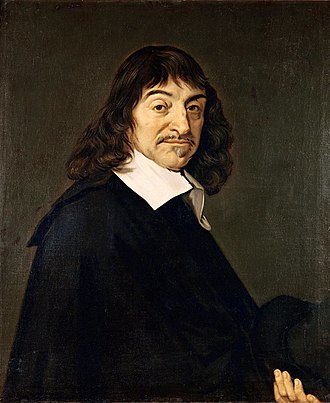
René Descartes is called the father of modern philosophy, and for once the cliché is exact. He set out, in the middle of the seventeenth century, to tear down everything he had been taught and rebuild knowledge on a foundation that no doubt could shake. The method he used — doubting everything that could possibly be doubted — and the foundation he found — “I think, therefore I am” — redirected Western thought from the world to the mind, from authority to the individual’s reason, and from the question “what is there?” to the question “how do I know?”. His dualism of mind and body created the mind–body problem that philosophers, psychologists and neuroscientists still argue about. And as a mathematician he invented analytic geometry — the Cartesian coordinates every schoolchild learns — and as a physicist he proposed a mechanical universe that prepared the way for Newton.
Life
La Flèche
René Descartes was born on 31 March 1596 in La Haye, Touraine (the town is now called Descartes), into a family of minor nobility. His mother died when he was a year old; he was raised by his grandmother. He was a sickly child and was allowed to stay in bed in the mornings, a habit of thinking in bed he kept all his life.
From about 1606 to 1614 he studied at the new Jesuit college of La Flèche, one of the best schools in Europe, where he learned scholastic Aristotelian philosophy, classical languages, mathematics, and — new and exciting — news of Galileo’s telescopic discoveries. In the Discourse on Method he recalled his disappointment: he had learned much, but found himself “embarrassed by so many doubts and errors” that he seemed to have gained nothing except a growing awareness of his ignorance. Only mathematics pleased him, “because of the certainty and evidence of its reasonings”.
He took a law degree at Poitiers (1616), then resolved to seek no other knowledge than what he could find in himself “or else in the great book of the world”.
The soldier and the dreams
In 1618 he went to the Netherlands as a gentleman volunteer in the army of Maurice of Nassau. At Breda he met Isaac Beeckman, a Dutch schoolmaster and natural philosopher, who woke his interest in applying mathematics to physics. In 1619 he joined the army of the Duke of Bavaria at the start of the Thirty Years’ War.
On the night of 10 November 1619, in a stove-heated room (poêle) near Ulm, after a day of intense thought, Descartes had three dreams that he took to be a divine call to found a new science: in one, he was buffeted by a whirlwind; in another, a thunderclap woke him and he saw sparks in the room; in the third, he found a book of poems open at Ausonius’s line Quod vitae sectabor iter? — “What path in life shall I follow?” He vowed a pilgrimage to the shrine of Our Lady of Loreto in thanksgiving.
The Netherlands
After years of travel, in 1628 Descartes settled in the Dutch Republic, where he lived for twenty years, changing address more than a dozen times to protect his privacy. (“Bene vixit, bene qui latuit” — he lives well who hides well — was his motto.) He worked on mathematics, optics, physiology (he dissected animals bought from butchers) and metaphysics.
In 1633 he was about to publish The World (Le Monde), a treatise on physics that assumed the Earth moves around the sun, when he heard that Galileo had been condemned by the Roman Inquisition. He withdrew it. Instead, in 1637, he published three scientific essays — Optics, Meteorology and Geometry — with a preface in French, the Discourse on the Method of Rightly Conducting One’s Reason and of Seeking Truth in the Sciences. Writing in French rather than Latin was a deliberate choice: he wanted to be read by anyone with “good sense”, including women.
The Meditations and the Objections
In 1641 he published, in Latin, the Meditations on First Philosophy, with an unusual feature: before publication, his friend Marin Mersenne circulated the manuscript to leading thinkers, and Descartes printed six (in the second edition seven) sets of Objections with his Replies. The objectors included Thomas Hobbes, the theologian Antoine Arnauld, and the atomist Pierre Gassendi. This is one of the great philosophical debates in print.
The Principles of Philosophy (1644), dedicated to Princess Elisabeth of Bohemia, presented his whole system as a textbook, hoping to replace Aristotle in the schools. His metaphor: philosophy is a tree whose roots are metaphysics, trunk physics, and branches medicine, mechanics and morals.
Elisabeth
From 1643 Descartes corresponded with Princess Elisabeth of Bohemia, the exiled daughter of the “Winter King” of Bohemia, a brilliant philosopher in her own right. Her very first letter posed the question his system could not answer: how can the soul, being only a thinking substance, determine the body’s spirits to perform voluntary actions, given that motion seems to require contact and extension? Descartes’s answers were evasive; Elisabeth pressed. Their correspondence also ranged over the passions, grief, happiness and politics, and led to his last work, The Passions of the Soul (1649). Elisabeth is now recognized as one of the most acute philosophers of the century.
Sweden and death
In 1649, after much hesitation, Descartes accepted an invitation from Queen Christina of Sweden to come to Stockholm as her philosophy tutor. The queen insisted on lessons at five in the morning in the Swedish winter. Within months he caught pneumonia and died on 11 February 1650, aged fifty-three. (A theory that he was poisoned with arsenic by a Catholic priest has been proposed but is unproven.) His body was later moved to France; his skull, separated from the rest, is in the Musée de l’Homme in Paris.
He had one child, a daughter, Francine, born in 1635 to Helena Jans, a servant; he called her his “niece” in public but loved her dearly. Her death from scarlet fever in 1640, at five, was, he said, the greatest sorrow of his life.
The method
Four rules
The Discourse gives four rules of method (Part II):
- Never accept anything as true unless you clearly know it to be so — avoid precipitation and prejudice; include nothing in your judgments beyond what presents itself so clearly and distinctly that you have no occasion to doubt it.
- Divide each difficulty into as many parts as possible.
- Conduct your thoughts in order, beginning with the simplest objects and rising step by step to the more complex.
- Make enumerations so complete and reviews so general that you are sure of leaving nothing out.
The model is mathematics: “those long chains of reasoning, so simple and easy, which geometers use… gave me occasion to imagine that all the things which can fall under human knowledge follow from one another in the same way.”
The provisional morality
While demolishing his beliefs, one must still live. So Descartes adopts a “provisional morality” (morale par provision): obey the laws and customs of his country and religion; be as firm and resolute in action as possible, like travellers lost in a forest who should keep walking in one direction rather than wander in circles; try to conquer himself rather than fortune; and devote his life to cultivating reason.
The Meditations
First Meditation: what can be called into doubt
Some years ago I was struck by the large number of falsehoods that I had accepted as true in my childhood, and by the highly doubtful nature of the whole edifice that I had subsequently based on them. I realized that it was necessary, once in the course of my life, to demolish everything completely and start again right from the foundations.
Rather than examine every belief, Descartes attacks their foundations — like a man sorting a basket of apples who tips them all out and puts back only the sound ones (his image in the Seventh Replies). The doubt proceeds in stages:
- The senses sometimes deceive — about small or distant things. But surely not about my sitting here by the fire in my dressing-gown, holding this paper?
- The dream argument. “There are never any sure signs by means of which being awake can be distinguished from being asleep.” I have often dreamed that I was sitting by the fire when I was undressed in bed. Still, even dreams are composed of simple elements — shape, quantity, number — and arithmetic and geometry seem true whether I am awake or asleep.
- The deceiving God. But perhaps an omnipotent God has made me so that I go wrong every time I add two and three. If God is good, that seems unlikely — but then why do I ever err?
- The evil demon. “I will suppose therefore that not God, who is supremely good and the source of truth, but rather some malicious demon of the utmost power and cunning has employed all his energies in order to deceive me.” Sky, earth, colours, shapes — all are delusions of dreams he has devised to ensnare my judgment.
The demon is a methodological device — Descartes does not believe in it — but it makes doubt hyperbolic: universal and systematic. It is the ancestor of the “brain in a vat” and of The Matrix.
Second Meditation: the cogito
Is there not a God, or whatever I may call him, who puts into me the thoughts I am now having?… But I have convinced myself that there is absolutely nothing in the world… Does it now follow that I too do not exist? No: if I convinced myself of something then I certainly existed. But there is a deceiver of supreme power and cunning who is deliberately and constantly deceiving me. In that case I too undoubtedly exist, if he is deceiving me; and let him deceive me as much as he can, he will never bring it about that I am nothing so long as I think that I am something. So… I must finally conclude that this proposition, I am, I exist, is necessarily true whenever it is put forward by me or conceived in my mind.
Note that the Meditations never says cogito, ergo sum. That formula — “je pense, donc je suis” — appears in the Discourse (IV) and, in Latin, in the Principles (I.7). In the Meditations the certainty is of “I am, I exist” whenever I think it — which suggests the cogito (see Cogito, ergo sum) is not a syllogism with a suppressed premise (“everything that thinks exists”) but an immediate intuition, self-verifying in the act of thinking. Descartes says as much in the Second Replies.
Then: what am I? Not a body (I can doubt that I have one), but “a thing that thinks” (res cogitans): “a thing that doubts, understands, affirms, denies, is willing, is unwilling, and also imagines and has sensory perceptions.”
The wax
To show that the mind is better known than the body, Descartes takes a piece of beeswax just taken from the honeycomb: it has the taste of honey, the scent of flowers, a colour, shape, size; it is hard and cold; it makes a sound when struck. Bring it near the fire: the taste and smell vanish, the colour changes, it melts, becomes hot, makes no sound. Yet it is the same wax. So what I know of the wax is not given by the senses (all those qualities changed) or by imagination (I cannot imagine all its possible shapes) but by the mind alone — an understanding of something extended, flexible and changeable. And in judging that I see men passing in the street below, I see only hats and coats, which might cover automatons; I judge that they are men.
Third Meditation: God
To get beyond the cogito, Descartes needs a guarantee that clear and distinct perceptions are true. He finds it in God. Among his ideas is the idea of God — “a substance that is infinite, eternal, immutable, independent, supremely intelligent, supremely powerful”. The cause of an idea must have at least as much reality as the idea represents (a principle he calls “manifest by the natural light”). I am finite; I could not be the cause of the idea of an infinite being. Therefore God exists. The idea of God is “like the mark of the craftsman stamped on his work”.
He adds a second argument: I could not have come into existence or be preserved in existence by myself, by my parents, or by any lesser cause; only God could sustain me.
Fourth Meditation: error
If God is no deceiver, why do I err? Because my will is infinite (I can affirm or deny anything) while my understanding is finite. Error arises when I let the will run ahead of the understanding and assent to what I do not clearly perceive. So the remedy is to suspend judgment until perception is clear and distinct. This is a theory of epistemic responsibility: error is a misuse of freedom.
Fifth Meditation: essence and the ontological argument
Material things, insofar as they are objects of pure mathematics, have true and immutable natures. And the idea of God, like the idea of a triangle, has a nature: existence belongs to the essence of a supremely perfect being as necessarily as the angles of a triangle equal two right angles. “It is no less a contradiction to think of God (that is, a supremely perfect being) lacking existence (that is, lacking a perfection), than it is to think of a mountain without a valley.” This is Descartes’s version of the ontological argument — which Immanuel Kant later refuted with “existence is not a predicate”.
Sixth Meditation: the world and the body
Finally Descartes argues that material things exist. I have a passive faculty of sensation; something must produce my sensory ideas; God has given me a great propensity to believe they come from bodies, and no faculty to correct this; so, since God is no deceiver, bodies exist — though they may not be exactly as the senses represent them. Their essence is extension — length, breadth, depth — the subject matter of geometry.
And mind and body are really distinct: “I have a clear and distinct idea of myself, in so far as I am simply a thinking, non-extended thing; and on the other hand I have a distinct idea of body, in so far as this is simply an extended, non-thinking thing. And accordingly, it is certain that I am really distinct from my body, and can exist without it.”
Yet, he adds, “I am not merely present in my body as a sailor is present in a ship, but… I am very closely joined and, as it were, intermingled with it, so that I and the body form a unit.” Pain, hunger and thirst are “confused modes of thinking” that arise from this union.
Dualism and its problems
Two substances
Descartes’s universe contains two kinds of created substance:
| Mind (res cogitans) | Body (res extensa) | |
|---|---|---|
| Essence | Thought | Extension |
| Divisible? | No — indivisible | Yes — infinitely |
| Known by | Introspection, with certainty | Mathematical physics |
| Free? | Yes — the will | No — governed by mechanical laws |
Everything in nature except human minds — including animals and the human body — is a machine: matter in motion, explicable by size, shape and motion. Animals, notoriously, are automata without feelings in the full sense (though scholars debate how strictly Descartes held this). The human body is like a clock or the hydraulic statues in the royal gardens at Saint-Germain.
Interaction and the pineal gland
But if mind is unextended and body extended, how do they interact? Descartes located the main seat of the soul’s interaction with the body in the pineal gland, a small, single structure deep in the brain (most brain structures are paired), where the soul could influence the flow of the “animal spirits” — a fine fluid flowing through the nerves. Elisabeth’s objection was never adequately answered; later Cartesians tried occasionalism (Malebranche: God causes bodily events on the occasion of mental ones, and vice versa) and Gottfried Wilhelm Leibniz tried pre-established harmony; Baruch Spinoza abolished the two substances in favour of one.
Gilbert Ryle’s ghost
In The Concept of Mind (1949), Gilbert Ryle attacked Cartesian dualism as “the dogma of the Ghost in the Machine” — a “category mistake”, like a visitor to Oxford who sees the colleges, libraries and laboratories and then asks, “But where is the University?” Modern physicalists, functionalists and embodied-cognition theorists generally reject Descartes’s dualism. Yet the “hard problem of consciousness” (David Chalmers) — why there is subjective experience at all — keeps the Cartesian question alive.
The objections
The Objections and Replies are a goldmine:
- The Cartesian circle (Arnauld, Fourth Objections): “How can the author avoid reasoning in a circle when he says that we are sure that what we clearly and distinctly perceive is true only because God exists? But we can be sure that God exists only because we clearly and distinctly perceive this.” Descartes’s reply — that the divine guarantee is needed only for remembered conclusions, not present intuitions — has satisfied few.
- Hobbes (Third Objections): from “I am thinking” it follows only that I am something that thinks — perhaps a body. Why assume the thinker is immaterial?
- Gassendi (Fifth Objections): why not “I walk, therefore I am”? Descartes: because I can doubt I am walking (I may be dreaming), but not that I am thinking I walk.
- Mersenne and others: the idea of God may come from ourselves, by amplifying finite perfections.
- Elisabeth: interaction.
Mathematics and physics
Analytic geometry
The Geometry (1637) unites algebra and geometry: curves can be represented by equations, and equations by curves, via a system of coordinates. (Pierre de Fermat developed similar ideas independently.) The “Cartesian plane”, the use of x, y, z for unknowns and a, b, c for knowns, and superscripts for powers (x²) all come from Descartes. This made possible the calculus of Newton and Leibniz.
Optics
The Optics gave the law of refraction (the sine law, also found by Snell), and explained the rainbow — the angle at which it appears — by tracing rays through spherical drops of water.
The mechanical universe
In Descartes’s physics, the universe is a plenum: there is no vacuum, since extension is matter. Motion is transmitted by contact. The heavens are made of vortices — huge whirlpools of fine matter carrying the planets around the sun. He formulated a principle of inertia (a body continues in its state of motion unless acted on) and laws of collision (most of them wrong). Newton’s Principia (1687) — “Mathematical Principles of Natural Philosophy”, a title that answers Descartes’s Principles of Philosophy — replaced the vortices with universal gravitation acting at a distance.
Morals and passions
Descartes’s moral philosophy, scattered in letters and in the Passions of the Soul, is Stoic in spirit. The passions — he lists six primitive ones: wonder, love, hatred, desire, joy and sadness — are bodily movements felt by the soul; they are good in themselves but must be governed by reason. The highest virtue is generosity (générosité): knowing that nothing truly belongs to us but the free disposition of our will, and feeling a firm resolution to use it well. Generosity is the remedy for all the disorders of the passions.
Legacy
The rationalist succession
Descartes’s successors — Baruch Spinoza, Malebranche, Gottfried Wilhelm Leibniz — accepted his rationalism and mathematical method while fiercely revising his metaphysics. See Continental Rationalism.
The empiricist reaction
John Locke rejected innate ideas; David Hume looked for the thinking self and found only a bundle of perceptions. See Rationalism vs. Empiricism.
Kant and after
Immanuel Kant turned the cogito into the “I think” that must be able to accompany all my representations — a formal condition, not a knowable substance — and refuted Descartes’s “problematic idealism”. Husserl’s Cartesian Meditations (1931) made Descartes the starting point of phenomenology. Martin Heidegger accused him of asking about the cogito and forgetting the sum — the meaning of being. Friedrich Nietzsche attacked the “I” as a grammatical prejudice. Wittgenstein’s private language argument struck at the idea of a self that knows its own mind independently of the public world.
Modern culture
“Cartesian” has become shorthand for the split between mind and body, reason and emotion, subject and object, humanity and nature — blamed for everything from the mechanization of nature to the neglect of embodiment. Antonio Damasio’s Descartes’ Error (1994) argued, from neuroscience, that reason depends on emotion and the body. Feminist philosophers have critiqued the Cartesian disembodied knower. But Descartes’s demand for intellectual autonomy — accept nothing on authority, think for yourself, begin from what you can know clearly — remains the charter of modern thought.
Key terms
- Methodical doubt
- Doubting everything that can possibly be doubted, in order to find what cannot.
- Evil demon (malin génie)
- A hypothetical omnipotent deceiver — the device that makes doubt universal.
- Cogito
- "I think, therefore I am" — the first certainty.
- Res cogitans / res extensa
- Thinking substance / extended substance.
- Clear and distinct perception
- Perception so evident that it compels assent — the criterion of truth.
Using Descartes in conversation
- On scepticism and simulation: the evil demon and the dream argument — the original “how do you know you’re not in the Matrix?”
- On self-knowledge: “I think, therefore I am” — the one thing no deceiver can take away. (Add Augustine’s “if I am deceived, I exist” for extra credit.)
- On starting over: tip out the basket of apples and put back only the sound ones.
- On the mind–body problem: how does an unextended mind move an extended body? Elisabeth asked first.
René Descartes in two minutes
The father of modern philosophy, who doubted everything that could be doubted and found one thing that could not — that he himself was thinking.
- Methodical doubt. Tear everything down to the foundations. Doubt the senses (they sometimes deceive), doubt waking life (dreams feel real), doubt even mathematics (an evil demon might deceive me).
- Cogito, ergo sum. However much I doubt, I must exist in order to doubt. “I think, therefore I am” is the first certainty, the Archimedean point on which knowledge can be rebuilt.
- Clear and distinct ideas. Whatever I perceive clearly and distinctly is true — guaranteed by a God who is no deceiver.
- Mind–body dualism. Mind is thinking, unextended substance; body is extended, unthinking substance. How they interact (through the pineal gland, Descartes guessed) became the mind–body problem.
- Innate ideas. Some ideas — God, the self, mathematical truths — are not drawn from experience but born with the mind.
- The world as machine. Animals and the physical world are mechanisms explicable by matter in motion; only the rational soul stands outside.
“I think, therefore I am.” — Discourse on Method, Part IV (1637); Latin "cogito, ergo sum" in Principles I.7 (1644)
Answering: Augustine of Hippo, Michel de Montaigne · Answered by: Blaise Pascal, Baruch Spinoza, John Locke, Gottfried Wilhelm Leibniz, David Hume, Immanuel Kant, Martin Heidegger, Ludwig Wittgenstein
Curiosities
did you know?- Descartes liked to think in bed until late morning — Queen Christina’s 5 a.m. lessons may have helped kill him.
- His skull is kept apart from the rest of his remains, in the Musée de l’Homme in Paris.
- He withdrew his treatise The World from publication on hearing that Galileo had been condemned.
- We owe him x and y as unknowns, and the Cartesian coordinate system.
Questions to Argue About
debate club →- How do you know you are not dreaming right now?
- Could a machine ever think — or only imitate thinking?
- Is the mind something other than the brain?
Arguments
argument library →The Cogito
Whatever else an all-powerful deceiver could make me doubt, he cannot make me doubt that I exist while I am thinking.
- I can doubt anything that a powerful deceiver could make me falsely believe.
- If I am deceived, I must exist in order to be deceived.
- Doubting is a form of thinking.
∴ I think, therefore I am — my existence as a thinking thing is certain.
3 objections
- Lichtenberg: We should only say “it thinks”, as we say “it rains”; the “I” is assumed, not proved.
- Hume: Introspection finds only perceptions, never a perceiving self.
- Gassendi: Why not “I walk, therefore I am”? (Descartes: because I can doubt that I walk, but not that I seem to.)
The Ontological Argument
The idea of a supremely perfect being includes existence, as the idea of a triangle includes three angles — so God exists.
- I have the idea of a supremely perfect being.
- Existence is a perfection.
- A supremely perfect being lacking existence would lack a perfection — a contradiction.
∴ A supremely perfect being — God — necessarily exists.
2 objections
- Gaunilo (to Anselm): By the same reasoning one could prove the existence of a perfect island.
- Kant: Existence is not a real predicate. A hundred real thalers contain no more than a hundred possible ones; existence adds nothing to a concept.
In Their Own Words
2 quotationsI think, therefore I am.
Je pense, donc je suis.
Context & when to use it
The foundational certainty of modern philosophy; for self-knowledge and doubt.
If you would be a real seeker after truth, it is necessary that at least once in your life you doubt, as far as possible, all things.
Context & when to use it
For methodical doubt and intellectual honesty.
Sententiae
phrases in the originalCogito, ergo sum
Origin. Descartes, first in French (“je pense, donc je suis”, Discourse on Method, 1637), then in Latin in the Principles of Philosophy (1644). — René Descartes
⚠ The Meditations never use this formula — there it is “ego sum, ego existo” (I am, I exist). Augustine had argued “si fallor, sum”.
For the one certainty that survives doubt; the birth of modern subjectivity.
Explore Next
related by shared connections
Søren Kierkegaard
The melancholy Dane, father of existentialism, who set the passionate individual against Hegel’s System and faith against reason — “truth is subjectivity”.
British Empiricism
The view that all knowledge comes from experience — the mind begins as a blank slate on which the senses write.
The Enlightenment
The eighteenth-century movement that put reason, science, tolerance and individual liberty at the centre of human affairs — “Sapere aude!”

Plato
Socrates’ student and Aristotle’s teacher, author of the dialogues, founder of the Academy, and the philosopher of the Forms — of whom Whitehead said all Western philosophy is a series of footnotes.

Thomas Aquinas
Dominican friar and the greatest of the scholastics, who wove Aristotle’s philosophy and Christian theology into a single vast system — the Summa Theologiae — with five ways to prove God.

Friedrich Nietzsche
Philosopher with a hammer who announced the death of God, unmasked the genealogy of morality, and called for new values — the will to power, eternal recurrence, the Übermensch, amor fati.