Works
Treatises, dialogues, novels, plays, scriptures.
Indian
The Ṛg Veda
The oldest text of India and one of the oldest in any Indo-European language — 1,028 hymns to the gods of fire, storm, sky and order, composed c. 1500–1000 BCE and preserved orally, syllable for syllable, for over three thousand years. Its final book already asks how the universe began, and whether even its creator knows.
The Upaniṣads
The philosophical dialogues that close the Vedas (c. 800–200 BCE) — forest teachings in which kings, priests, women and a boy at Death’s door ask what the Self is, what Brahman is, and how to be free. The source of Vedānta, and of almost every later Indian idea about the self.

Bṛhadāraṇyaka Upaniṣad
The “Great Forest” Upanishad, oldest and longest, home of Yājñavalkya’s debates, the teaching to Maitreyī, and “neti neti”.

Chāndogya Upaniṣad
One of the oldest Upanishads, famed for Uddālaka’s teaching to Śvetaketu — tat tvam asi — and Satyakāma’s honest answer about his birth.
Taittirīya Upaniṣad
The Upaniṣad of the five sheaths and the graduation address — it defines Brahman as “truth, knowledge, infinity”, peels away the layers of the self from food to bliss, measures the bliss of Brahman, and tells departing students “Treat your mother as a god.”

Kaṭha Upaniṣad
The story of the boy Naciketas, who goes to the house of Death and asks what happens after death — receiving the teaching of the immortal Self.
Kena Upaniṣad
The “By whom?” Upaniṣad — by whom is the mind sent forth, the breath set going, speech uttered? Its answer is the paradox that Brahman is known only by those who know they do not know it — and a story of the gods humbled by a blade of grass.

The Rāmāyaṇa
Vālmīki’s epic of Rāma, the exiled prince who crosses the sea to rescue his wife Sītā from the demon king Rāvaṇa — India’s ādikāvya, the “first poem”, and the model of dharma for two thousand years.
Īśā Upaniṣad
The shortest of the principal Upaniṣads — eighteen verses that begin “All this is pervaded by the Lord” and reconcile renunciation with action, knowledge with works, and the one with the many.
Muṇḍaka Upaniṣad
The Upaniṣad of the “shaven head” — it distinguishes the “lower knowledge” of the Vedas and sciences from the “higher knowledge” of the imperishable, compares ritual to leaky boats, gives the image of two birds on one tree, and India its national motto, “Truth alone triumphs”.
Śvetāśvatara Upaniṣad
The most theistic of the principal Upaniṣads — it identifies Brahman with Rudra-Śiva, a personal Lord to be loved, blends Vedānta with early Sāṃkhya and Yoga, and first uses the words māyā and bhakti in their later senses.
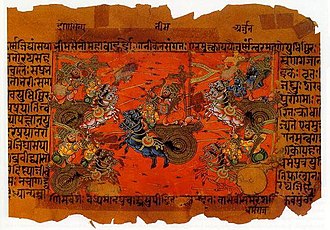
The Mahābhārata
The great epic of India — the war between the Pāṇḍavas and the Kauravas, cousins fighting for a kingdom — and, at about 100,000 couplets, the longest poem ever composed, containing the Bhagavad Gītā and almost the whole of Indian thought on dharma.
Saṅgam Poetry
The oldest Tamil literature (c. 300 BCE–300 CE) — 2,381 poems by 473 poets, on love (akam) and war (puṟam), in which each landscape — mountain, forest, field, seashore, desert — carries a mood of love. One of the great classical literatures of the world.
The Arthaśāstra
Kauṭilya’s treatise on statecraft — 15 books on kingship, administration, economy, law, espionage, diplomacy and war. Lost for centuries and rediscovered in 1905, it is the most comprehensive ancient manual of government in any civilisation.
The Dhammapada
423 verses of the Buddha’s teaching in 26 chapters — on the mind, the fool and the wise, anger, craving, the path and the true Brahmin. The best-loved Buddhist scripture, and the shortest door into the Buddha’s ethics.
The Jātakas
547 stories of the Buddha’s previous lives — as a hare, a monkey king, a merchant, a prince — told to illustrate the virtues that lead to awakening. India’s great treasury of folk tales, carved on stūpas and painted in caves.
Brahma Sūtras
Bādarāyaṇa’s 555 terse aphorisms systematizing the Upanishads — so condensed they are unreadable without the commentaries that founded the schools of Vedānta.
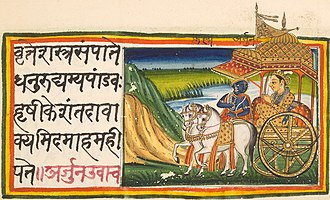
The Bhagavad Gītā
The “Song of the Lord” — Kṛṣṇa’s teaching to the despairing warrior Arjuna on the battlefield of Kurukṣetra, on duty, action without attachment, knowledge and devotion.
The Manusmṛti
The most famous of the Hindu law books — a treatise on dharma covering creation, the four classes, the stages of life, the duties of kings, marriage, inheritance, crime and penance. Revered for two millennia as the code of Hindu society, and condemned in modern times as the charter of caste and of women’s subordination.
The Nāṭyaśāstra
Bharata’s encyclopaedia of the performing arts — theatre, dance, music, costume, architecture, and the theory of rasa — called the “fifth Veda”, composed for all classes of people. The foundation of Indian aesthetics.
The Nyāya Sūtras
The root text of Indian logic — about 530 aphorisms on the means of valid knowledge, the structure of argument, the art of debate and its dishonest tricks, and the self, the world and liberation.
The Pañcatantra
The ancient Indian book of animal fables written to teach princes the art of practical wisdom (nīti) — the jackals Karaṭaka and Damanaka, the monkey and the crocodile, the lion and the hare — translated into more languages than almost any book except the Bible.
Māṇḍūkya Upaniṣad
The shortest Upaniṣad — twelve verses on the syllable Oṃ and the four states of consciousness, waking, dreaming, deep sleep and the “fourth” (turīya), the pure Self. Said to be enough, by itself, for liberation.
The Questions of King Milinda
A dialogue between the Indo-Greek king Menander and the Buddhist monk Nāgasena — the chariot argument for no-self, the flame of rebirth, and a Greek king’s sharp questions answered with Indian wit. A meeting of Greece and India in the 2nd century BCE.
Mūlamadhyamakakārikā
Nāgārjuna’s 450 verses in 27 chapters — the founding text of Madhyamaka, which examines causation, motion, the self, time and nirvāṇa, and shows that nothing has intrinsic existence; everything is empty because everything is dependent.
Tattvārtha Sūtra
Umāsvāti’s “Manual of the Meaning of the Reals” — the first Sanskrit summary of Jain philosophy, 350 sūtras accepted by both Digambaras and Śvetāmbaras, covering knowledge, souls, the universe, karma, ethics and liberation.
The Kāmasūtra
Vātsyāyana’s treatise on kāma — pleasure, love and desire — as one of the three legitimate aims of life. Far more than a sex manual, it is a handbook of urban culture, courtship, marriage, friendship and the arts of living well.
The Little Clay Cart
Śūdraka’s Sanskrit comedy of love, crime and revolution — a poor Brahmin merchant, a generous courtesan, a burglar with a theory of house-breaking, a vicious royal brother-in-law and a popular uprising — the most realistic and modern-feeling play of ancient India.
The Heart Sūtra
The shortest and most famous Mahāyāna scripture — a single page in which the bodhisattva Avalokiteśvara declares that “form is emptiness, emptiness is form”, negates every Buddhist category, and ends with a mantra: “gone, gone, gone beyond, gone altogether beyond — awakening, hail!”
The Yoga Sūtras
Patañjali’s 196 aphorisms — the root text of classical Yoga — which define yoga as the stilling of the mind’s fluctuations, diagnose the afflictions that cause suffering, set out the eight limbs of practice, and end in the “isolation” of pure consciousness.
Sāṃkhya Kārikā
Īśvarakṛṣṇa’s 72-verse poem that is the classical statement of Sāṃkhya philosophy — from the threefold suffering of life, through the evolution of nature in twenty-five principles, to the liberating vision in which nature, “seen”, stops dancing.
Meghadūta (The Cloud Messenger)
Kālidāsa’s lyric poem of 111 verses in which an exiled yakṣa asks a monsoon cloud to carry a message of love to his wife in the Himālaya — describing, as the cloud flies north, all of India alive with longing.
The Recognition of Śakuntalā
Kālidāsa’s seven-act masterpiece — a king and a hermit girl fall in love in a forest, a curse erases his memory, a lost ring restores it, and the lovers are reunited in heaven. The most celebrated play in Sanskrit, which astonished Goethe and Europe.
The Tirukkuṟaḷ
Tiruvaḷḷuvar’s 1,330 couplets in 133 chapters on virtue (aṟam), wealth and statecraft (poruḷ), and love (inbam) — a secular, universal ethic, compact and witty, the “Tamil Veda” and one of the most translated books of India.
Cilappatikāram (The Tale of an Anklet)
The great Tamil epic (c. 5th century) by the prince-monk Iḷaṅkō Aṭikaḷ — Kaṇṇaki’s husband is executed on a false charge of stealing the queen’s anklet; she proves his innocence, tears off her breast and burns the city of Madurai, and becomes a goddess.
The Bhāgavata Purāṇa
The most beloved of the Purāṇas (c. 9th–10th century) — twelve books of devotion to Viṣṇu, culminating in the tenth book’s life of Kṛṣṇa: the butter-thief child, the cowherd, the lover of the gopīs, the god who dances with every devotee at once.
Gītagovinda
Jayadeva’s 12th-century Sanskrit song-cycle on the love of Rādhā and Kṛṣṇa — jealousy, separation, longing and reunion — the most musical and sensuous poem in Sanskrit, read as an allegory of the soul’s love for God.
Rāmcaritmānas
Tulsīdās’s 16th-century retelling of the Rāmāyaṇa in Avadhī Hindi — 12,800 lines of devotional epic that made Rāma the God of North India, recited daily, staged every year as Rāmlīlā, and loved more than any other book in Hindi.
Hind Swaraj
Gandhi’s 1909 manifesto, written in ten days on a ship — a dialogue in which the “Editor” tells an impatient “Reader” that true home rule is rule over oneself, that modern civilisation is a disease, and that India must win freedom by non-violence and the spinning wheel.
Gitanjali
Tagore’s 1912 collection of devotional prose-poems, translated by himself from Bengali, which won the 1913 Nobel Prize — intimate songs to a God found in nature, in human labour, in love and in death.
Annihilation of Caste
Ambedkar’s 1936 undelivered speech — the most powerful critique of caste ever written — arguing that caste is a division of labourers, not of labour, that it rests on the authority of the Hindu scriptures, and that it cannot be reformed but only destroyed.
Godān
Premchand’s last and greatest novel (1936) — the life and death of Hori, a poor peasant who longs only to own a cow, crushed by debt, caste, landlords and priests — the epic of the Indian village under colonial rule.
Chinese

Tao Te Ching
The 81 short chapters of the “Classic of the Way and its Power” — the foundational text of Daoism and one of the most translated books ever written.

The Analects
The collected sayings and conversations of Confucius and his disciples — the most influential book in East Asian history.
Ancient Greek

The Iliad
Homer’s epic of the wrath of Achilles in the tenth year of the Trojan War — the founding poem of Western literature, and its greatest poem of war, grief and mortality.

The Odyssey
Homer’s epic of Odysseus’s ten-year journey home from Troy — monsters, witches, the underworld and a household besieged — the archetype of every adventure, every homecoming and every clever hero.

Antigone
Sophocles’ tragedy of the young woman who buries her brother against the king’s decree — the founding drama of conscience against the state, which Hegel read as the collision of two rights.

Oedipus the King
Sophocles’ tragedy of the king who hunts down the murderer of his predecessor — and discovers that he himself killed his father and married his mother. Aristotle’s model of the perfect tragedy.
The Apology of Socrates
Plato’s account of Socrates’ defence speech at his trial in 399 BCE — a manifesto for the philosophical life.
The Republic
Plato’s great dialogue on justice — in the soul and in the city — containing the philosopher-kings, the Allegory of the Cave, and the banishment of the poets.
Roman & Latin

Patristic & Medieval

Italian

The Divine Comedy
Dante’s journey through Hell, Purgatory and Paradise — the summa of medieval thought in a hundred cantos, and one of the greatest poems ever written.

The Prince
Machiavelli’s short, scandalous handbook on gaining and keeping power — the founding text of political realism.
Spanish

British & Irish

Hamlet
Shakespeare’s longest play — a prince ordered by his father’s ghost to avenge a murder thinks, doubts, delays, feigns madness, and dies in the act.

King Lear
An old king divides his kingdom between the daughters who flatter him and banishes the one who loves him — and is stripped of everything on a heath in a storm.

Macbeth
Shakespeare’s shortest tragedy — a brave soldier, prompted by witches and his wife, murders his king and wades so deep in blood that life becomes “a tale told by an idiot”.
French

Pensées
Pascal’s unfinished defence of Christianity, left as nearly a thousand fragments — on the thinking reed, diversion, the infinite spaces, and the Wager.

Candide
Voltaire’s comic philosophical tale, in which a naïve young man and his optimist tutor suffer every disaster the eighteenth century could offer — ending with “we must cultivate our garden”.
The Myth of Sisyphus
Camus’s essay on the absurd — why not suicide? — ending with the image of Sisyphus pushing his rock, happy.
The Stranger
Camus’s first novel — Meursault, who will not pretend to feel what he does not feel, kills an Arab on a beach and is condemned for not weeping at his mother’s funeral.
Existentialism Is a Humanism
Sartre’s 1945 public lecture — the most popular statement of existentialism — existence precedes essence, man is condemned to be free.
The Rebel
Camus’s history of revolt — metaphysical and political — arguing that rebellion that kills for history betrays its own origin. It ended his friendship with Sartre.
German-language

Critique of Pure Reason
Kant’s masterwork, asking what reason can know without experience — and answering that it can know the forms of all possible experience, but nothing beyond.
Prolegomena to Any Future Metaphysics
Kant’s short, clearer restatement of the first Critique, where he credits Hume with waking him from his dogmatic slumber.
Critique of Practical Reason
Kant’s second Critique — the moral law is a fact of reason, and through it we know we are free.
Phenomenology of Spirit
Hegel’s first masterpiece — the “voyage of discovery” of consciousness through sense-certainty, self-consciousness, reason, spirit and religion to absolute knowing.

Faust
Goethe’s two-part dramatic poem of the scholar who wagers his soul with Mephistopheles that no moment of pleasure will ever satisfy him — the defining myth of modern restless striving.
The World as Will and Representation
Schopenhauer’s single great work — the world is my representation; in itself it is Will; and the Will is the source of all suffering.
The Gay Science
Nietzsche’s most joyful book — where God is first declared dead, the madman runs into the marketplace, and the thought of eternal recurrence first appears.
Thus Spoke Zarathustra
Nietzsche’s prophetic prose-poem — Zarathustra descends from his mountain to teach the Übermensch, the will to power and eternal recurrence.
Beyond Good and Evil
Nietzsche’s “prelude to a philosophy of the future” — an attack on the prejudices of philosophers, from Plato to Kant, and a sketch of the free spirit.
On the Genealogy of Morality
Nietzsche’s three essays tracing “good and evil”, guilt, and the ascetic ideal back to their hidden, all-too-human origins.

The Trial
Josef K. is arrested one morning without having done anything wrong, and spends a year trying to understand an invisible court — until two men take him to a quarry and kill him “like a dog”.

The Metamorphosis
Gregor Samsa, a travelling salesman, wakes one morning transformed into a monstrous vermin — and his family’s duty slowly curdles into disgust and relief.
Scandinavian
Russian

Fathers and Sons
Turgenev’s novel of the generation gap — the nihilist Bazarov against the old liberal Kirsanovs — which gave Russia the word “nihilist”.
What Is to Be Done?
Chernyshevsky’s prison-written utopian novel of “new people” and rational egoism — badly written, enormously influential, the target of Dostoevsky’s Underground Man.

Notes from Underground
A spiteful, hyper-conscious ex-official rants from his “mousehole” against reason, progress and the Crystal Palace — often called the first existentialist novel.
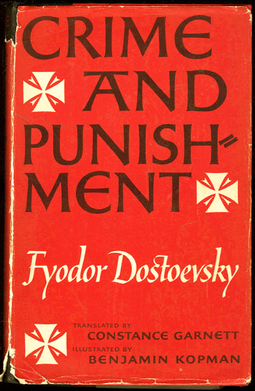
Crime and Punishment
A poor ex-student in St Petersburg murders an old pawnbroker to prove he is an “extraordinary man” — and is undone not by the police but by his own conscience and by Sonya’s love.

Demons
Dostoevsky’s prophetic political novel — a provincial town possessed by revolutionary nihilists, the murder of one of their own, and the hollow charisma of Stavrogin.

The Brothers Karamazov
Dostoevsky’s last and greatest novel — a murdered father, three brothers (the sensualist, the intellectual, the saint), and the deepest debate about God and evil in literature.
A Confession
Tolstoy’s account of his mid-life crisis — at the height of fame he could not answer “why live?” and nearly killed himself, until he found meaning in the faith of simple people.

The Death of Ivan Ilyich
Tolstoy’s novella of a respectable judge who, dying of a trivial injury, realizes that his correct, comfortable life was a lie — and finds, at the last moment, the light.