
Key Ideas
The epigraph — the Gadarene swine from Luke 8.
Pyotr Verkhovensky — the conspirator who binds his cell together with blood.
Kirillov — if there is no God, then I am God; the highest act of self-will is suicide.
Shatov — the murdered believer in Russia’s God.
Stavrogin — strength without direction, the void at the centre.
Shigalyov — “starting from unlimited freedom, I arrive at unlimited despotism.”
Fathers and sons — the liberal Stepan Trofimovich begot the nihilist Pyotr.
Based on a real case: in 1869 the revolutionary Sergei Nechayev and his group murdered a student, Ivan Ivanov, in Moscow. Also translated The Possessed and The Devils. Albert Camus adapted it for the stage in 1959 and called it one of the four or five works he ranked above all others.
Characters
2Alexei Kirillov
The engineer in Demons who reasons that if God does not exist, man must become God — and that the supreme act of self-will is suicide.
Nikolai Stavrogin
The magnetic, empty aristocrat at the centre of Demons — everyone’s idol, nobody’s master, strength without belief.
Lines to Remember
2 quotationsIf there is no God, then I am God.
Context & when to use it
Kirillov’s logic — if God is dead, the highest point of my self-will is to kill myself.
For the man-god, the Übermensch before Nietzsche, the logical suicide.
Starting from unlimited freedom, I arrive at unlimited despotism.
Context & when to use it
The revolutionary theorist describing his own system.
For how utopian revolutions end in tyranny — prophetic of the twentieth century.
Explore Next
related by shared connectionsThe Death of God
Nietzsche’s announcement that belief in God has become unbelievable — and that with Him the foundations of Western morality have gone.
The Übermensch
Nietzsche’s “overman” — the human being who, after the death of God, creates new values and affirms life wholly.
Yevgeny Bazarov
Turgenev’s young doctor-nihilist who rejects art, love and every authority — and dies of a cut finger, having loved and lost.

Nikolai Chernyshevsky
Radical critic and author of What Is to Be Done? — the utopian novel of “rational egoism” that inspired Lenin and provoked Dostoevsky’s Underground Man.
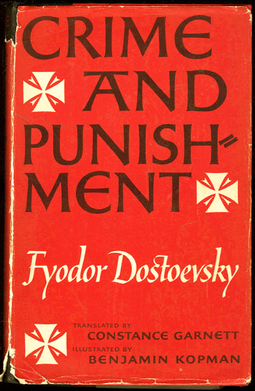
Crime and Punishment
A poor ex-student in St Petersburg murders an old pawnbroker to prove he is an “extraordinary man” — and is undone not by the police but by his own conscience and by Sonya’s love.
The Road of Nihilism
How “nothing matters” became an idea, a movement, a diagnosis, and a test — from Jacobi to Camus.