Stavrogin has seeded each of the novel’s ideologies — Shatov’s Russian Christianity, Kirillov’s man-god — and believes in none. His suppressed chapter, “At Tikhon’s”, confesses a crime against a young girl. His suicide note: “my desires are too weak; they cannot guide me.”
Explore Next
related by shared connectionsAlexei Kirillov
The engineer in Demons who reasons that if God does not exist, man must become God — and that the supreme act of self-will is suicide.
Russian Nihilism
The 1860s movement of young Russian radicals who rejected tradition, religion, art and authority in the name of science, utility and the people.
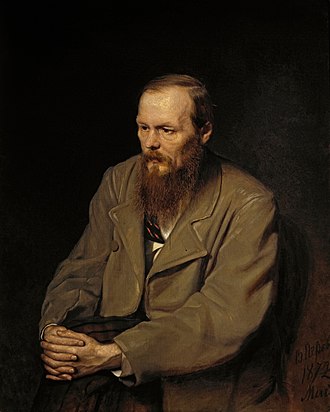
Fyodor Dostoevsky
The Russian novelist of the abyss — crime, faith, freedom, suffering — whose characters argue philosophy with their lives. Nietzsche called him the only psychologist he had anything to learn from.

Macbeth
Shakespeare’s shortest tragedy — a brave soldier, prompted by witches and his wife, murders his king and wades so deep in blood that life becomes “a tale told by an idiot”.
Rodion Raskolnikov
Impoverished ex-student who murders a pawnbroker to prove he is an “extraordinary man” beyond morality — and is broken and reborn by his conscience.

Hamlet
Shakespeare’s longest play — a prince ordered by his father’s ghost to avenge a murder thinks, doubts, delays, feigns madness, and dies in the act.