In 1800 Russia had almost no literature of European standing. By 1900 it had produced several of the greatest novels ever written. The Golden Age began with Pushkin (1799–1837), Russia’s national poet, whose Eugene Onegin — a novel in verse — set the type of the “superfluous man”; continued with Lermontov and Gogol, whose Dead Souls and “The Overcoat” (of which Dostoevsky is supposed to have said “we all came out from under Gogol’s overcoat”) founded Russian prose; and culminated in the great realists — Ivan Turgenev, Fyodor Dostoevsky, Leo Tolstoy — and the dramatist and story-writer Chekhov.
What made it extraordinary was ambition. Under censorship, with no free press or parliament, literature became the place where Russia argued about everything: serfdom, God, nihilism, revolution, the meaning of life. The “accursed questions” (proklyatye voprosy) — is there a God? how should we live? who is to blame? what is to be done? — are asked not in essays but by characters who stake their lives on the answers.
Read: Crime and Punishment, The Brothers Karamazov, Notes from Underground, Demons, Fathers and Sons, The Death of Ivan Ilyich. Follow the theme Nihilism and the room Russian Thought.
Map of Influence
who answered whom, inside this roomThinkers & Authors
5
Ivan Turgenev
The most Western of the great Russian novelists, whose Fathers and Sons created Bazarov and gave the word “nihilist” to an entire generation.
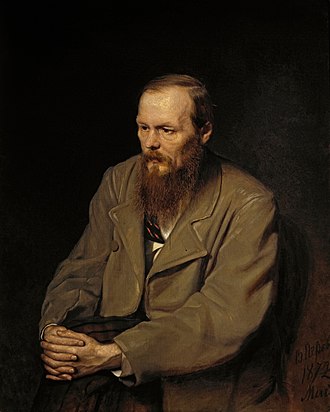
Fyodor Dostoevsky
The Russian novelist of the abyss — crime, faith, freedom, suffering — whose characters argue philosophy with their lives. Nietzsche called him the only psychologist he had anything to learn from.

Nikolai Chernyshevsky
Radical critic and author of What Is to Be Done? — the utopian novel of “rational egoism” that inspired Lenin and provoked Dostoevsky’s Underground Man.

Leo Tolstoy
The Russian giant of War and Peace and Anna Karenina, who in mid-life fell into a crisis of meaning and reinvented himself as a prophet of non-violence and simple Christian love.

Anton Chekhov
Russian doctor, short-story writer and playwright who revolutionised both forms — stories without neat plots or morals, plays where the drama happens beneath ordinary talk — and became the great artist of wasted lives, quiet longing and compassion.
Works
7
Fathers and Sons
Turgenev’s novel of the generation gap — the nihilist Bazarov against the old liberal Kirsanovs — which gave Russia the word “nihilist”.
What Is to Be Done?
Chernyshevsky’s prison-written utopian novel of “new people” and rational egoism — badly written, enormously influential, the target of Dostoevsky’s Underground Man.

Notes from Underground
A spiteful, hyper-conscious ex-official rants from his “mousehole” against reason, progress and the Crystal Palace — often called the first existentialist novel.
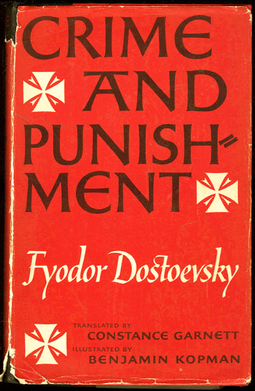
Crime and Punishment
A poor ex-student in St Petersburg murders an old pawnbroker to prove he is an “extraordinary man” — and is undone not by the police but by his own conscience and by Sonya’s love.

Demons
Dostoevsky’s prophetic political novel — a provincial town possessed by revolutionary nihilists, the murder of one of their own, and the hollow charisma of Stavrogin.

The Brothers Karamazov
Dostoevsky’s last and greatest novel — a murdered father, three brothers (the sensualist, the intellectual, the saint), and the deepest debate about God and evil in literature.

The Death of Ivan Ilyich
Tolstoy’s novella of a respectable judge who, dying of a trivial injury, realizes that his correct, comfortable life was a lie — and finds, at the last moment, the light.
Characters
9Alyosha Karamazov
The youngest brother, novice of the elder Zosima, “the hero” of the novel — who answers Ivan’s arguments not with refutation but with a kiss.
Yevgeny Bazarov
Turgenev’s young doctor-nihilist who rejects art, love and every authority — and dies of a cut finger, having loved and lost.
Ivan Ilyich Golovin
A successful, decent, utterly conventional judge who learns, dying, that he never really lived.
Ivan Karamazov
The rational, tormented middle brother who “returns his ticket” to God’s world and authors the Grand Inquisitor — and whose idea that “everything is permitted” kills his father.
Alexei Kirillov
The engineer in Demons who reasons that if God does not exist, man must become God — and that the supreme act of self-will is suicide.
Rodion Raskolnikov
Impoverished ex-student who murders a pawnbroker to prove he is an “extraordinary man” beyond morality — and is broken and reborn by his conscience.
Nikolai Stavrogin
The magnetic, empty aristocrat at the centre of Demons — everyone’s idol, nobody’s master, strength without belief.
Sonya Marmeladova
The meek young prostitute who reads Raskolnikov the raising of Lazarus and follows him to Siberia — Dostoevsky’s image of redemptive love.
The Underground Man
Dostoevsky’s nameless, spiteful, hyper-conscious narrator who rebels against reason, progress and his own interests to prove he is free.
Great Scenes
3Rebellion — Returning the Ticket
Ivan tells Alyosha true stories of tortured children and declares that no future harmony could be worth one child’s tear — so he respectfully returns his ticket.
The Grand Inquisitor
Ivan Karamazov’s prose-poem — Christ returns to sixteenth-century Seville, and the aged Cardinal Inquisitor imprisons him, explaining that humanity cannot bear the freedom He offered.
Sonya Reads Lazarus
In her bare room, by a candle-end, the prostitute Sonya reads the murderer Raskolnikov the Gospel story of the raising of Lazarus.
Coming to the Library
20 pages being writtenVoices
quotations from this traditionThere ought to be behind the door of every happy, contented man someone standing with a hammer, continually reminding him with a knock that there are unhappy people.
Brevity is the sister of talent.
Краткость — сестра таланта.
What matters is not fame, not glory, not what I dreamed of, but the capacity to endure. Learn to bear your cross and have faith.
It seemed as though in a little while the solution would be found, and then a new and splendid life would begin; and it was clear to both of them that the end was still far off, and that the most complicated and difficult part of it was only just beginning.
Beauty will save the world.
Мир спасёт красота.
If there is no God and no immortality, then everything is permitted.
It’s not God that I don’t accept, Alyosha, only I most respectfully return Him the ticket.
The whole world of knowledge is not worth that child’s prayer to “dear, kind God”!
Feed men, and then ask of them virtue!
Nothing has ever been more insupportable for a man and a human society than freedom.
Each of us is guilty before all, for all, and I more than the others.
What is hell? I maintain that it is the suffering of being unable to love.