He is forty, a retired collegiate assessor living on a small inheritance in a “wretched, horrid” room. He talks to imaginary gentlemen readers, mocks them, contradicts himself, and confesses humiliations — his years-long plan to bump into an officer on Nevsky Prospect; the farewell dinner where he makes a fool of himself; his cruelty to the prostitute Liza, who alone offered him love.
He is the ancestor of every modern anti-hero: Kafka’s narrators, Sartre’s Roquentin, Camus’s Clamence (The Fall), Ellison’s Invisible Man.
How to use him: against technocratic utopias, against the idea that people always act in their own interest, and to describe the paralysis of overthinking.
Lines to Remember
4 quotationsI am a sick man… I am a spiteful man. I am an unattractive man.
Context & when to use it
One of the great opening lines — self-diagnosis as self-display.
For the modern anti-hero, self-loathing, the confessional voice.
Twice two makes four is no longer life, gentlemen, but the beginning of death.
Context & when to use it
Against a world fully explained by reason — he even admits “twice two makes five is sometimes a very charming thing too.”
Against technocracy, determinism, utopias of calculation.
Man… would deliberately desire the most fatal rubbish… simply to prove to himself that men are still men and not the keys of a piano.
Context & when to use it
Against rational egoism — the most advantageous advantage is one’s own free, even foolish, choice.
Against behavioural economics, social engineering, algorithmic prediction of humans.
To be too conscious is an illness — a real thorough-going illness.
Context & when to use it
Hyper-consciousness paralyses action — the Underground Man as a Hamlet in a mousehole.
For overthinking, anxiety, the intellectual’s paralysis.
Explore Next
related by shared connectionsWhat Is to Be Done?
Chernyshevsky’s prison-written utopian novel of “new people” and rational egoism — badly written, enormously influential, the target of Dostoevsky’s Underground Man.

Nikolai Chernyshevsky
Radical critic and author of What Is to Be Done? — the utopian novel of “rational egoism” that inspired Lenin and provoked Dostoevsky’s Underground Man.
Anxiety
Not fear of something, but dread before freedom and nothingness — for Kierkegaard “the dizziness of freedom”, for Heidegger the mood that reveals the nothing.
Phenomenology of Spirit
Hegel’s first masterpiece — the “voyage of discovery” of consciousness through sense-certainty, self-consciousness, reason, spirit and religion to absolute knowing.
Geist (Spirit)
Hegel’s name for reality as self-knowing mind unfolding through nature, history, culture and philosophy.
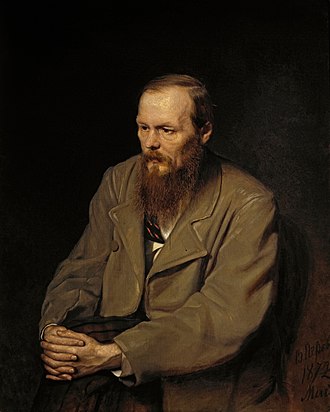
Fyodor Dostoevsky
The Russian novelist of the abyss — crime, faith, freedom, suffering — whose characters argue philosophy with their lives. Nietzsche called him the only psychologist he had anything to learn from.