In this introduction
In Sanskrit, the word usually translated “philosophy” is darśana — from dṛś, “to see”. A darśana is a way of seeing: a vision of what is real, how we know it, and how we can be free. That last word matters. Almost every Indian school, however rigorous its logic, aims finally at mokṣa, liberation from suffering and from the cycle of rebirth (saṃsāra) driven by karma. And almost every school argues about dharma, the order that holds the world together. Start with those four pages: they are the grammar of everything else.
This room gathers three thousand years of argument. The Buddhist and Jain traditions — which rejected the Veda’s authority — have rooms of their own (Buddhism, Jainism), and so do the poet-saints of bhakti (The Bhakti Movement); but the traditions argued with one another for two millennia and cannot be understood apart.
I. The Veda: hymns and the first questions
The oldest text is the Ṛg Veda (c. 1500–1000 BCE), preserved by memory alone for three thousand years. Its hymns praise fire, storm and dawn, and its idea of ṛta, cosmic order, became dharma. Its last book asks how the world began — and the Creation Hymn ends: “he who looks down from the highest heaven, only he knows — or perhaps he does not know.” Ekaṃ sad viprā bahudhā vadanti: truth is one; the wise call it by many names.
II. The Upaniṣads: the Self
The Upaniṣads (c. 800–200 BCE) turn inward. In the forest dialogues of the Bṛhadāraṇyaka, Yājñavalkya teaches that the Self is “the unseen seer”, describable only as neti neti; Gārgī presses him to the edge of the askable; Maitreyī asks whether wealth can make her immortal. In the Chāndogya, Uddālaka dissolves salt in water and tells his son: tat tvam asi — that thou art (Ātman is Brahman). In the Kaṭha, a boy goes to the house of Death. Read also the Īśā, Kena, Muṇḍaka, Māṇḍūkya, Taittirīya and Śvetāśvatara.
III. The epics and the Gītā
The Mahābhārata — a hundred thousand couplets on a war between cousins — concludes that “the truth of dharma is hidden in a cave”. At its centre stands the Bhagavad Gītā: Arjuna lays down his bow; Kṛṣṇa answers with the paths of action without attachment, knowledge and devotion. The Rāmāyaṇa offers an ideal of dharma — and in its last book questions it.
IV. The dissenters
Not everyone accepted the Veda. The materialist Cārvāka held that only perception is knowledge and the body is the self: “once the body is ash, how can it return?” The śramaṇas — Mahāvīra and the Buddha — rejected sacrifice and caste and founded Jainism and Buddhism.
V. The six darśanas
From about the 2nd century BCE, orthodox (āstika) thought crystallised into six schools, each with a root text of terse sūtras and a long tree of commentaries:
| School | Founder & root text | The core idea |
|---|---|---|
| [[schools/nyaya | Nyāya]] | [[thinkers/gautama-akshapada |
| [[schools/vaisheshika | Vaiśeṣika]] | [[thinkers/kanada |
| [[schools/samkhya | Sāṃkhya]] | [[thinkers/kapila |
| [[schools/yoga | Yoga]] | [[thinkers/patanjali |
| [[schools/mimamsa | Mīmāṃsā]] | [[thinkers/jaimini |
| [[schools/vedanta | Vedānta]] | [[thinkers/badarayana |
VI. Vedānta: the great debate
Is the self identical with Brahman, a part of God, or eternally other? Gauḍapāda said nothing was ever born; Śaṅkara built Advaita — the rope and the snake; Rāmānuja answered with Viśiṣṭādvaita — the world as God’s body; Madhva with Dvaita — five eternal differences. See Śaṅkara vs. Rāmānuja, and Māyā.
VII. Śaiva philosophy, language and beauty
In Kashmir, Śaiva non-dualism made consciousness free and dynamic, and its master Abhinavagupta explained why tragedy pleases (rasa). Behind it all stands Indian linguistics: Pāṇini‘s grammar and Bhartṛhari‘s philosophy of the Word; and the theatre of Bharata.
VIII. Power, law and the good life
The Arthaśāstra of Kauṭilya is the ancient world’s fullest manual of statecraft; the Manusmṛti the most contested law book; the Tamil Tirukkuṟaḷ of Tiruvaḷḷuvar the most universal ethics; the Kāmasūtra the science of pleasure. Aśoka tried to rule by dhamma.
IX. Bhakti
From the Tamil saints to Kabīr, Mīrā, Tulsīdās and Nānak, devotion became a revolution open to all. See the The Bhakti Movement room.
X. Modern Indian philosophy
Rammohun Roy read the Upaniṣads as rational monotheism; Dayānanda cried “back to the Vedas”; Ramakrishna found all religions true and Vivekananda carried Vedānta to Chicago; Aurobindo made it evolutionary; Ramana reduced it to one question — “Who am I?” Tagore found the infinite in the finite; Gandhi made ahiṃsā a politics (Hind Swaraj); Ambedkar demanded the annihilation of caste and turned to the Buddha; Iqbal rethought the self; Radhakrishnan explained India to the world; Krishnamurti refused every authority.
How the Indian and Western traditions meet
- Parmenides and Uddālaka: being cannot come from non-being. See Parmenides.
- Hume and the Buddha: the self as a bundle; the problem of induction already in the Cārvākas.
- Kant and Yājñavalkya: the knower that can never be known as an object.
- The Stoics and the Gītā: act well in your role, unattached to outcomes. See Stoicism.
- Schopenhauer, who kept the Upaniṣads by his bed: “the consolation of my life”. See Arthur Schopenhauer.
- Pāṇini and Chomsky; Nāgārjuna and Wittgenstein; Abhinavagupta and Kant on disinterested pleasure.
Where to begin
- Kaṭha Upaniṣad — a boy, Death, and what survives.
- The Bhagavad Gītā — a soldier’s crisis, three paths to freedom.
- Gautama Buddha — the other answer.
- Advaita Vedānta — the rope and the snake.
- Annihilation of Caste — the argument India still has with itself.
Map of Influence
who answered whom, inside this roomThinkers & Authors
62Vyāsa
The legendary sage who, Hindu tradition holds, divided the Veda into four, composed the Mahābhārata (in which he is also a character and the grandfather of both warring clans), and wrote the Purāṇas — the archetypal author of Indian tradition.
Uddālaka Āruṇi
Upanishadic teacher who instructed his son Śvetaketu with salt in water and the seed of a banyan, ending each lesson — “tat tvam asi”, that thou art.

Yājñavalkya
The boldest sage of the Upanishads, who taught that the Self (ātman) is the unseen seer, describable only as “neti neti” — not this, not this.
Gārgī Vācaknavī
The woman philosopher who challenged Yājñavalkya at King Janaka’s court with questions about what the universe is “woven on” — pressing him until he warned that her head would fall off, then returning with two questions “like arrows”. One of the earliest named women philosophers in history.
Maitreyī
Yājñavalkya’s wife, “a discourser on Brahman”, who asked whether all the wealth in the world could make her immortal — and, refusing her share of his property, received instead his teaching that all love is love of the Self.
Kapila
The legendary founder of Sāṃkhya, revered as the “first knower” (ādividvān) and, in later Hinduism, as an incarnation of Viṣṇu — a sage known almost entirely through myth, to whom India credits the first systematic philosophy of consciousness and nature.

Gautama Buddha
The prince who left his palace to seek an end to suffering, awoke under the Bodhi tree, and taught the Four Noble Truths, the Middle Way and no-self (anattā).
Mahāvīra
The twenty-fourth and last tīrthaṅkara of Jainism — a prince of the eastern Gaṅgā plain who renounced everything at thirty, practised twelve years of extreme austerity, attained omniscience, and taught a path of radical non-violence, truth and non-possession for thirty years.
Vālmīki
The ādikavi — “first poet” — to whom the Rāmāyaṇa is attributed; by legend a highway robber who became a sage, and whose grief at the death of a bird became the first verse.
Pāṇini
The grammarian of ancient Gandhāra whose Aṣṭādhyāyī — 4,000 rules generating the whole of Sanskrit — is the most rigorous description of any language before modern linguistics, and one of the great intellectual achievements of antiquity.
Kauṭilya (Cāṇakya)
The Brahmin strategist who, by tradition, made Candragupta Maurya emperor and wrote the Arthaśāstra — the ancient world’s most comprehensive treatise on statecraft, economics, law, diplomacy, espionage and war. India’s Machiavelli, two thousand years before Machiavelli.
Aśoka
The Mauryan emperor (r. c. 268–232 BCE) who, after the slaughter of his conquest of Kaliṅga, turned to Buddhism and governed by “dhamma” — non-violence, tolerance and welfare — proclaimed in edicts carved on rocks and pillars across India. His lion capital is India’s emblem; his wheel is on its flag.
Jaimini
The sage credited with the Mīmāṃsā Sūtras, the founding text of Vedic hermeneutics — and, in legend, a disciple of Vyāsa who heard the Mahābhārata from his master.
Kaṇāda
The founder of Vaiśeṣika and traditional author of the Vaiśeṣika Sūtras — the sage remembered as India’s first atomist, who taught that everything perceptible is built from eternal, indivisible particles.
Bādarāyaṇa
The author, by tradition, of the Brahma Sūtras — the systematisation of the Upaniṣads that became the root text of every school of Vedānta. Often identified with Vyāsa, compiler of the Vedas and author of the Mahābhārata.
Bharata Muni
The legendary sage credited with the Nāṭyaśāstra — the founding treatise of Indian theatre, dance, music and aesthetics, and the theory of rasa.
Aśvaghoṣa
The 1st–2nd century Buddhist poet and dramatist — author of the Buddhacarita, the first full epic of the Buddha’s life, and the Saundarananda — often called the first great poet of classical Sanskrit, before Kālidāsa.
Gautama Akṣapāda
The founder of the Nyāya school and traditional author of the Nyāya Sūtras — the first systematic Indian treatise on logic, knowledge and debate. Legend gave him eyes in his feet.

Nāgārjuna
Founder of the Madhyamaka (“Middle Way”) school of Buddhism, who argued that all things are empty (śūnya) of independent existence — including emptiness itself.
Patañjali
The compiler of the Yoga Sūtras — 196 terse aphorisms that define yoga as the stilling of the mind — honoured by tradition also as the grammarian of the Great Commentary on Pāṇini and as an incarnation of the serpent Ādiśeṣa.
Kundakunda
The most revered Digambara Jain teacher — author of the Samayasāra, which distinguishes the absolute standpoint, from which the soul is pure consciousness untouched by karma, from the conventional standpoint, from which it is bound.
Tiruvaḷḷuvar
The Tamil poet-sage who wrote the Tirukkuṟaḷ — 1,330 couplets on virtue, wealth and love that form the most revered ethical work in Tamil, translated into more languages than almost any other Indian text.
Asaṅga
Co-founder of Yogācāra Buddhism, who after twelve years of fruitless meditation found the future Buddha Maitreya in a wounded dog — and wrote the great maps of the bodhisattva path and of consciousness.
Vasubandhu
The 4th–5th century Buddhist philosopher who wrote the definitive summary of Abhidharma — and then, converted by his brother Asaṅga, became co-founder of Yogācāra, arguing that the world we experience is “representation only”.
Buddhaghosa
The 5th-century Indian monk who went to Sri Lanka and translated and systematised the Theravāda commentaries — author of the Visuddhimagga, “The Path of Purification”, the definitive map of Theravāda doctrine and meditation.
Bhartṛhari
The 5th-century philosopher of language who taught that ultimate reality is the Word (śabda-brahman), that meaning flashes forth as a whole (sphoṭa), and that all knowledge is shot through with language — and, by tradition, the poet of the Three Centuries on love, worldly wisdom and renunciation.
Dignāga
The founder of Buddhist logic and epistemology — only perception and inference give knowledge, perception grasps bare particulars, concepts are constructions, and words mean by excluding (apoha). He revolutionised the logic of every Indian school.
Gauḍapāda
The earliest systematic teacher of Advaita Vedānta, whose verses on the Māṇḍūkya Upaniṣad taught that nothing has ever really been born — the waking world is like a dream, and the one consciousness only seems to become many.
Dharmakīrti
The 7th-century Buddhist logician who perfected Dignāga’s epistemology — proving momentariness, refuting a creator God and the Veda’s authority, and defining knowledge by its reliability — the most formidable philosophical opponent the Hindu schools ever faced.
Kumārila Bhaṭṭa
The 7th-century Mīmāṃsā philosopher who turned Vedic ritual hermeneutics into a full philosophy — defending the authorless Veda, the self-validity of knowledge and a realist world against the Buddhists, and arguing that no creator God is needed.
Śāntideva
The 8th-century Nālandā monk whose Bodhicaryāvatāra (“The Way of the Bodhisattva”) is the most beloved poem of Mahāyāna Buddhism — a guide to compassion, patience and wisdom that the Dalai Lama calls his greatest inspiration.

Ādi Śaṅkara
The great systematizer of Advaita (non-dual) Vedānta — Brahman alone is real, the world is māyā, and the individual self is none other than Brahman.
Āṇṭāḷ
The only woman among the twelve Tamil Āḻvār saints (9th century) — a girl who wore the garland meant for Viṣṇu, refused any human husband, and wrote the Tiruppāvai and Nācciyār Tirumoḻi, poems of longing for God as her bridegroom.
Abhinavagupta
The towering Kashmiri polymath (c. 950–1016) — the great systematiser of non-dual Kashmir Śaivism and the greatest theorist of Indian aesthetics, who taught that in the experience of art (rasa) the self tastes its own blissful consciousness.
Udayana
The great Nyāya philosopher of Mithilā who gave Indian philosophy its classic proofs of God’s existence, defended the reality of the self against the Buddhists, and closed the classical age of Nyāya-Vaiśeṣika.

Rāmānuja
Founder of Viśiṣṭādvaita — “qualified non-dualism” — who argued against Śaṅkara that the world and souls are real, forming the body of a personal God.
Hemacandra
The Jain polymath of 12th-century Gujarat — grammarian, poet, logician, lexicographer, historian and royal adviser — called “the omniscient of the Kali age”, who persuaded a king to ban animal slaughter.
Basavaṇṇa (Basava)
The 12th-century Kannada saint, poet and statesman who founded the Vīraśaiva (Liṅgāyat) movement — rejecting caste, temples, priests and the Vedas, preaching that work is worship and that every devotee carries Śiva on his body.
Madhva
The 13th-century philosopher from Udupi who founded Dvaita Vedānta — the uncompromising teaching that God, souls and matter are eternally distinct, and that Viṣṇu alone is independent.
Jñāneśvar
The 13th-century Marathi saint-poet who, at about twenty, wrote the Jñāneśvarī — a 9,000-verse commentary on the Bhagavad Gītā in Marathi that founded Marathi literature and the Vārkarī devotional tradition — and entered living samādhi at twenty-one.
Gaṅgeśa Upādhyāya
The 14th-century logician of Mithilā who founded Navya-Nyāya, the “New Logic”, in his Tattvacintāmaṇi — a technical language of such precision that it became the common idiom of Indian scholarship for five centuries.
Lal Ded (Lalleśvarī)
The 14th-century Kashmiri Śaiva mystic who wandered naked singing short verses (vākhs) of fierce, non-dual devotion — the mother of Kashmiri literature, claimed equally by Hindus and Muslims.
Rāmānanda
The 14th–15th century Vaiṣṇava teacher of Vārāṇasī who, by tradition, opened devotion to Rāma to all castes and both sexes, and whose disciples included Kabīr, Ravidās and Pīpā — the bridge between South Indian theology and North Indian bhakti.
Kabīr
The 15th-century weaver-poet of Vārāṇasī who mocked both Hindu and Muslim orthodoxy, taught devotion to a formless God found within, and left the most quoted couplets (dohās) in the Hindi language.
Guru Nānak
The founder of Sikhism (1469–1539) — a Punjabi mystic and poet who proclaimed “there is no Hindu, there is no Muslim”, taught devotion to the one formless God (Ik Onkār), honest work and sharing, and the equality of all people.
Sūrdās
The 16th-century blind poet of Braj whose songs of Kṛṣṇa’s childhood mischief and the gopīs’ longing — the Sūrsāgar, “Ocean of Sūr” — are the heart of Kṛṣṇa devotion in Hindi.
Caitanya Mahāprabhu
The 15th–16th century Bengali saint who led an ecstatic movement of singing the names of Kṛṣṇa, regarded by his followers as Kṛṣṇa and Rādhā in one body — founder of Gauḍīya Vaiṣṇavism and ancestor of the Hare Kṛṣṇa movement.
Mīrābāī
The 16th-century Rajput princess who declared herself the bride of Kṛṣṇa, defied her royal in-laws, survived (the legends say) cups of poison and a basket with a snake, and left her palace to sing — the most beloved woman poet of North India.
Tulsīdās
The 16th-century poet of Vārāṇasī who retold the Rāmāyaṇa in Avadhī as the Rāmcaritmānas — the most widely read and recited book in North India — and wrote the Hanumān Chālīsā, sung daily by millions.
Tukārām
The 17th-century Marathi saint-poet, a grocer of the Śūdra caste, whose thousands of abhaṅgas to Viṭṭhal of Pandharpur — honest, anguished, joyful, scornful of hypocrisy — are the most loved poems in Marathi.
Raja Rammohun Roy
The Bengali reformer (1772–1833) called the “father of modern India” — translator of the Upaniṣads as rational monotheism, founder of the Brahmo Samāj, campaigner against satī, and champion of modern education and a free press.
Dayānanda Sarasvatī
The Gujarati ascetic (1824–1883) who founded the Ārya Samāj with the cry “Back to the Vedas!” — rejecting idol-worship, caste by birth, and the Purāṇas, and calling for a rational Vedic religion, education for women and the reconversion of those who had left Hinduism.
Ramakrishna Paramahamsa
The 19th-century Bengali mystic of the Dakshineswar Kālī temple who practised Hindu, Muslim and Christian paths and declared “as many faiths, so many paths” — the guru of Vivekananda and the fountainhead of modern Hindu universalism.
Rabindranath Tagore
The Bengali poet, novelist, composer, painter, educator and philosopher — the first non-European Nobel laureate in literature (1913, for Gitanjali) — author of the national anthems of India and Bangladesh, founder of Santiniketan, and a universalist who argued with Gandhi and warned the world against nationalism.
Swami Vivekananda
The Bengali monk, disciple of Ramakrishna, who brought Vedānta and Yoga to the West at the 1893 Parliament of Religions in Chicago (“Sisters and brothers of America!”), preached a “practical Vedānta” of service to humanity as service to God, and awakened modern Hindu self-confidence.
Mahatma Gandhi
The leader of India’s independence movement and the philosopher of satyāgraha — “truth-force”, non-violent resistance — who turned the Jain and Hindu ideal of ahiṃsā into a method of mass politics, and whose ideas of truth, non-violence, self-rule and simplicity changed the twentieth century.
Sri Aurobindo
The revolutionary nationalist turned yogi and philosopher of Pondicherry, whose The Life Divine and Integral Yoga teach that evolution is spirit’s ascent through matter, life and mind toward a “supermind” that will divinise earthly life.
Muhammad Iqbal
The Urdu and Persian poet-philosopher of Lahore who preached “khudī” — the self’s dynamic development — as the heart of a reconstructed Islam, wrote “Sāre jahāṅ se acchā” for India, and later envisioned a Muslim homeland that became Pakistan.
Ramana Maharshi
The silent sage of Arunachala (1879–1950), who at sixteen experienced his own death and the deathless Self, and taught one practice above all — self-inquiry, “Who am I?” — the simplest and most direct path of Advaita.
Sarvepalli Radhakrishnan
The philosopher-statesman who presented Indian philosophy to the West as a living tradition — Oxford’s Spalding Professor of Eastern Religions, author of Indian Philosophy, and India’s second President. Teachers’ Day is his birthday.
B. R. Ambedkar
The Dalit jurist, economist, philosopher and statesman who rose from “untouchability” to become the principal architect of India’s Constitution — the fiercest critic of caste and of the Hindu scriptures that sanctified it, and the founder of modern Indian Buddhism.
Jiddu Krishnamurti
The philosopher raised by the Theosophists to be a “World Teacher”, who renounced the role in 1929 — “truth is a pathless land” — and spent sixty years teaching that freedom comes only from seeing the movement of one’s own mind, without authority, method or guru.
Works
31The Ṛg Veda
The oldest text of India and one of the oldest in any Indo-European language — 1,028 hymns to the gods of fire, storm, sky and order, composed c. 1500–1000 BCE and preserved orally, syllable for syllable, for over three thousand years. Its final book already asks how the universe began, and whether even its creator knows.
The Upaniṣads
The philosophical dialogues that close the Vedas (c. 800–200 BCE) — forest teachings in which kings, priests, women and a boy at Death’s door ask what the Self is, what Brahman is, and how to be free. The source of Vedānta, and of almost every later Indian idea about the self.

Bṛhadāraṇyaka Upaniṣad
The “Great Forest” Upanishad, oldest and longest, home of Yājñavalkya’s debates, the teaching to Maitreyī, and “neti neti”.

Chāndogya Upaniṣad
One of the oldest Upanishads, famed for Uddālaka’s teaching to Śvetaketu — tat tvam asi — and Satyakāma’s honest answer about his birth.
Taittirīya Upaniṣad
The Upaniṣad of the five sheaths and the graduation address — it defines Brahman as “truth, knowledge, infinity”, peels away the layers of the self from food to bliss, measures the bliss of Brahman, and tells departing students “Treat your mother as a god.”

Kaṭha Upaniṣad
The story of the boy Naciketas, who goes to the house of Death and asks what happens after death — receiving the teaching of the immortal Self.
Kena Upaniṣad
The “By whom?” Upaniṣad — by whom is the mind sent forth, the breath set going, speech uttered? Its answer is the paradox that Brahman is known only by those who know they do not know it — and a story of the gods humbled by a blade of grass.
Īśā Upaniṣad
The shortest of the principal Upaniṣads — eighteen verses that begin “All this is pervaded by the Lord” and reconcile renunciation with action, knowledge with works, and the one with the many.
Muṇḍaka Upaniṣad
The Upaniṣad of the “shaven head” — it distinguishes the “lower knowledge” of the Vedas and sciences from the “higher knowledge” of the imperishable, compares ritual to leaky boats, gives the image of two birds on one tree, and India its national motto, “Truth alone triumphs”.
Śvetāśvatara Upaniṣad
The most theistic of the principal Upaniṣads — it identifies Brahman with Rudra-Śiva, a personal Lord to be loved, blends Vedānta with early Sāṃkhya and Yoga, and first uses the words māyā and bhakti in their later senses.
The Arthaśāstra
Kauṭilya’s treatise on statecraft — 15 books on kingship, administration, economy, law, espionage, diplomacy and war. Lost for centuries and rediscovered in 1905, it is the most comprehensive ancient manual of government in any civilisation.
The Dhammapada
423 verses of the Buddha’s teaching in 26 chapters — on the mind, the fool and the wise, anger, craving, the path and the true Brahmin. The best-loved Buddhist scripture, and the shortest door into the Buddha’s ethics.
Brahma Sūtras
Bādarāyaṇa’s 555 terse aphorisms systematizing the Upanishads — so condensed they are unreadable without the commentaries that founded the schools of Vedānta.
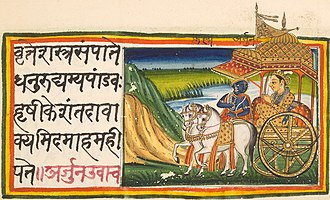
The Bhagavad Gītā
The “Song of the Lord” — Kṛṣṇa’s teaching to the despairing warrior Arjuna on the battlefield of Kurukṣetra, on duty, action without attachment, knowledge and devotion.
The Manusmṛti
The most famous of the Hindu law books — a treatise on dharma covering creation, the four classes, the stages of life, the duties of kings, marriage, inheritance, crime and penance. Revered for two millennia as the code of Hindu society, and condemned in modern times as the charter of caste and of women’s subordination.
The Nāṭyaśāstra
Bharata’s encyclopaedia of the performing arts — theatre, dance, music, costume, architecture, and the theory of rasa — called the “fifth Veda”, composed for all classes of people. The foundation of Indian aesthetics.
The Nyāya Sūtras
The root text of Indian logic — about 530 aphorisms on the means of valid knowledge, the structure of argument, the art of debate and its dishonest tricks, and the self, the world and liberation.
Māṇḍūkya Upaniṣad
The shortest Upaniṣad — twelve verses on the syllable Oṃ and the four states of consciousness, waking, dreaming, deep sleep and the “fourth” (turīya), the pure Self. Said to be enough, by itself, for liberation.
The Questions of King Milinda
A dialogue between the Indo-Greek king Menander and the Buddhist monk Nāgasena — the chariot argument for no-self, the flame of rebirth, and a Greek king’s sharp questions answered with Indian wit. A meeting of Greece and India in the 2nd century BCE.
Mūlamadhyamakakārikā
Nāgārjuna’s 450 verses in 27 chapters — the founding text of Madhyamaka, which examines causation, motion, the self, time and nirvāṇa, and shows that nothing has intrinsic existence; everything is empty because everything is dependent.
Tattvārtha Sūtra
Umāsvāti’s “Manual of the Meaning of the Reals” — the first Sanskrit summary of Jain philosophy, 350 sūtras accepted by both Digambaras and Śvetāmbaras, covering knowledge, souls, the universe, karma, ethics and liberation.
The Kāmasūtra
Vātsyāyana’s treatise on kāma — pleasure, love and desire — as one of the three legitimate aims of life. Far more than a sex manual, it is a handbook of urban culture, courtship, marriage, friendship and the arts of living well.
The Heart Sūtra
The shortest and most famous Mahāyāna scripture — a single page in which the bodhisattva Avalokiteśvara declares that “form is emptiness, emptiness is form”, negates every Buddhist category, and ends with a mantra: “gone, gone, gone beyond, gone altogether beyond — awakening, hail!”
The Yoga Sūtras
Patañjali’s 196 aphorisms — the root text of classical Yoga — which define yoga as the stilling of the mind’s fluctuations, diagnose the afflictions that cause suffering, set out the eight limbs of practice, and end in the “isolation” of pure consciousness.
Sāṃkhya Kārikā
Īśvarakṛṣṇa’s 72-verse poem that is the classical statement of Sāṃkhya philosophy — from the threefold suffering of life, through the evolution of nature in twenty-five principles, to the liberating vision in which nature, “seen”, stops dancing.
The Tirukkuṟaḷ
Tiruvaḷḷuvar’s 1,330 couplets in 133 chapters on virtue (aṟam), wealth and statecraft (poruḷ), and love (inbam) — a secular, universal ethic, compact and witty, the “Tamil Veda” and one of the most translated books of India.
The Bhāgavata Purāṇa
The most beloved of the Purāṇas (c. 9th–10th century) — twelve books of devotion to Viṣṇu, culminating in the tenth book’s life of Kṛṣṇa: the butter-thief child, the cowherd, the lover of the gopīs, the god who dances with every devotee at once.
Rāmcaritmānas
Tulsīdās’s 16th-century retelling of the Rāmāyaṇa in Avadhī Hindi — 12,800 lines of devotional epic that made Rāma the God of North India, recited daily, staged every year as Rāmlīlā, and loved more than any other book in Hindi.
Hind Swaraj
Gandhi’s 1909 manifesto, written in ten days on a ship — a dialogue in which the “Editor” tells an impatient “Reader” that true home rule is rule over oneself, that modern civilisation is a disease, and that India must win freedom by non-violence and the spinning wheel.
Gitanjali
Tagore’s 1912 collection of devotional prose-poems, translated by himself from Bengali, which won the 1913 Nobel Prize — intimate songs to a God found in nature, in human labour, in love and in death.
Annihilation of Caste
Ambedkar’s 1936 undelivered speech — the most powerful critique of caste ever written — arguing that caste is a division of labourers, not of labour, that it rests on the authority of the Hindu scriptures, and that it cannot be reformed but only destroyed.
Ideas
12Dharma
The central idea of Indian civilisation — the order that holds the world together, and the duty, law, virtue and right way of living that each being owes to it. For Buddhists, the Dhamma is also the Buddha’s teaching and the ultimate constituents of reality.
Ātman is Brahman
The central Upanishadic insight — the innermost Self of each being is identical with the ultimate reality of the universe.
Karma
“Action” — and the law that every intentional action leaves a trace that ripens, in this life or a future one, as happiness or suffering. Shared by Hindus, Buddhists, Jains and Sikhs, karma explains the inequalities of fortune without a judge, and binds the self to the round of rebirth.
Mokṣa
Liberation — release from the cycle of rebirth and from all suffering, the highest goal of human life in the Hindu and Jain traditions (and, as nirvāṇa, in Buddhism). Every Indian school defines it differently, and the arguments over what it is, and how it is won, are the backbone of Indian philosophy.
Saṃsāra
“Wandering” — the beginningless cycle of birth, death and rebirth through which beings pass according to their karma, and from which every major Indian religion seeks release.
Anattā (No-Self)
The Buddha’s teaching that there is no permanent, unchanging self — only a flowing stream of physical and mental processes.
Anekāntavāda
The Jain doctrine that reality is many-sided — that every thing has infinite aspects and every statement captures only one, so that truth requires holding many viewpoints together. Expressed in the parable of the blind men and the elephant and formalised in the sevenfold logic of syādvāda.
Nirvāṇa
The Buddhist goal — the “blowing out” of the fires of greed, hatred and delusion, the end of suffering and of rebirth. The Buddha described it as unborn and unconditioned, and refused to say whether the awakened exist after death.
Pratītyasamutpāda (Dependent Origination)
The Buddha’s central insight — “when this exists, that comes to be; when this ceases, that ceases.” Nothing exists independently; everything arises from conditions. Applied to suffering, it becomes the twelve-linked chain from ignorance to death.
Śūnyatā (Emptiness)
Emptiness — the Mahāyāna teaching that all things lack intrinsic, independent existence (svabhāva), because they arise in dependence on causes, parts and concepts. Not nothingness, but the openness that makes change and freedom possible.
Rasa
The Indian theory of aesthetic experience — the “flavour” or “relish” that art evokes in the audience. Bharata named eight rasas; Abhinavagupta added peace and explained rasa as the self tasting its own consciousness through universalised emotion.
Māyā
The power of appearance — in Advaita, the cosmic illusion by which the one Brahman appears as a world of many things.
Schools & Movements
17Vedānta
“The end of the Veda” — the schools that interpret the Upanishads, Bhagavad Gītā and Brahma Sūtras to understand Brahman, the Self, and liberation.
Cārvāka (Lokāyata)
India’s materialist school — only perception is knowledge, only matter is real, there is no soul, no rebirth, no karma and no God, and the purpose of life is pleasure. Its own books are lost; we know it through the furious refutations of every other school.
Jainism
The ancient Indian tradition of the Jinas — radical non-violence toward every living being, a soul weighed down by karmic matter, the “many-sidedness” of truth, and liberation by self-discipline without a creator God. Small in numbers, immense in influence.
Buddhism
The tradition founded by the Buddha — suffering, impermanence, no-self, and the path to nirvāṇa — later dividing into Theravāda, Mahāyāna (Madhyamaka, Yogācāra) and Vajrayāna.
Sāṃkhya
The oldest of the classical Indian systems — a radical dualism of pure, inactive consciousness (puruṣa) and active, unconscious nature (prakṛti) with its three strands, the guṇas. Liberation is seeing that consciousness was never really entangled in nature.
Mīmāṃsā
The school of Vedic interpretation — the hermeneutics of ritual and duty that treated the Veda as eternal and authorless, defended the self-validity of knowledge, denied a creator God, and developed theories of language, meaning and law that shaped all of Hindu jurisprudence.
Theravāda and the Abhidharma
The oldest surviving school of Buddhism — the Pāli Canon, the arhat ideal, and the Abhidhamma analysis of experience into momentary ultimate realities — living today in Sri Lanka, Myanmar, Thailand, Laos and Cambodia.
Nyāya
India’s great school of logic and epistemology — the theory of valid knowledge (pramāṇa), the five-membered syllogism, the catalogue of fallacies, realist metaphysics, and the most famous arguments for God in Indian philosophy. Its later form, Navya-Nyāya, became the technical language of all Indian scholarship.
Vaiśeṣika
India’s school of natural philosophy and atomism — reality analysed into six (later seven) categories, the world built from eternal, indivisible atoms of earth, water, fire and air, combined by an unseen moral force. Merged with Nyāya, it gave Indian realism its map of what exists.
Yoga (darśana)
The classical school of Patañjali — Sāṃkhya’s dualism of consciousness and nature, plus a God and a practical method — defining yoga as “the stilling of the fluctuations of the mind” and mapping the eight limbs from ethics to absorption.
Madhyamaka
Nāgārjuna’s school of emptiness — nothing has intrinsic existence (svabhāva), all things are empty because they arise in dependence, and even emptiness is empty. Its dialectic dismantles every view, and it became the summit of Tibetan Buddhist philosophy.
Yogācāra
The “mind-only” school of Mahāyāna Buddhism, founded by Asaṅga and Vasubandhu — the world we experience is a construction of consciousness, carried by a “storehouse” of karmic seeds; awakening is the transformation of the basis of consciousness itself.
The Bhakti Movement
The great devotional revolution of Indian religion — from the Tamil Āḻvārs and Nāyaṉārs (6th–9th centuries) to Kabīr, Mīrābāī, Tulsīdās and Tukārām — which made passionate, personal love of God, sung in the languages of the people, a path to liberation open to every caste and to women.
Advaita Vedānta
Non-dualist Vedānta — Brahman alone is real, the world is appearance (māyā), and the self is identical with Brahman.
Kashmir Śaivism
The non-dual Śaiva philosophy of medieval Kashmir — reality is the free, self-aware consciousness of Śiva, who playfully contracts himself into the many selves and the world, and liberation is the recognition that you are Śiva. The world is not illusion but God’s self-expression.
Viśiṣṭādvaita
Qualified non-dualism — Brahman is one, but includes real souls and matter as its body; liberation is through devotion and grace.
Dvaita Vedānta
Madhva’s realist, theistic Vedānta — God (Viṣṇu) alone is independent; souls and matter are real, eternally distinct from God and from each other, and wholly dependent on him. The most uncompromising rejection of Advaita in Indian thought.
Coming to the Library
15 pages being writtenVoices
quotations from this traditionThat which is the finest essence — this whole world has that as its Self. That is the Truth. That is the Self. That thou art, Śvetaketu.
स य एषोऽणिमैतदात्म्यमिदं सर्वं तत्सत्यं स आत्मा तत्त्वमसि श्वेतकेतो
From the unreal lead me to the real; from darkness lead me to light; from death lead me to immortality.
असतो मा सद्गमय। तमसो मा ज्योतिर्गमय। मृत्योर्मा अमृतं गमय॥
This Self is not this, not this. It is ungraspable, for it is not grasped; indestructible, for it is not destroyed; unattached, for it does not attach itself.
स एष नेति नेत्यात्मा
What should I do with that which will not make me immortal?
You cannot see the seer of seeing; you cannot hear the hearer of hearing; you cannot think the thinker of thinking; you cannot know the knower of knowing.
Arise! Awake! Approach the great ones and learn. Sharp as the edge of a razor, hard to cross — the path is difficult, so the sages say.
उत्तिष्ठत जाग्रत प्राप्य वरान्निबोधत। क्षुरस्य धारा निशिता दुरत्यया दुर्गं पथस्तत्कवयो वदन्ति॥
The knowing Self is not born; it does not die. It has not come from anywhere, has not become anything. Unborn, eternal, everlasting, ancient — it is not slain when the body is slain.
Your right is to action alone, never to its fruits. Let not the fruits of action be your motive, nor let your attachment be to inaction.
कर्मण्येवाधिकारस्ते मा फलेषु कदाचन। मा कर्मफलहेतुर्भूर्मा ते सङ्गोऽस्त्वकर्मणि॥
Weapons do not cut it, fire does not burn it, water does not wet it, wind does not dry it.
नैनं छिन्दन्ति शस्त्राणि नैनं दहति पावकः। न चैनं क्लेदयन्त्यापो न शोषयति मारुतः॥
As a man casts off worn-out garments and puts on others that are new, so the embodied Self casts off worn-out bodies and enters into others that are new.
Better is one’s own duty, though imperfectly done, than the duty of another well performed.
श्रेयान्स्वधर्मो विगुणः परधर्मात्स्वनुष्ठितात्
I am Time, the mighty destroyer of worlds, come forth to annihilate the peoples.
कालोऽस्मि लोकक्षयकृत्प्रवृद्धो लोकान्समाहर्तुमिह प्रवृत्तः