Contents · 6 sections · 4 min
Key Ideas
Athāto brahma-jijñāsā — “now, therefore, the inquiry into Brahman” (1.1.1).
Brahman is that from which the origin, sustenance and dissolution of the world proceed (1.1.2).
Refutations of rival schools — Sāṃkhya, Buddhists, Jains.
The Brahma Sūtras (also Vedānta Sūtras, Śārīraka Sūtras, or Uttara Mīmāṃsā Sūtras), attributed to Bādarāyaṇa, are a collection of some 555 aphorisms that systematise the teaching of the Upaniṣads about Brahman and refute rival philosophies. Composed or compiled probably between the second century BCE and the second century CE (some scholars argue for as late as 400 CE), they form, with the Upaniṣads and the The Bhagavad Gītā, the “three sources” (prasthāna-traya) of Vedānta. Their sūtras are so terse — often two or three words, with no subject or verb — that they are unintelligible without a commentary. This is precisely why they became the founding text of every Vedānta school: to found a school, one wrote a commentary on the Brahma Sūtras showing that they taught one’s own view. Ādi Śaṅkara read them as Advaita, Rāmānuja as Viśiṣṭādvaita, Madhva as Dvaita, Nimbārka, Vallabha and Baladeva as their own forms of Vedānta. The history of their interpretation is the history of Vedānta.
Structure
The sūtras are arranged in four chapters (adhyāyas), each of four quarters (pādas), organised into topics (adhikaraṇas):
- Samanvaya (“harmony”): all the Upaniṣads have Brahman as their one consistent subject. Ambiguous passages that mention the “space”, “light”, “breath” or “person” are shown to refer to Brahman.
- Avirodha (“non-contradiction”): the Vedānta view is not contradicted by reason, by smṛti, or by rival systems — Sāṃkhya, Yoga, Vaiśeṣika, Buddhism, Jainism, the Pāśupata and Pāñcarātra sects — which are criticised one by one. It also discusses the origin of the elements and of the self.
- Sādhana (“means”): the means of liberation — the self’s journey through rebirth, the nature of Brahman, the various meditations (vidyās) taught in the Upaniṣads, and the relation of knowledge to ritual action.
- Phala (“fruit”): the result of knowledge — liberation, the path of the departing soul, and the state of the liberated.
The opening sūtras
The first four sūtras are the most famous, and each school’s commentary on them (the catuḥsūtrī) contains its philosophy in miniature:
- athāto brahma-jijñāsā — “Now, therefore, the inquiry into Brahman.” It echoes the first sūtra of the Mīmāṃsā Sūtras (“Now, therefore, the inquiry into dharma”). Commentators argue about what “now” follows: the study of ritual (Rāmānuja), or the four qualifications of discrimination, dispassion, virtue and longing for liberation (Śaṅkara).
- janmādy asya yataḥ — “(Brahman is that) from which the origin, etc. (sustenance and dissolution) of this (world proceed).” For Advaita this is a “secondary” definition, describing Brahman by its relation to an appearance; for the theistic schools, a description of God’s real creative power.
- śāstra-yonitvāt — “Because scripture is its source” — or: “because it is the source of scripture”. Brahman is known through scripture, not by inference.
- tat tu samanvayāt — “But that (is known), because of harmony” — all Upaniṣadic texts consistently teach Brahman.
The critique of rival schools
The second chapter’s refutations shaped Indian debate. Against Sāṃkhya: unconscious nature cannot by itself produce an orderly world, as a heap of stones cannot build a palace (2.2.1). Against Vaiśeṣika atomism: atoms cannot combine without a cause of their first motion. Against Buddhism: momentary things cannot combine into aggregates, and idealism is refuted because “non-existence (of external things) is not, because they are perceived” (2.2.28). Against Jainism: the doctrine of many-sidedness is incoherent, since “contradictory properties cannot exist in one thing at the same time” (2.2.33). These sūtras are the scriptural basis of the Vedāntins’ long war with the Buddhists and Jains.
Interpretation
The Sūtras themselves seem to favour some form of bhedābheda, difference-in-identity, between Brahman and the world: Brahman is both the material and the efficient cause of the world, as clay is of pots (1.4.23), and the self is “a part” (aṃśa) of Brahman (2.3.43). They cite earlier teachers who disagreed — Āśmarathya held that self and Brahman are both different and non-different, Auḍulomi that they become one only in liberation, Kāśakṛtsna that the self simply is Brahman. Many modern scholars (George Thibaut, Hajime Nakamura) think Rāmānuja’s reading is closer to the text than Śaṅkara’s; Advaitins answer that the text speaks at the conventional level.
The commentary tree
Śaṅkara’s Brahmasūtrabhāṣya is the oldest surviving complete commentary and the masterpiece of Advaita prose; it begins with the famous preface on superimposition (adhyāsa). Rāmānuja’s Śrī Bhāṣya opens with its great critique of māyā. Madhva wrote a short Bhāṣya and a longer Anuvyākhyāna. Each generated its own chain of sub-commentaries — for Advaita, Vācaspati Miśra’s Bhāmatī and Prakāśātman’s Vivaraṇa; for Viśiṣṭādvaita, Sudarśana Sūri’s Śrutaprakāśikā; for Dvaita, Jayatīrtha’s Nyāyasudhā — and the debate continues in modern commentaries by Radhakrishnan and others.
In conversation
The opening four words — athāto brahma-jijñāsā, “now, therefore, the inquiry into Brahman” — are the motto of Vedānta. And the Brahma Sūtras are the classic case of a text whose meaning lies in its readers: the same 555 sentences founded half a dozen incompatible philosophies.
The Commentary Tree
mūla → bhāṣya → ṭīkāIn India a root text is rarely read alone. Terse sūtras or verses (mūla) are unfolded by a commentary (bhāṣya), which is explained by sub-commentaries (ṭīkā, vārttika) — each generation arguing with the last. This is how Brahma Sūtras has been read.
- Brahma Sūtras
- Brahmasūtrabhāṣya
Opens with the preface on superimposition (adhyāsa).
- Bhāmatī
- Pañcapādikā → Vivaraṇa
- Brahmasūtrabhāṣya
A rival reading: Brahman really transforms into the world.
- Śrī Bhāṣya
Opens with the great critique of māyā.
- Śrutaprakāśikā
- Vedāntapārijātasaurabha
- Nyāyasudhā
- Aṇubhāṣya
- Govinda Bhāṣya
Explore Next
related by shared connectionsŚaṅkara vs. Rāmānuja
The great Vedāntic debate — is the self identical with Brahman, and the world an illusion? Or are souls and world real, the body of a personal God?
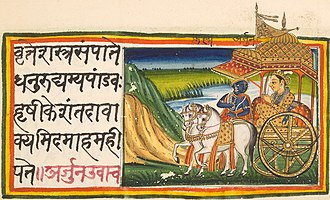
The Bhagavad Gītā
The “Song of the Lord” — Kṛṣṇa’s teaching to the despairing warrior Arjuna on the battlefield of Kurukṣetra, on duty, action without attachment, knowledge and devotion.

Bṛhadāraṇyaka Upaniṣad
The “Great Forest” Upanishad, oldest and longest, home of Yājñavalkya’s debates, the teaching to Maitreyī, and “neti neti”.
Uddālaka Āruṇi
Upanishadic teacher who instructed his son Śvetaketu with salt in water and the seed of a banyan, ending each lesson — “tat tvam asi”, that thou art.
Viśiṣṭādvaita
Qualified non-dualism — Brahman is one, but includes real souls and matter as its body; liberation is through devotion and grace.
Sri Aurobindo
The revolutionary nationalist turned yogi and philosopher of Pondicherry, whose The Life Divine and Integral Yoga teach that evolution is spirit’s ascent through matter, life and mind toward a “supermind” that will divinise earthly life.