Indian literature is an ocean — in Sanskrit, Pāli, Prakrit, Tamil, Persian, Hindi, Urdu, Bengali and dozens of other languages. This room begins with the classical Sanskrit tradition and the works that every Indian reader knows.
The two epics are the foundation. The Rāmāyaṇa of Vālmīki — the “first poem” (ādikāvya) — tells of Prince Rāma, exiled to the forest with his wife Sītā and brother Lakṣmaṇa; of Sītā’s abduction by the demon-king Rāvaṇa; of the monkey-hero Hanumān; and of the war on Laṅkā. The Mahābhārata, attributed to Vyāsa, is the longest poem in the world: the tragic war between the Pāṇḍava and Kaurava cousins at Kurukṣetra, containing within it the The Bhagavad Gītā, in which Arjuna lays down his bow and Kṛṣṇa teaches him duty, knowledge and devotion. Its central question — what is dharma, right action, when every choice is compromised? — makes it the most morally complex epic ever written.
Classical kāvya (court poetry and drama) reached its height with Kālidāsa (c. 4th–5th century), whose play Abhijñānaśākuntalam (The Recognition of Śakuntalā) enchanted Goethe, and whose Meghadūta (The Cloud Messenger) has an exiled lover send a message to his wife by a monsoon cloud. Indian aesthetics developed the theory of rasa — the “taste” or emotional flavour a work evokes in the sensitive spectator.
The bhakti poets — Kabīr, Mīrābāī, Sūrdās, Tulsīdās — sang devotion in the languages of the people, and in the twentieth century Rabindranath Tagore won the Nobel Prize (1913) for Gitanjali.
The Upanishadic stories already in the library — Naciketas at the House of Death, Tat Tvam Asi — Salt in Water — are some of the earliest great narratives of Indian thought.
Map of Influence
who answered whom, inside this roomThinkers & Authors
26Vyāsa
The legendary sage who, Hindu tradition holds, divided the Veda into four, composed the Mahābhārata (in which he is also a character and the grandfather of both warring clans), and wrote the Purāṇas — the archetypal author of Indian tradition.
Vālmīki
The ādikavi — “first poet” — to whom the Rāmāyaṇa is attributed; by legend a highway robber who became a sage, and whose grief at the death of a bird became the first verse.
Aśvaghoṣa
The 1st–2nd century Buddhist poet and dramatist — author of the Buddhacarita, the first full epic of the Buddha’s life, and the Saundarananda — often called the first great poet of classical Sanskrit, before Kālidāsa.
Tiruvaḷḷuvar
The Tamil poet-sage who wrote the Tirukkuṟaḷ — 1,330 couplets on virtue, wealth and love that form the most revered ethical work in Tamil, translated into more languages than almost any other Indian text.

Kālidāsa
The greatest poet and dramatist of classical Sanskrit — author of Śakuntalā, The Cloud Messenger and the Birth of Kumāra — whose art of love, nature and longing made him “the Shakespeare of India”.
Bhartṛhari
The 5th-century philosopher of language who taught that ultimate reality is the Word (śabda-brahman), that meaning flashes forth as a whole (sphoṭa), and that all knowledge is shot through with language — and, by tradition, the poet of the Three Centuries on love, worldly wisdom and renunciation.
Dharmakīrti
The 7th-century Buddhist logician who perfected Dignāga’s epistemology — proving momentariness, refuting a creator God and the Veda’s authority, and defining knowledge by its reliability — the most formidable philosophical opponent the Hindu schools ever faced.
Śāntideva
The 8th-century Nālandā monk whose Bodhicaryāvatāra (“The Way of the Bodhisattva”) is the most beloved poem of Mahāyāna Buddhism — a guide to compassion, patience and wisdom that the Dalai Lama calls his greatest inspiration.
Āṇṭāḷ
The only woman among the twelve Tamil Āḻvār saints (9th century) — a girl who wore the garland meant for Viṣṇu, refused any human husband, and wrote the Tiruppāvai and Nācciyār Tirumoḻi, poems of longing for God as her bridegroom.
Hemacandra
The Jain polymath of 12th-century Gujarat — grammarian, poet, logician, lexicographer, historian and royal adviser — called “the omniscient of the Kali age”, who persuaded a king to ban animal slaughter.
Basavaṇṇa (Basava)
The 12th-century Kannada saint, poet and statesman who founded the Vīraśaiva (Liṅgāyat) movement — rejecting caste, temples, priests and the Vedas, preaching that work is worship and that every devotee carries Śiva on his body.
Jayadeva
The 12th-century Sanskrit poet of Bengal or Odisha whose Gītagovinda — the love, quarrel and reunion of Rādhā and Kṛṣṇa — is the most sensuous devotional poem in Sanskrit, sung in temples and danced in Odissi to this day.
Amīr Khusrau
The 13th–14th century poet, musician and Sufi of Delhi — disciple of Nizāmuddīn Auliyā, master of Persian verse, pioneer of Hindavi (early Hindi-Urdu), and by tradition the inventor of qawwālī, the khayāl and the sitar.
Jñāneśvar
The 13th-century Marathi saint-poet who, at about twenty, wrote the Jñāneśvarī — a 9,000-verse commentary on the Bhagavad Gītā in Marathi that founded Marathi literature and the Vārkarī devotional tradition — and entered living samādhi at twenty-one.
Lal Ded (Lalleśvarī)
The 14th-century Kashmiri Śaiva mystic who wandered naked singing short verses (vākhs) of fierce, non-dual devotion — the mother of Kashmiri literature, claimed equally by Hindus and Muslims.
Kabīr
The 15th-century weaver-poet of Vārāṇasī who mocked both Hindu and Muslim orthodoxy, taught devotion to a formless God found within, and left the most quoted couplets (dohās) in the Hindi language.
Guru Nānak
The founder of Sikhism (1469–1539) — a Punjabi mystic and poet who proclaimed “there is no Hindu, there is no Muslim”, taught devotion to the one formless God (Ik Onkār), honest work and sharing, and the equality of all people.
Sūrdās
The 16th-century blind poet of Braj whose songs of Kṛṣṇa’s childhood mischief and the gopīs’ longing — the Sūrsāgar, “Ocean of Sūr” — are the heart of Kṛṣṇa devotion in Hindi.
Mīrābāī
The 16th-century Rajput princess who declared herself the bride of Kṛṣṇa, defied her royal in-laws, survived (the legends say) cups of poison and a basket with a snake, and left her palace to sing — the most beloved woman poet of North India.
Tulsīdās
The 16th-century poet of Vārāṇasī who retold the Rāmāyaṇa in Avadhī as the Rāmcaritmānas — the most widely read and recited book in North India — and wrote the Hanumān Chālīsā, sung daily by millions.
Tukārām
The 17th-century Marathi saint-poet, a grocer of the Śūdra caste, whose thousands of abhaṅgas to Viṭṭhal of Pandharpur — honest, anguished, joyful, scornful of hypocrisy — are the most loved poems in Marathi.
Mirza Ghalib
The greatest poet of Urdu (1797–1869) — master of the ghazal, of wit, paradox, grief and doubt — who lived through the fall of the Mughal world in 1857 and wrote its elegy in letters and verse.
Rabindranath Tagore
The Bengali poet, novelist, composer, painter, educator and philosopher — the first non-European Nobel laureate in literature (1913, for Gitanjali) — author of the national anthems of India and Bangladesh, founder of Santiniketan, and a universalist who argued with Gandhi and warned the world against nationalism.
Sri Aurobindo
The revolutionary nationalist turned yogi and philosopher of Pondicherry, whose The Life Divine and Integral Yoga teach that evolution is spirit’s ascent through matter, life and mind toward a “supermind” that will divinise earthly life.
Muhammad Iqbal
The Urdu and Persian poet-philosopher of Lahore who preached “khudī” — the self’s dynamic development — as the heart of a reconstructed Islam, wrote “Sāre jahāṅ se acchā” for India, and later envisioned a Muslim homeland that became Pakistan.
Premchand
The greatest writer of modern Hindi and Urdu fiction — novelist of the Indian village, of peasants crushed by debt, caste and colonial rule — whose Godān and stories like “The Shroud” founded social realism in Indian literature.
Works
21The Ṛg Veda
The oldest text of India and one of the oldest in any Indo-European language — 1,028 hymns to the gods of fire, storm, sky and order, composed c. 1500–1000 BCE and preserved orally, syllable for syllable, for over three thousand years. Its final book already asks how the universe began, and whether even its creator knows.
The Upaniṣads
The philosophical dialogues that close the Vedas (c. 800–200 BCE) — forest teachings in which kings, priests, women and a boy at Death’s door ask what the Self is, what Brahman is, and how to be free. The source of Vedānta, and of almost every later Indian idea about the self.

Chāndogya Upaniṣad
One of the oldest Upanishads, famed for Uddālaka’s teaching to Śvetaketu — tat tvam asi — and Satyakāma’s honest answer about his birth.

Kaṭha Upaniṣad
The story of the boy Naciketas, who goes to the house of Death and asks what happens after death — receiving the teaching of the immortal Self.

The Rāmāyaṇa
Vālmīki’s epic of Rāma, the exiled prince who crosses the sea to rescue his wife Sītā from the demon king Rāvaṇa — India’s ādikāvya, the “first poem”, and the model of dharma for two thousand years.
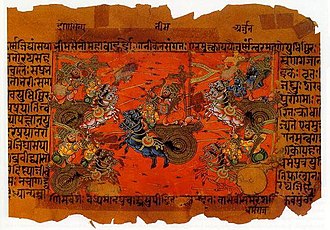
The Mahābhārata
The great epic of India — the war between the Pāṇḍavas and the Kauravas, cousins fighting for a kingdom — and, at about 100,000 couplets, the longest poem ever composed, containing the Bhagavad Gītā and almost the whole of Indian thought on dharma.
The Jātakas
547 stories of the Buddha’s previous lives — as a hare, a monkey king, a merchant, a prince — told to illustrate the virtues that lead to awakening. India’s great treasury of folk tales, carved on stūpas and painted in caves.
Saṅgam Poetry
The oldest Tamil literature (c. 300 BCE–300 CE) — 2,381 poems by 473 poets, on love (akam) and war (puṟam), in which each landscape — mountain, forest, field, seashore, desert — carries a mood of love. One of the great classical literatures of the world.
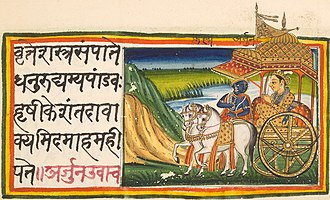
The Bhagavad Gītā
The “Song of the Lord” — Kṛṣṇa’s teaching to the despairing warrior Arjuna on the battlefield of Kurukṣetra, on duty, action without attachment, knowledge and devotion.
The Nāṭyaśāstra
Bharata’s encyclopaedia of the performing arts — theatre, dance, music, costume, architecture, and the theory of rasa — called the “fifth Veda”, composed for all classes of people. The foundation of Indian aesthetics.
The Pañcatantra
The ancient Indian book of animal fables written to teach princes the art of practical wisdom (nīti) — the jackals Karaṭaka and Damanaka, the monkey and the crocodile, the lion and the hare — translated into more languages than almost any book except the Bible.
Mūlamadhyamakakārikā
Nāgārjuna’s 450 verses in 27 chapters — the founding text of Madhyamaka, which examines causation, motion, the self, time and nirvāṇa, and shows that nothing has intrinsic existence; everything is empty because everything is dependent.
The Little Clay Cart
Śūdraka’s Sanskrit comedy of love, crime and revolution — a poor Brahmin merchant, a generous courtesan, a burglar with a theory of house-breaking, a vicious royal brother-in-law and a popular uprising — the most realistic and modern-feeling play of ancient India.
Sāṃkhya Kārikā
Īśvarakṛṣṇa’s 72-verse poem that is the classical statement of Sāṃkhya philosophy — from the threefold suffering of life, through the evolution of nature in twenty-five principles, to the liberating vision in which nature, “seen”, stops dancing.
Meghadūta (The Cloud Messenger)
Kālidāsa’s lyric poem of 111 verses in which an exiled yakṣa asks a monsoon cloud to carry a message of love to his wife in the Himālaya — describing, as the cloud flies north, all of India alive with longing.
The Recognition of Śakuntalā
Kālidāsa’s seven-act masterpiece — a king and a hermit girl fall in love in a forest, a curse erases his memory, a lost ring restores it, and the lovers are reunited in heaven. The most celebrated play in Sanskrit, which astonished Goethe and Europe.
Cilappatikāram (The Tale of an Anklet)
The great Tamil epic (c. 5th century) by the prince-monk Iḷaṅkō Aṭikaḷ — Kaṇṇaki’s husband is executed on a false charge of stealing the queen’s anklet; she proves his innocence, tears off her breast and burns the city of Madurai, and becomes a goddess.
Gītagovinda
Jayadeva’s 12th-century Sanskrit song-cycle on the love of Rādhā and Kṛṣṇa — jealousy, separation, longing and reunion — the most musical and sensuous poem in Sanskrit, read as an allegory of the soul’s love for God.
Rāmcaritmānas
Tulsīdās’s 16th-century retelling of the Rāmāyaṇa in Avadhī Hindi — 12,800 lines of devotional epic that made Rāma the God of North India, recited daily, staged every year as Rāmlīlā, and loved more than any other book in Hindi.
Gitanjali
Tagore’s 1912 collection of devotional prose-poems, translated by himself from Bengali, which won the 1913 Nobel Prize — intimate songs to a God found in nature, in human labour, in love and in death.
Godān
Premchand’s last and greatest novel (1936) — the life and death of Hori, a poor peasant who longs only to own a cow, crushed by debt, caste, landlords and priests — the epic of the Indian village under colonial rule.
Ideas
1Characters
1Great Scenes
3Naciketas at the House of Death
Given away by his angry father, the boy Naciketas waits three days at Death’s door, and refuses all the riches Yama offers until Death tells him what lies beyond.
Tat Tvam Asi — Salt in Water
Uddālaka tells his son Śvetaketu to dissolve salt in water and taste it — invisible, yet everywhere — “that is the Self; that thou art.”
The Universal Form
Arjuna asks to see Kṛṣṇa’s true form — and beholds the whole universe, all beings, all gods, and all the warriors rushing into Time’s blazing mouths.
Coming to the Library
18 pages being writtenVoices
quotations from this traditionThat which is the finest essence — this whole world has that as its Self. That is the Truth. That is the Self. That thou art, Śvetaketu.
स य एषोऽणिमैतदात्म्यमिदं सर्वं तत्सत्यं स आत्मा तत्त्वमसि श्वेतकेतो
Arise! Awake! Approach the great ones and learn. Sharp as the edge of a razor, hard to cross — the path is difficult, so the sages say.
उत्तिष्ठत जाग्रत प्राप्य वरान्निबोधत। क्षुरस्य धारा निशिता दुरत्यया दुर्गं पथस्तत्कवयो वदन्ति॥
The knowing Self is not born; it does not die. It has not come from anywhere, has not become anything. Unborn, eternal, everlasting, ancient — it is not slain when the body is slain.
Your right is to action alone, never to its fruits. Let not the fruits of action be your motive, nor let your attachment be to inaction.
कर्मण्येवाधिकारस्ते मा फलेषु कदाचन। मा कर्मफलहेतुर्भूर्मा ते सङ्गोऽस्त्वकर्मणि॥
Weapons do not cut it, fire does not burn it, water does not wet it, wind does not dry it.
नैनं छिन्दन्ति शस्त्राणि नैनं दहति पावकः। न चैनं क्लेदयन्त्यापो न शोषयति मारुतः॥
As a man casts off worn-out garments and puts on others that are new, so the embodied Self casts off worn-out bodies and enters into others that are new.
Better is one’s own duty, though imperfectly done, than the duty of another well performed.
श्रेयान्स्वधर्मो विगुणः परधर्मात्स्वनुष्ठितात्
I am Time, the mighty destroyer of worlds, come forth to annihilate the peoples.
कालोऽस्मि लोकक्षयकृत्प्रवृद्धो लोकान्समाहर्तुमिह प्रवृत्तः
Day after day countless creatures go to the abode of Death, yet those who remain wish to live forever. What can be more wonderful than this?
What is here may be found elsewhere; what is not here is nowhere.
yad ihāsti tad anyatra yan nehāsti na tat kvacit
Non-violence is the highest dharma.
ahiṃsā paramo dharmaḥ
May you, hunter, find no rest for endless years, since you killed one of a pair of cranes, lost in love.
mā niṣāda pratiṣṭhāṃ tvam agamaḥ śāśvatīḥ samāḥ