Key Ideas
Separation (vipralambha) — the deepest form of love.
A travelogue of India seen from a cloud — rivers, mountains, cities, temples.
Nature as lover — rivers as women, the cloud as a suitor.
The founding text of the sandeśa-kāvya (messenger poem) genre.
The Meghadūta (“Cloud Messenger”) is a lyric poem by Kālidāsa, of about 111 stanzas in the slow, stately mandākrāntā metre, and one of the most beloved poems in Sanskrit. A yakṣa — a semi-divine attendant of Kubera, god of wealth — has been exiled for a year from his home in Alakā, on the slopes of Mount Kailāsa, for neglecting his duties, and has been living in the hermitages of Rāmagiri in central India. At the start of the monsoon, maddened with longing for his young wife, he sees a great dark cloud against the mountain and asks it to carry a message to her.
The first part (Pūrvamegha) describes the route the cloud will take northward across India — over the Narmadā and the Vindhya hills, over the city of Ujjayinī with its palaces, lovers, temple dancers and the shrine of Mahākāla, over the rivers Siprā and Gambhīrā, past Kurukṣetra and the Ganges, to the Himālaya and Kailāsa — and every landscape is animated with love: rivers are women longing for the cloud, peacocks dance to greet it, cranes fly before it. The second part (Uttaramegha) describes Alakā, the yakṣa’s house, and his wife — pale and thin with separation, counting the days by placing flowers on the threshold, painting his portrait, trying to sing to her lute but forgetting the melody — and gives the message: he sees her in everything, in the creepers, the eyes of the deer, the moon; the curse will end in four months; they will be reunited. The poem founded the genre of the messenger poem (sandeśa-kāvya) and has been imitated, translated and illustrated for fifteen centuries.
Curiosities
did you know?- It inspired over fifty imitations in Sanskrit and other languages — poems sent via a goose, a cuckoo, a wind, a bee, the moon.
- Its slow mandākrāntā metre (‘slowly stepping’) imitates the heavy, drifting movement of a rain cloud.
Questions to Argue About
debate club →- Why does longing make the world more beautiful?
Explore Next
related by shared connectionsAśvaghoṣa
The 1st–2nd century Buddhist poet and dramatist — author of the Buddhacarita, the first full epic of the Buddha’s life, and the Saundarananda — often called the first great poet of classical Sanskrit, before Kālidāsa.
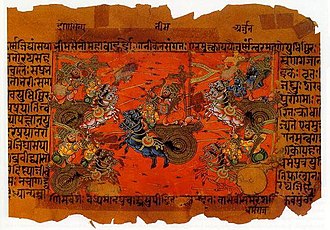
The Mahābhārata
The great epic of India — the war between the Pāṇḍavas and the Kauravas, cousins fighting for a kingdom — and, at about 100,000 couplets, the longest poem ever composed, containing the Bhagavad Gītā and almost the whole of Indian thought on dharma.
The Little Clay Cart
Śūdraka’s Sanskrit comedy of love, crime and revolution — a poor Brahmin merchant, a generous courtesan, a burglar with a theory of house-breaking, a vicious royal brother-in-law and a popular uprising — the most realistic and modern-feeling play of ancient India.
Saṃsāra
“Wandering” — the beginningless cycle of birth, death and rebirth through which beings pass according to their karma, and from which every major Indian religion seeks release.
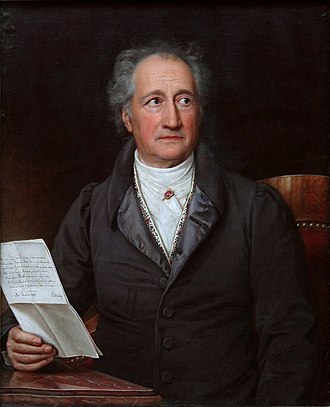
Johann Wolfgang von Goethe
Germany’s greatest writer — poet, novelist, dramatist, scientist and statesman — whose Faust is the modern myth of the striving soul, and whose life was itself treated as a work of art.

The Rāmāyaṇa
Vālmīki’s epic of Rāma, the exiled prince who crosses the sea to rescue his wife Sītā from the demon king Rāvaṇa — India’s ādikāvya, the “first poem”, and the model of dharma for two thousand years.