Key Ideas
A courtesan as heroine — Vasantasenā, generous and free.
Ordinary people — gamblers, thieves, servants — on the classical stage.
Political revolution as the happy ending.
The Mṛcchakaṭika (“The Little Clay Cart”) is a Sanskrit play in ten acts attributed to a king named Śūdraka, composed perhaps between the second and fifth centuries CE. Unlike most Sanskrit drama, which deals with gods and kings, it is set among ordinary people in the city of Ujjayinī: Cārudatta, a Brahmin merchant who has become poor through generosity; Vasantasenā, a wealthy and noble-hearted courtesan who loves him; Śarvilaka, a Brahmin burglar who expounds the science of house-breaking and steals to buy the freedom of the slave girl he loves; gamblers, shampooers, servants; and the villain Saṃsthānaka, the king’s vicious, absurd brother-in-law, who pursues Vasantasenā, strangles her when she rejects him, and frames Cārudatta for her murder. Cārudatta is condemned and led to execution — but Vasantasenā, revived by a Buddhist monk, appears in time; meanwhile a popular revolution overthrows the tyrannical king, led by a cowherd, Āryaka. The play mixes comedy, romance, satire and political drama, and its realism, humour and social range have made it, for modern readers, the most accessible classic of Sanskrit theatre.
Curiosities
did you know?- The title comes from a scene in which the hero’s little son cries because his clay toy cart is not gold like a rich boy’s — and Vasantasenā fills it with her jewels.
- It was adapted as the Hindi film Utsav (1984) and staged in Paris and New York in the 19th–20th centuries.
Questions to Argue About
debate club →- Can a comedy be political?
Explore Next
related by shared connections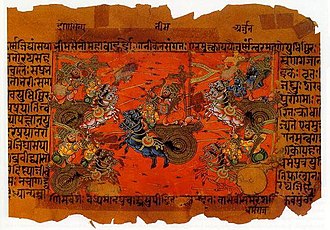
The Mahābhārata
The great epic of India — the war between the Pāṇḍavas and the Kauravas, cousins fighting for a kingdom — and, at about 100,000 couplets, the longest poem ever composed, containing the Bhagavad Gītā and almost the whole of Indian thought on dharma.
Meghadūta (The Cloud Messenger)
Kālidāsa’s lyric poem of 111 verses in which an exiled yakṣa asks a monsoon cloud to carry a message of love to his wife in the Himālaya — describing, as the cloud flies north, all of India alive with longing.
Cilappatikāram (The Tale of an Anklet)
The great Tamil epic (c. 5th century) by the prince-monk Iḷaṅkō Aṭikaḷ — Kaṇṇaki’s husband is executed on a false charge of stealing the queen’s anklet; she proves his innocence, tears off her breast and burns the city of Madurai, and becomes a goddess.
Master and Slave Morality
Nietzsche’s genealogy — “good/bad” was the self-affirmation of nobles; “good/evil” was invented by the resentful weak to revenge themselves on the strong.

The Rāmāyaṇa
Vālmīki’s epic of Rāma, the exiled prince who crosses the sea to rescue his wife Sītā from the demon king Rāvaṇa — India’s ādikāvya, the “first poem”, and the model of dharma for two thousand years.
Vyāsa
The legendary sage who, Hindu tradition holds, divided the Veda into four, composed the Mahābhārata (in which he is also a character and the grandfather of both warring clans), and wrote the Purāṇas — the archetypal author of Indian tradition.