In this introduction
Western philosophy begins, by convention, in 584 BCE, with an eclipse — the one Thales of Miletus is said to have predicted. Thales asked what everything is made of and answered “water”. The answer was wrong; the question — a single natural explanation for everything, without myth — started a conversation that has not stopped.
The four ages
| Age | Dates | Questions | Figures |
|---|---|---|---|
| The Presocratics | c. 600–400 BCE | What is the world made of? Does anything really change? | Thales, Anaximander, Pythagoras, Heraclitus, Parmenides, Zeno, Empedocles, Democritus — see The Pre-Socratics |
| The Classical age | c. 470–322 BCE | What is justice, virtue, knowledge? How should we live? | The Sophists, Socrates, Plato, Aristotle |
| The Hellenistic age | 323–31 BCE | How can I be happy — tranquil — in an uncertain world? | Epicureans (Epicurus), Stoics, Cynics, Sceptics |
| The Roman & late antique age | 31 BCE–529 CE | Practical wisdom, consolation, the One | Lucretius, Cicero, Seneca, Epictetus, Marcus Aurelius, Plotinus, Augustine of Hippo, Boethius |
The first quarrel: being and becoming
The first great debate set Heraclitus — everything flows, strife is the father of all — against Parmenides — only what-is is; change is illusion. Every later Greek thinker had to answer it: the atomists (unchanging atoms moving in the void), Plato (unchanging Forms above a changing world), Aristotle (change as the actualization of potential). See Being vs. Becoming.
The turn to the human
In the fifth century, Athens became the centre of the Greek world, and the Sophists — professional teachers of rhetoric like Protagoras (“man is the measure of all things”) and Gorgias — taught that truth and morality are relative to culture and persuasion. Socrates answered with relentless questioning about what justice, courage and piety are, and was executed for it in 399. His student Plato built the theory of Forms, the tripartite soul and the ideal republic; Plato’s student Aristotle built logic, biology, ethics and politics on observation of this world.
The schools of happiness
After Alexander’s conquests (d. 323), the city-state lost its independence, and philosophy turned to the individual’s peace of mind:
- Epicureans: pleasure as tranquillity; the gods do not care; death is nothing to us.
- Stoics (Stoicism): virtue is the only good; some things are up to us, most are not; live in agreement with nature.
- Cynics: Diogenes in his barrel — live according to nature, scorn convention (“stand out of my sunlight”, he told Alexander).
- Sceptics: Pyrrho and later Sextus Empiricus — suspend judgment on everything, and tranquillity follows “as a shadow follows a body”.
Rome and the end of antiquity
Romans translated Greek philosophy into a way of life for statesmen. Cicero coined much of the Latin philosophical vocabulary (qualitas, moralis). Lucretius put Epicurus into verse. Seneca, Epictetus and Marcus Aurelius made Stoicism a practice. Plotinus (204–270) built Neoplatonism — all things emanating from the One and returning to it — which shaped Christian, Islamic and Jewish mysticism. Hypatia of Alexandria, mathematician and Neoplatonist, was murdered by a Christian mob in 415. Boethius, awaiting execution in 524, wrote The Consolation of Philosophy, the most read book of the Middle Ages after the Bible. In 529, Justinian’s edict is traditionally said to have closed the schools of Athens.
Where to begin
- Plato’s Apology, Crito and Phaedo — the trial and death of Socrates.
- Aristotle, Nicomachean Ethics Book I.
- Epicurus’s Letter to Menoeceus — four pages.
- Marcus Aurelius, Meditations Book 2.
Map of Influence
who answered whom, inside this roomThinkers & Authors
10
Heraclitus
The obscure philosopher of Ephesus for whom everything flows, strife is the father of all things, and a hidden logos governs the endless change.

Parmenides
The stern pre-Socratic of Elea who argued that only what-is can be thought, that nothing comes from nothing, and that change and plurality are illusions.
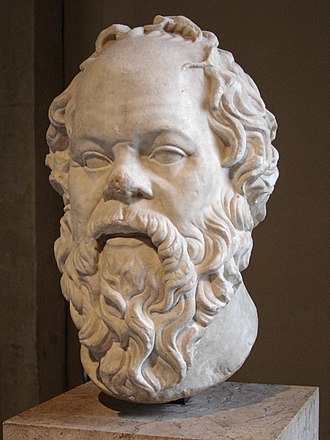
Socrates
The Athenian gadfly who wrote nothing, claimed to know nothing, questioned everyone — and was put to death for it, becoming philosophy’s martyr.

Plato
Socrates’ student and Aristotle’s teacher, author of the dialogues, founder of the Academy, and the philosopher of the Forms — of whom Whitehead said all Western philosophy is a series of footnotes.

Aristotle
Plato’s greatest student and tutor of Alexander the Great, who founded logic, systematized biology, ethics and politics, and brought the Forms down to earth.

Epicurus
The gentle materialist who taught that pleasure — understood as the absence of pain and fear — is the goal of life, and that death is nothing to us.

Lucretius
Roman poet whose single masterpiece, On the Nature of Things, set Epicurean atomism to hexameter verse — and, rediscovered in 1417, helped kindle modernity.

Seneca
Roman Stoic, playwright and statesman — tutor and adviser to Nero — whose letters on time, death, anger and friendship are among the most readable works of ancient philosophy.

Epictetus
The former slave who became the greatest teacher of Stoicism — “We are disturbed not by things, but by our judgments about things.”

Marcus Aurelius
Roman emperor and Stoic philosopher whose private notebook, the Meditations, is the most intimate record of a mind trying to be good while ruling the world.
Works
3The Apology of Socrates
Plato’s account of Socrates’ defence speech at his trial in 399 BCE — a manifesto for the philosophical life.
The Republic
Plato’s great dialogue on justice — in the soul and in the city — containing the philosopher-kings, the Allegory of the Cave, and the banishment of the poets.

Meditations
The private notebook of the Stoic emperor Marcus Aurelius, written on campaign — the most intimate and enduring work of ancient practical philosophy.
Ideas
3Nothing from Nothing
The ancient principle that nothing comes from nothing — the foundation of Greek physics and the target of the Christian doctrine of creation from nothing.
The Forms
Plato’s eternal, perfect, unchanging realities — Beauty itself, Justice itself, the Good — of which the things we see are imperfect copies.
Eudaimonia
Flourishing, living well — Aristotle’s name for the highest human good, activity of the soul in accordance with virtue.
Schools & Movements
4The Pre-Socratics
The first Greek philosophers — from Thales to Democritus — who asked what everything is made of and replaced myth with argument.
Platonism
The tradition descending from Plato — eternal Forms, an immortal soul, and a reality higher than the senses — from the Academy through Neoplatonism to Christian theology.
Epicureanism
The school of the Garden — a materialist philosophy aiming at tranquillity through friendship, simple pleasures and freedom from the fear of gods and death.
Stoicism
The Hellenistic and Roman philosophy of virtue, reason and acceptance — happiness lies in what is up to us, our judgments and choices, not in external things.
Coming to the Library
16 pages being writtenVoices
quotations from this traditionThe unexamined life is not worth living.
ὁ δὲ ἀνεξέταστος βίος οὐ βιωτὸς ἀνθρώπῳ
I am wiser than this man; for neither of us really knows anything fine and good, but this man thinks he knows something when he does not, whereas I, as I do not know anything, do not think I do either.
Now it is time to go away, I to die, and you to live; but which of us goes to the better lot is known to none but God.
Crito, we owe a cock to Asclepius. Pay it and do not neglect it.
They see only their own shadows, or the shadows of one another, which the fire throws on the opposite wall of the cave.
Until philosophers are kings, or the kings and princes of this world have the spirit and power of philosophy… cities will never have rest from their evils.
You cannot step twice into the same river; for other waters are ever flowing on to you.
Character is destiny.
ἦθος ἀνθρώπῳ δαίμων
War is the father of all and king of all.
πόλεμος πάντων μὲν πατήρ ἐστι, πάντων δὲ βασιλεύς
For it is the same thing to think and to be.
τὸ γὰρ αὐτὸ νοεῖν ἐστίν τε καὶ εἶναι
One swallow does not make a spring, nor does one fine day; and so too one day, or a short time, does not make a man blessed and happy.
Man is by nature a political animal… he who is unable to live in society, or who has no need because he is sufficient for himself, must be either a beast or a god.