Key Ideas
The oracle at Delphi and Socratic ignorance.
Socrates as the gadfly God sent to sting Athens awake.
No evil can happen to a good man, in life or death.
Death is either dreamless sleep or a journey to meet the great dead — neither is to be feared.
“Apology” here means apologia, defence — Socrates apologizes for nothing. Condemned by a jury of 501 citizens, he proposes free meals in the Prytaneum as his “penalty”. The speech ends: “Now it is time to go, I to die and you to live; which of us goes to the better lot is known to no one except the god.”
Great Scenes
1Lines to Remember
3 quotationsThe unexamined life is not worth living.
ὁ δὲ ἀνεξέταστος βίος οὐ βιωτὸς ἀνθρώπῳ
Context & when to use it
At his trial, refusing to go into exile and keep quiet — a life without philosophical examination is no life for a human being.
The founding sentence of philosophy. For reflection, self-knowledge, intellectual courage.
I am wiser than this man; for neither of us really knows anything fine and good, but this man thinks he knows something when he does not, whereas I, as I do not know anything, do not think I do either.
Context & when to use it
After questioning a politician reputed to be wise.
The authentic source of “I know that I know nothing” — use against overconfidence and the Dunning–Kruger effect.
⚠ The slogan “I know that I know nothing” is a later compression; Socrates’ actual claim is more modest.
Now it is time to go away, I to die, and you to live; but which of us goes to the better lot is known to none but God.
Context & when to use it
The last words of the Apology.
For facing death with philosophical calm.
Sententiae
phrases in the originalHen oida hoti ouden oida
Origin. A later Greek slogan summarizing Socrates in Plato’s Apology (21d). — Socrates
⚠ Socrates never says this in Plato. His claim is subtler — he does not think he knows what he does not know.
For intellectual humility — and for correcting someone who quotes it as Socrates’ exact words.
Explore Next
related by shared connectionsThe Republic
Plato’s great dialogue on justice — in the soul and in the city — containing the philosopher-kings, the Allegory of the Cave, and the banishment of the poets.
Platonism
The tradition descending from Plato — eternal Forms, an immortal soul, and a reality higher than the senses — from the Academy through Neoplatonism to Christian theology.
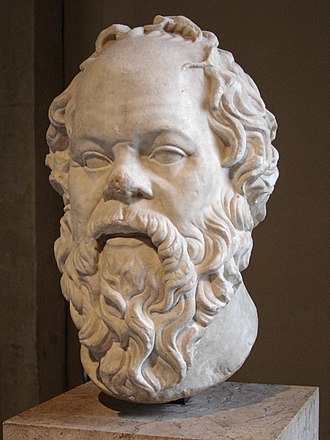
Socrates
The Athenian gadfly who wrote nothing, claimed to know nothing, questioned everyone — and was put to death for it, becoming philosophy’s martyr.
The Forms
Plato’s eternal, perfect, unchanging realities — Beauty itself, Justice itself, the Good — of which the things we see are imperfect copies.
Hemacandra
The Jain polymath of 12th-century Gujarat — grammarian, poet, logician, lexicographer, historian and royal adviser — called “the omniscient of the Kali age”, who persuaded a king to ban animal slaughter.
Jaimini
The sage credited with the Mīmāṃsā Sūtras, the founding text of Vedic hermeneutics — and, in legend, a disciple of Vyāsa who heard the Mahābhārata from his master.