


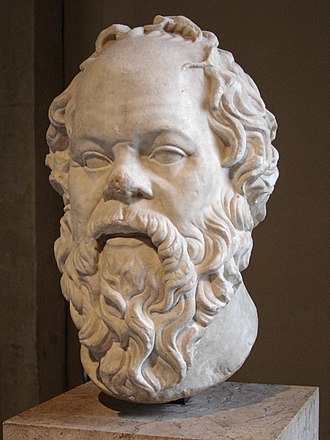


Contents · 20 sections · 36 min
Plato in Six Ideas
the essentialsThe Theory of Forms
Beyond the changing world of the senses lie eternal, perfect Forms — Beauty itself, Justice itself, the Good — of which particular things are imperfect copies.
The Allegory of the Cave
Humanity is chained in a cave watching shadows on a wall, mistaking them for reality. Philosophy is the painful turning-around and ascent into the sunlight of the Good.
Knowledge is recollection
Learning is remembering what the immortal soul knew before birth — shown when an untaught slave boy works out a geometry problem (Meno).
The tripartite soul
Reason, spirit and appetite — a charioteer with two horses. Justice in the soul is each part doing its own work, with reason ruling.
The philosopher-king
Until philosophers rule as kings, or kings become philosophers, there will be no end to the troubles of states.
Eros as ladder
In the Symposium, love rises from one beautiful body to all beautiful bodies, to beautiful souls, laws, knowledge — and finally to Beauty itself.
Alfred North Whitehead’s famous remark — that “the safest general characterization of the European philosophical tradition is that it consists of a series of footnotes to Plato” — is an exaggeration only by a little. Plato asked what knowledge is, what justice is, what love is, what the soul is, whether the gods are good, whether art corrupts, who should rule, and what it is to live well; and for most of those questions he offered not only answers but the very terms in which later philosophers would argue. He invented the philosophical dialogue, founded the first institution of higher learning in Europe, and created, in the figure of Socrates, the West’s enduring image of what a philosopher is.
He was also one of the greatest prose writers in any language. His dialogues are drama — set at drinking parties, in prison cells, on country walks by a river — and their characters are vivid, funny, arrogant, sincere. This essay traces his life, the shape of his work, his central doctrines in their own terms, the objections to them (beginning with Plato’s own), and the long afterlife of Platonism.
Life
An Athenian aristocrat
Plato was born in Athens around 428 or 427 BCE, early in the Peloponnesian War between Athens and Sparta. His family was among the most distinguished in the city. His father, Ariston, claimed descent from Codrus, an early king of Athens; his mother, Perictione, was related to Solon, the great lawgiver. His older brothers, Glaucon and Adeimantus, are the main interlocutors in the Republic. His mother’s cousin Critias and her brother Charmides would become leading members of the Thirty Tyrants.
The name “Plato” (Platōn) may be a nickname — ancient biographers said it came from platys, “broad”, referring to his shoulders (he was said to have wrestled) or the breadth of his style. His given name, according to Diogenes Laertius, was Aristocles, after his grandfather. Much of the ancient biographical tradition is legend, and should be read as such.
Socrates and the turn from politics
A young man of Plato’s class was expected to enter politics. Instead he came under the spell of Socrates, the strange, ugly, irresistible questioner of the Athenian marketplace. In the Seventh Letter — whose authenticity is disputed, but which is our fullest account — Plato describes how he was disillusioned by the brutality of the Thirty Tyrants in 404, then by the restored democracy, which in 399 condemned Socrates to death on charges of impiety and corrupting the young. Plato was present at the trial (he names himself in the Apology) but, he tells us, absent from the execution through illness (Phaedo 59b).
The Seventh Letter draws the conclusion that would shape the Republic: “the human race will not be free of evils until either the race of those who are right and true philosophers comes into political power, or that of the rulers in the cities, by some dispensation of providence, becomes truly philosophic” (326a–b).
Travels and Sicily
After Socrates’ death, Plato left Athens for a time — to Megara, perhaps to Egypt and Cyrene. Around 388/7 he visited southern Italy, where he met the Pythagorean philosopher and statesman Archytas of Tarentum; Pythagoreanism — with its mathematics, its belief in the immortality and transmigration of the soul, and its communal discipline — left deep marks on his thought.
He then went to Syracuse in Sicily, at the court of the tyrant Dionysius I. There he befriended Dion, the tyrant’s brother-in-law, an earnest young man who became his devoted disciple. The visit ended badly: an ancient story (probably embroidered) says Dionysius had Plato sold as a slave at Aegina, from which a friend ransomed him.
Twice more, in 367 and 361, Plato returned to Syracuse, invited by Dion to educate the new ruler, Dionysius II, in the hope of creating a philosopher-king. Both visits failed. Dionysius was flattered by philosophy but not converted; Dion was exiled, later seized power, and was murdered in 354. The Seventh Letter is in part an apology for these disastrous adventures in practical politics.
The Academy
Around 387, Plato founded a school in a grove sacred to the hero Akademos, about a mile outside the walls of Athens. The Academy was not a university in the modern sense — no fees, no degrees, no fixed curriculum — but a community of people doing philosophy and mathematics together. Eudoxus, one of the greatest Greek mathematicians, worked there; Theaetetus developed the theory of irrational numbers and of the regular solids. A later legend says the gateway bore the inscription “Let no one ignorant of geometry enter.”
In 367 a seventeen-year-old from Stagira named Aristotle arrived; he stayed twenty years. The Academy survived in some form until the sixth century CE — Justinian is usually said to have closed the pagan schools of Athens in 529 — making it one of the longest-lived institutions in European history.
Plato died around 348/7, at about eighty, according to one story while writing, according to another at a wedding feast.
The dialogues
Why dialogues?
Plato wrote about thirty-five dialogues (the ancient collection includes some spurious ones) and thirteen letters (most of doubtful authenticity). He never speaks in his own voice. Everything we have is put into the mouths of characters — most often Socrates, but in late works a Stranger from Elea, an Athenian Stranger, or Timaeus of Locri.
Why? Several reasons are offered. The dialogue form imitates the living practice of Socratic questioning, and so invites readers to think for themselves rather than to absorb doctrine. In the Phaedrus (274c–278b), Socrates criticizes writing itself: written words “seem to talk to you as though they were intelligent, but if you ask them anything about what they say… they go on telling you just the same thing forever”; they cannot defend themselves, and they produce the appearance of wisdom without the reality. The Seventh Letter (341c–d) goes further: about the most important matters there is no written treatise by Plato, nor will there be, “for it does not admit of verbal expression like other studies, but, after much converse about the matter itself and a life lived together, suddenly a light, as it were, is kindled in one soul by a flame that leaps to it from another.”
Chronology
Scholars traditionally divide the dialogues into three groups, partly on the basis of style (nineteenth-century “stylometry” counted features like particles and sentence rhythms, which change over Plato’s career), partly on content:
| Period | Dialogues (traditional grouping) | Character |
|---|---|---|
| Early (“Socratic”) | Apology, Crito, Euthyphro, Laches, Charmides, Lysis, Hippias Minor, Ion, Protagoras, Gorgias (late in group) | Socrates asks “what is X?”, refutes definitions, ends in aporia |
| Middle | Meno, Phaedo, Symposium, Republic, Phaedrus, Cratylus | Theory of Forms, recollection, immortality, tripartite soul, ideal city |
| Late | Parmenides, Theaetetus, Sophist, Statesman, Timaeus, Critias, Philebus, Laws | Self-criticism, dialectical method, cosmology, more practical politics |
This scheme is contested — some scholars (“unitarians”) hold that Plato’s views were largely consistent and that differences reflect literary purpose — but it remains a useful map.
The Socratic problem
Because Socrates wrote nothing, we know him through Plato, Xenophon and the comic playwright Aristophanes. How much of “Plato’s Socrates” is historical? The influential view of Gregory Vlastos (Socrates: Ironist and Moral Philosopher, 1991) distinguishes an early Socrates — a moral philosopher who disavows knowledge and seeks definitions — from a middle-period Socrates who is really Plato’s mouthpiece for metaphysical doctrines (the Forms, recollection, the tripartite soul) that the historical Socrates never held. Aristotle supports this division: he says Socrates sought universal definitions but did not “separate” them, whereas Plato did (Metaphysics 1078b).
The early dialogues: Socratic questioning
The “what is X?” question
The early dialogues share a pattern. Someone claims expertise or makes a confident moral assertion. Socrates asks: what is courage (the Laches)? temperance (Charmides)? friendship (Lysis)? piety (Euthyphro)? Not examples — the thing itself, the one feature all courageous acts have in common, “that by which” they are courageous. The interlocutor offers a definition; Socrates draws out its consequences and shows that they conflict with other things the speaker believes. The dialogue ends in aporia — perplexity, “no way through”.
This method — the elenchus — has a moral purpose. Socrates thinks that wrongdoing comes from ignorance, so exposing false confidence is a form of care for the soul.
The Euthyphro dilemma
The most famous argument of the early dialogues comes from the Euthyphro. Euthyphro is prosecuting his own father for the death of a servant, confident that this is pious. Socrates asks him to define piety. Euthyphro proposes that the pious is what the gods love. Socrates asks:
Is the pious loved by the gods because it is pious, or is it pious because it is loved by the gods? (10a)
If the first, then piety is something independent of the gods’ love, and we have not yet said what it is. If the second, then piety is arbitrary — whatever the gods happen to love. Translated into monotheism — is something good because God commands it, or does God command it because it is good? — this dilemma still structures every debate about religion and morality. It is the founding argument for the autonomy of ethics.
Virtue is knowledge
The Protagoras contains Socrates’ most surprising claims: that all the virtues are really one (knowledge), and that no one does wrong willingly. What looks like weakness of will — knowing the better but doing the worse (Greek akrasia) — is really a mistake of measurement, like misjudging the size of near and distant objects. If we had an “art of measurement” for pleasures and pains, we would never go wrong (356c–357b).
This “Socratic intellectualism” is one of the doctrines Plato later revised. In the Republic, the soul has parts that can genuinely conflict, so one can know the good and still be dragged away by appetite.
Gorgias: the challenge of Callicles
The Gorgias raises the stakes. Socrates argues against the rhetorician Gorgias and his pupil Polus that it is worse to do injustice than to suffer it, and that the unjust man who escapes punishment is more miserable than the one who is punished. Then Callicles bursts in with the most powerful anti-moral speech in Plato before the Republic: conventional justice is a device by which the weak many restrain the strong few; by nature, it is just for the better to have more than the worse; the truly happy man lets his desires grow as large as possible and has the power to satisfy them (482c–486d). Friedrich Nietzsche knew Callicles well.
Socrates replies with the image of the leaky jar: the life of insatiable desire is like trying to fill jars full of holes, endlessly pouring and never satisfied. The dialogue ends with a myth of judgment after death — the first of Plato’s great eschatological myths.
The Meno: can virtue be taught?
The Meno is the hinge between the early and middle dialogues. Meno, a handsome young Thessalian, asks Socrates whether virtue can be taught. Socrates, as usual, says he doesn’t even know what virtue is.
Meno’s paradox
Meno, exasperated, poses a famous puzzle (80d–e): how can you search for something when you don’t know what it is? If you don’t know it, how will you recognize it when you find it? And if you know it, why search?
Recollection and the slave boy
Socrates’ answer is the theory of recollection (anamnēsis). The soul is immortal and has been born many times; it has seen all things, here and in the underworld; so “searching and learning are, as a whole, recollection” (81d).
He demonstrates with an experiment. He calls over one of Meno’s slave boys, who has never studied geometry, draws a square in the sand, and asks how to construct a square double in area. The boy first guesses wrongly (double the side). Socrates, asking only questions, leads him to see his mistake — he is now in aporia, but better off, because he knows he does not know — and then to the correct answer: the square on the diagonal. Since Socrates “taught” him nothing, the knowledge must have been in him all along (82b–85b).
True opinion and knowledge
The dialogue ends with a distinction that would become foundational for epistemology. True opinion is as good a guide to action as knowledge — someone who has a correct opinion about the road to Larissa will get there as well as someone who knows. But true opinions are like the statues of Daedalus, which run away unless tied down. They become knowledge when they are “tied down by an account of the reason why” (aitias logismōi, 98a). This is the ancestor of the “justified true belief” analysis of knowledge — and of the whole field of epistemology.
The Theory of Forms
What the Forms are
The middle dialogues introduce the doctrine for which Plato is most famous. Besides the many beautiful things we can see — faces, bodies, vases, sunsets — there exists the Beautiful itself (auto to kalon). Besides the many equal sticks and stones, there is the Equal itself. Besides just acts and just cities, there is Justice itself. These are the Forms (eidē or ideai — hence “Ideas”, though they are not mental). See The Forms.
The Forms have a cluster of features:
- Eternal and unchanging. Beauty itself “always is and neither comes to be nor passes away, neither waxes nor wanes” (Symposium 211a).
- Pure and unqualified. Beautiful things are beautiful in one respect and ugly in another, beautiful to one person and not to another. The Beautiful itself is beautiful without qualification.
- Intelligible, not sensible. They are grasped by thought, not seen with the eyes.
- Separate. They exist apart from the things that “participate” in them (this is the claim Aristotle attacks).
- Causes and standards. Things are beautiful because they participate in Beauty (Phaedo 100d); the Forms are the models of which sensible things are imperfect copies.
Why believe in them?
Plato offers several lines of thought:
- The argument from knowledge. Knowledge must be of what is stable and true; the sensible world is changing and full of contradictions (the same stick looks equal from one angle, unequal from another). So if knowledge is possible at all, there must be stable objects of knowledge (Republic V, 476–480).
- The argument from recollection. We judge that two sticks are “not quite” equal; to judge this, we must already have the idea of perfect equality, which we never saw in experience. So we must have known it before birth (Phaedo 74a–75d).
- The “one over many” argument. Whenever many things share a predicate, there is a single Form corresponding to the predicate (Republic X, 596a).
- The Heraclitean premise. Plato was influenced, Aristotle tells us, by the Heraclitean Cratylus, who held that the sensible world is in constant flux, so that knowledge of it is impossible; Plato concluded that knowledge must be of something else (Metaphysics 987a). The Forms are thus a synthesis of Parmenides (unchanging being) and Heraclitus (the flux of the sensible).
The Form of the Good
The highest Form is the Good. In the Republic, Socrates refuses to say directly what it is, offering instead three linked images.
The Sun (507b–509c). As the sun gives visible things both their visibility and their coming-to-be and growth, so the Good gives the Forms both their intelligibility and their being — and is itself “beyond being” (epekeina tēs ousias, 509b) in dignity and power. That phrase would echo for two thousand years in Neoplatonist and mystical theology.
The Divided Line (509d–511e). A line divided into four segments represents four levels of cognition, each with its object:
| State of mind | Object |
|---|---|
| Understanding (noēsis) | The Forms, grasped dialectically up to the first principle |
| Thought (dianoia) | Mathematical objects, reasoned about from hypotheses |
| Belief (pistis) | Physical things — animals, plants, artifacts |
| Imagination (eikasia) | Images — shadows, reflections |
The Cave (514a–520a), the most famous image in philosophy — see The Allegory of the Cave. Prisoners chained since birth see only shadows thrown by a fire on the wall before them; one is released, turned around, dragged up into the sunlight, and finally sees the sun itself. Returning to the cave, he is ridiculed — “and if they could lay hands on the man who was trying to set them free and lead them up, would they not kill him?” (517a). Education, Socrates concludes, is not putting sight into blind eyes but turning the whole soul around toward the light (518c–d).
The soul and its immortality
The Phaedo
The Phaedo is set in Socrates’ prison cell on the day of his execution. Its subject is death, and its claim is that philosophy is “practice for dying and being dead” (64a): since the philosopher spends his life separating the soul from the distractions of the body to contemplate the Forms, death — the soul’s final release — is nothing to fear.
Socrates offers four arguments for the immortality of the soul:
- The cyclical argument. Opposites come from opposites — the larger from the smaller, waking from sleeping. So the living come from the dead and the dead from the living.
- The recollection argument. Learning is recollection of Forms known before birth, so the soul existed before birth.
- The affinity argument. The soul resembles the Forms (invisible, ruling, divine) more than the body does, so it is likely to be indestructible like them.
- The final argument. The soul brings life to whatever it occupies; just as fire cannot admit cold, the soul cannot admit death — it withdraws, unharmed, at the approach of its opposite.
Simmias and Cebes raise powerful objections. Perhaps the soul is like the attunement of a lyre — produced by the arrangement of the body, destroyed when the lyre breaks. Perhaps it is like a weaver who wears out many cloaks but eventually perishes himself. Socrates’ replies are ingenious; few modern readers find them conclusive. The dialogue’s real power is in the portrait of a man facing death with calm, wit and curiosity — see The Death of Socrates.
The tripartite soul
In Republic IV (435b–441c), Plato argues that the soul has three parts, because the same thing cannot do or suffer opposites in the same respect at the same time — and yet we find ourselves both wanting to drink and refusing to drink. There must be:
- Reason (logistikon), which calculates what is best for the whole soul;
- Spirit (thumoeides), the seat of anger, pride, honour and indignation;
- Appetite (epithumētikon), the many-headed beast of desires for food, drink, sex and money.
He illustrates spirit with the story of Leontius, who saw corpses lying by the executioner and both desired to look and was disgusted with himself; finally, overcome, he ran up, forced his eyes open, and cried: “Look, you wretches, take your fill of the beautiful sight!” (439e–440a). Spirit sided with reason against appetite — and lost.
In the Phaedrus (246a–254e), the same structure becomes the image of the charioteer: reason drives a chariot drawn by two winged horses, one noble (spirit), one unruly (appetite). Compare the chariot image of the Kaṭha Upaniṣad, where the Self is the rider, the intellect the charioteer, the mind the reins and the senses the horses — one of the most striking parallels between Greek and Indian thought.
Justice in the soul, finally, is each part doing its own work: reason ruling, spirit as its ally, appetite obeying. Injustice is civil war within.
Love: the Symposium
The Symposium (written perhaps around 385–370) is set at a drinking party celebrating the tragedian Agathon’s victory in 416. The guests agree to make speeches in praise of Eros, the god of love. It is Plato’s most purely literary work.
- Phaedrus: Love makes lovers brave; an army of lovers would be invincible.
- Pausanias: there are two Loves — common (bodily, indiscriminate) and heavenly (directed at the soul, and so at males, in his telling).
- Eryximachus, a doctor: love is a cosmic principle of harmony between opposites.
- Aristophanes, the comic poet, tells the most memorable myth in Plato. Humans were once double creatures — round, with four arms, four legs, two faces — of three sexes: male-male, female-female, and male-female. Their arrogance led Zeus to slice them in two. Ever since, each half yearns for its other half. “Love is the name for our pursuit of wholeness, for our desire to be complete” (192e–193a).
- Agathon: a beautiful, empty speech praising Love as young, delicate and beautiful.
- Socrates recounts what he learned from Diotima, a priestess of Mantinea. Love is not a god but a daimōn, an intermediary between mortal and divine — the child of Poverty and Resource, always needy, always scheming. Love is desire for the good to be one’s own forever — and so desire for immortality, which mortals pursue by “giving birth in beauty”, in body (children) or in soul (poems, laws, virtues).
Then comes the ladder of love (210a–212a). The lover begins by loving one beautiful body; then sees that the beauty of all bodies is one; then comes to value beauty of soul above beauty of body; then the beauty of practices and laws; then of knowledge; until “turning to the great sea of beauty”, he catches sight suddenly of Beauty itself — “pure, clear, unmixed, not infected with human flesh and colours and much other mortal nonsense” (211e).
Finally, Alcibiades stumbles in drunk, crowned with ivy and violets, and gives a speech not about love but about Socrates — whom he loved and who would not be seduced, a man like the statues of Silenus that look grotesque outside but open to reveal images of gods within. The dialogue ends at dawn with Socrates arguing that the same man could write both comedy and tragedy, and then going about his day.
“Platonic love” in the modern sense — non-sexual affection — is a Renaissance coinage (Marsilio Ficino’s amor platonicus); Plato’s own Eros is passionate, erotic and finally philosophical.
The Republic
The Republic (Greek Politeia, “constitution” or “way of life of a city”) is Plato’s longest and most ambitious work, ten books long. Its ostensible question is: what is justice, and is the just life happier than the unjust? See The Republic.
The challenge (Books I–II)
Book I is a miniature early dialogue in which Socrates refutes three definitions of justice, ending with Thrasymachus, who erupts “like a wild beast” to claim that “justice is nothing other than the advantage of the stronger” (338c) — rulers make laws in their own interest and call obedience “justice”.
In Book II, Glaucon and Adeimantus sharpen the challenge. Glaucon tells the story of the Ring of Gyges: a shepherd finds a ring that makes him invisible, uses it to seduce the queen, kill the king and seize the throne. Anyone with such a ring, Glaucon argues, would behave the same: no one is just willingly, only from fear of being caught (359c–360d). Then he asks Socrates to compare the perfectly unjust man with a reputation for justice and the perfectly just man with a reputation for injustice, tortured and crucified — and to show that the second is happier. This is one of the most demanding tests ever set for moral philosophy.
The city and the soul
Socrates’ strategy is to look for justice “writ large” in a city, then find it in the individual soul. He builds a city in speech: first a simple city of farmers and craftsmen (“a city of pigs”, Glaucon scoffs), then a “luxurious” city that needs an army, then a purified city with three classes corresponding to the three parts of the soul:
| Class | Virtue | Part of soul |
|---|---|---|
| Rulers (philosopher-guardians) | Wisdom | Reason |
| Auxiliaries (soldiers) | Courage | Spirit |
| Producers (farmers, craftsmen, merchants) | (Temperance — shared by all) | Appetite |
Justice is “each doing its own” — each class performing its proper function and not meddling in the others’.
The noble lie, the guardians, the three waves
To secure stability, the citizens will be told a “noble lie” (gennaion pseudos, 414b–415d): that they were all born from the earth, and that the god mixed gold into the rulers, silver into the auxiliaries, iron and bronze into the farmers and craftsmen — though children may be born of a different metal from their parents and must be moved accordingly.
The guardians will live without private property or private families. In Book V Socrates faces “three waves” of objection:
- Women as guardians. Women differ from men only in bearing children and in average strength; the natures fit for guarding are distributed among both sexes, so women should receive the same education and serve as guardians — a radical proposal for fourth-century Athens.
- Community of wives and children. Among the guardians, mating will be arranged by rigged lotteries; children raised in common, so that every guardian regards all as family.
- Philosopher-kings. The biggest wave: “Until philosophers rule as kings in cities, or those who are now called kings and leading men genuinely and adequately philosophize… cities will have no rest from evils” (473c–d).
The education of philosophers
Books VI–VII describe the philosopher’s nature (love of truth, courage, memory, gentleness), the Sun, Line and Cave, and a long curriculum: arithmetic, plane and solid geometry, astronomy, harmonics — all studied not for practical use but to turn the soul from becoming to being — then dialectic, the study that reaches the first principle. After fifteen years of practical service, at fifty, the best will see the Good and take their turn ruling, reluctantly, as a duty.
Degenerate constitutions (Books VIII–IX)
Plato then describes how the ideal city decays, step by step, through four worse constitutions, each paired with a type of personality:
- Timocracy — rule by the honour-loving (like Sparta).
- Oligarchy — rule by the wealthy.
- Democracy — rule by the many, “a pleasant constitution, anarchic and many-coloured, distributing a sort of equality to equals and unequals alike” (558c). The democratic man lives each desire as it comes — drinking one day, dieting the next, now doing philosophy, now politics.
- Tyranny — which arises from democracy’s excess of freedom, when a popular champion becomes a wolf. The tyrannical man, ruled by a single mad Eros, is the most enslaved and miserable of all.
Socrates then gives three arguments that the just life is happier — including the remarkable calculation that the king lives 729 times more pleasantly than the tyrant (587e).
The quarrel with the poets (Book X)
Book X returns to the poets. Art is mimesis — imitation. A painter’s bed imitates the carpenter’s bed, which imitates the Form of Bed; so the painting is “third from the truth”. Poets like Homer imitate appearances of virtue without knowing it, and they nourish the emotions that reason should govern — making us weep at the hero’s grief, when we would be ashamed to weep so ourselves. So, except for hymns to the gods and praises of good men, poetry must be banished from the city — though Socrates admits “an ancient quarrel between philosophy and poetry” and invites poetry’s defenders to show it is beneficial (607b–d).
The irony that a great poet should write this has never been lost on readers. Aristotle’s Poetics is often read as the reply: tragedy produces catharsis, not corruption.
The myth of Er
The Republic ends with a myth. Er, a soldier killed in battle, revives on his funeral pyre and reports what he saw in the afterlife: souls judged, rewarded and punished, and then choosing their next lives by lot — Orpheus choosing to be a swan, Ajax a lion, Odysseus, cured of ambition, searching long for the quiet life of a private man. “The responsibility lies with the chooser; the god is blameless” (617e). Philosophy matters because it teaches us to choose well.
The Phaedrus: love, madness and writing
Socrates and the beautiful young Phaedrus walk outside the walls of Athens on a hot day and lie down under a plane tree by the river Ilissus — the only dialogue set in the countryside. After two speeches arguing that a boy should favour a non-lover over a lover, Socrates is struck by remorse and delivers a “palinode” in praise of divine madness (mania): prophecy, religious rites, poetry, and love. The soul, he says, is like a charioteer with two winged horses; before birth it followed the gods around the rim of heaven and glimpsed the Forms; the sight of beauty on earth makes the soul’s wings begin to grow again — painful, maddening, exhilarating. The dialogue ends with the critique of writing described above, and a beautiful prayer to Pan: “grant that I may become beautiful within.”
The late dialogues: Plato against Plato
The Parmenides
In the Parmenides, a young Socrates presents the Theory of Forms to the aged Parmenides and is demolished. The most famous objection, later called the Third Man Argument (by Aristotle), runs:
If large things are large by participating in the Large, then the Large and the large things together, being all large, must participate in a further Form of Largeness, and so on to infinity. (132a–b)
Other objections: are there Forms of mud, hair and dirt? How can a single Form be wholly present in many things — like a day, or like a sail spread over many people? If the Forms are entirely separate from us, we can never know them, and God, who knows them, could never know us. Parmenides concludes that these difficulties are real — but that without Forms, “one will have nowhere to turn one’s thought” (135b–c).
Did Plato abandon the Forms? Most scholars think he refined the theory rather than renouncing it. The Parmenides shows a philosopher of extraordinary intellectual honesty — willing to publish the best objections to his own central view.
The Theaetetus
The Theaetetus asks: what is knowledge? It ends in aporia, but its arguments set the agenda for epistemology. Socrates presents himself as a midwife: barren of wisdom himself, he helps others give birth to ideas and tests whether they are genuine or “wind-eggs” (150b–151d).
Three definitions are examined:
- Knowledge is perception. Linked to Protagoras’s “man is the measure of all things” and to a Heraclitean flux theory. Socrates’ most famous objection is the “self-refutation” argument: if every belief is true for whoever holds it, then the belief that Protagoras is wrong is true for those who hold it.
- Knowledge is true belief. Refuted by the jury example: a skilled orator can persuade a jury to a true verdict without their knowing the facts.
- Knowledge is true belief with an account (logos). Socrates considers several meanings of “account” and finds each inadequate.
The third definition is the ancestor of “justified true belief”, which Edmund Gettier’s three-page paper of 1963 showed to be insufficient — a problem still unresolved.
The Sophist and the problem of not-being
The Sophist is led by a Stranger from Elea, a follower of Parmenides. To define the sophist as a maker of false appearances, he must explain how it is possible to say what is not — which Parmenides had declared unthinkable. So the Stranger commits “parricide” against “father Parmenides” (241d): not-being, he argues, exists in a sense, as difference. To say “Theaetetus flies” is not to say something about nothing, but to say something different from what is about Theaetetus. The dialogue’s analysis of “the greatest kinds” — being, sameness, difference, motion, rest — and of the sentence as a combination of name and verb is a foundation of logic and philosophy of language.
The Timaeus
The Timaeus was for centuries Plato’s most read work — the only one widely available in Latin during the early Middle Ages. Timaeus of Locri gives a “likely story” of the creation of the cosmos. A divine craftsman, the Demiurge, being good and without envy, wishes everything to be as good as possible; looking to the eternal Forms as his model, he shapes the chaotic “receptacle” — a kind of space or medium, “the nurse of becoming” — into an ordered, living cosmos with a world-soul. The four elements are built from geometrical triangles assembled into regular solids (fire = tetrahedron, earth = cube, air = octahedron, water = icosahedron). Time is “a moving image of eternity” (37d).
The companion dialogue Critias begins the story of Atlantis, the island empire that attacked Athens nine thousand years earlier and sank into the sea in a single day and night — a fable which has launched a thousand pseudo-historical books.
The Laws
Plato’s last and longest work is a conversation among an Athenian, a Cretan and a Spartan walking to the cave of Zeus on Crete. They design the laws of a new colony, Magnesia. It is a “second-best” city: private property and families are permitted, laws have explanatory preambles to persuade citizens rather than merely command, and a mixed constitution balances monarchy and democracy. But it is also severe — a “Nocturnal Council” oversees the laws, and atheists are to be re-educated and, if incorrigible, executed (Book X). Book X also contains the first systematic argument in Greek for the existence of gods, from the priority of soul as self-moving motion.
The unwritten doctrines
Aristotle and later sources report that Plato gave a lecture “On the Good” which baffled its audience by discussing mathematics, and that he held “unwritten doctrines” (agrapha dogmata) deriving the Forms from two principles — the One and the Indefinite Dyad (Great-and-Small). The “Tübingen school” (Hans Krämer, Konrad Gaiser) built a whole esoteric Plato on these reports. Most scholars remain cautious.
More dialogues worth knowing
Crito: the Laws speak
Two days before the execution, Socrates’ wealthy friend Crito comes to the prison at dawn with a plan for escape: the guards are bribed, friends in Thessaly will receive him, and people will think his friends were cowards if they let him die. Socrates answers with a principle — one must never do wrong, even in return for wrong — and then with an extraordinary piece of rhetoric. He imagines the Laws of Athens appearing before him and asking: Do you mean to destroy us? We brought you into being, nurtured and educated you; you lived seventy years under us, free to leave at any time; you made an implicit agreement to obey us. If you thought us unjust, you should have persuaded us or left — not run away now, like a slave, in disguise (50a–54d).
The Crito is the first argument in Western philosophy for political obligation based on something like consent and gratitude — the ancestor of social contract theory — and it sits uneasily beside the Apology, where Socrates says he would disobey the city if it ordered him to stop philosophizing. Reconciling the two has kept scholars busy for a century; the most common answer is that Socrates distinguishes disobeying an unjust order (permitted, even required) from evading a legal punishment (not permitted).
Ion: poetry as divine possession
The short Ion shows Socrates questioning a professional reciter of Homer, who has just won a prize and is preening in his costume. Ion can speak beautifully about Homer, but about no other poet. Why? Socrates’ answer is that Ion has no art (technē), no knowledge: he is inspired, like the poets themselves, by a divine power that passes through them as magnetism passes through a chain of iron rings — from the Muse to the poet, from the poet to the rhapsode, from the rhapsode to the audience. “For the poet is a light and winged and holy thing, and there is no invention in him until he has been inspired and is out of his senses” (534b). It is half a compliment, half an insult — and the beginning of the quarrel the Republic will complete.
Cratylus: are names natural?
The Cratylus asks whether names belong to things by nature or by convention. Cratylus holds that each thing has a naturally correct name; Hermogenes, that names are arbitrary agreements. Socrates explores a long and often playful series of etymologies — some brilliant, some deliberately absurd — before concluding that we should learn about things from the things themselves, not from names. It is the founding text of the philosophy of language, and its debate about natural versus conventional signs returns in Saussure’s linguistics and in modern semantics.
Statesman: the royal weaver
In the Statesman, the Eleatic Stranger seeks to define the true statesman by the method of “division” — dividing a genus into species step by step. He tells a myth of cosmic cycles: in the age of Cronus, the god steered the cosmos and men lived without politics; in our age, the god has let go of the tiller, and humans must govern themselves. The true statesman, if he existed, would rule by knowledge, above written law, as a doctor treats patients without a rulebook. Since such a ruler is rare, law is the “second-best” — a rigid copy of wisdom. The statesman’s art is likened to weaving: binding together the courageous and the moderate temperaments, the warp and the woof, into a single fabric of citizens.
Philebus: pleasure and the good
The late Philebus returns to the question of the Protagoras: is the good life the life of pleasure, or of wisdom? Neither alone, Socrates argues. A life of pleasure without any intelligence would be the life of a mollusc or jellyfish — unable even to remember or anticipate its pleasures. A life of pure intelligence without any pleasure would be fit only for a god. The best life is a mixture, and its goodness is due to measure, proportion and truth. Along the way the dialogue offers a sophisticated classification of pleasures — true and false, pure and mixed — and a metaphysics of limit and the unlimited that echoes Pythagorean thought.
Menexenus and the funeral oration
The strange Menexenus contains a funeral speech for the Athenian war dead which Socrates says he learned from Aspasia, Pericles’ companion. It parodies the patriotic genre made famous by Pericles’ oration in Thucydides — and was, ironically, recited annually in Athens in later centuries as if it were sincere.
The myths of Plato
Plato, the great critic of poets, is also one of the greatest myth-makers. When argument reaches its limit — on the fate of the soul, the origin of the world, the nature of love — he tells a story, often introduced with a disclaimer that it is only “likely” or that a sensible man would not insist on its details.
| Myth | Dialogue | Point |
|---|---|---|
| The Ring of Gyges | Republic II | Would anyone be just if they could never be caught? |
| The metals (noble lie) | Republic III | A founding myth for a hierarchical city |
| The Cave | Republic VII | Education as the turning of the soul toward reality |
| Er | Republic X | Souls choose their lives — “the god is blameless” |
| The charioteer | Phaedrus | The divided soul and its longing for the Forms |
| Theuth and Thamus | Phaedrus | Writing as a drug for reminding, not for memory |
| The cicadas | Phaedrus | Men so enchanted by the Muses that they forgot to eat, and became cicadas |
| Aristophanes’ split humans | Symposium | Love as longing for one’s other half |
| Poros and Penia | Symposium | Love as the child of Resource and Poverty |
| The judgment of the dead | Gorgias, Phaedo | Souls judged naked, by naked judges |
| The Demiurge | Timaeus | The cosmos as the work of a good craftsman |
| Atlantis | Timaeus, Critias | A proud empire swallowed by the sea |
| The age of Cronus | Statesman | Politics begins when the god lets go |
Interpreters disagree about how seriously to take the myths. For some, they are pedagogical concessions — images for those who cannot follow the argument. For others (including many Neoplatonists), they are the summit of Plato’s thought, pointing where argument cannot go. The best answer may be that Plato wanted both: arguments to discipline the mind, myths to move the soul.
Plato the writer
It is easy to forget, reading Plato for his doctrines, how great an artist he is. A few features of his craft:
Setting. The Republic opens at the Piraeus, the port, during a festival with a torch-race on horseback — the first word is katebēn, “I went down”, like a descent into the underworld or the Cave. The Phaedrus takes place by a stream on a summer day, with cicadas singing overhead. The Phaedo ends at sunset in a prison.
Character. Thrasymachus blushes; Alcibiades barges in drunk; Aristophanes has the hiccups and must wait his turn; Euthyphro hurries off at the end, too busy to learn what piety is; Crito weeps.
Irony. Socrates professes ignorance while dismantling experts; praises his interlocutors in terms that mock them; tells myths while condemning myth-tellers. Kierkegaard wrote his dissertation on Socratic irony and concluded it was the beginning of subjectivity.
Frames. Many dialogues are narrated at second or third hand — the Symposium is reported by Apollodorus, who heard it from Aristodemus, years after the event — distancing us from the events and reminding us that philosophy is a tradition of conversation passed down.
Form as argument. The early dialogues end in aporia because the reader is meant to keep going. The Parmenides attacks its own central theory. Plato never tells us what he thinks — he makes us think.
Mathematics and the cosmos
Plato’s admiration for mathematics shaped everything. The Meno’s slave-boy proof, the Republic’s curriculum of mathematical studies, the Timaeus’s geometrical elements, and the Academy’s association with Eudoxus and Theaetetus all express a conviction that mathematical truth is the clearest model of knowledge: eternal, necessary, discovered by the mind and not by the senses.
His cosmology bequeathed a research programme. Plato (according to a later report) set astronomers the problem of “saving the phenomena” — explaining the apparently irregular motions of the planets by combinations of uniform circular motions. Eudoxus answered with nested spheres; Ptolemy, five centuries later, with epicycles; and Kepler, who in the Mysterium Cosmographicum (1596) tried to fit the planetary orbits between the five “Platonic solids”, finally broke the spell by discovering elliptical orbits. Galileo’s statement that the book of nature is written in the language of mathematics is Platonic in spirit, and Werner Heisenberg wrote that the elementary particles of modern physics resemble the regular solids of the Timaeus more than the atoms of Democritus.
Objections and controversies
Aristotle’s critique
Aristotle, Plato’s student for twenty years, became his most searching critic (Metaphysics I.9, XIII–XIV). The Forms, he argued, are “empty words and poetical metaphors”; “separating” universals from particulars doubles the things to be explained without explaining them; the Forms cannot explain change or motion; the Third Man regress is fatal. Aristotle kept form but put it in things: there is no Horse apart from horses.
Popper’s indictment
In The Open Society and Its Enemies (1945), written in New Zealand during the Second World War, Karl Popper accused Plato of being the founder of totalitarianism: the Republic proposes censorship, propaganda (the noble lie), eugenics, the abolition of the family for the ruling class, and the subordination of the individual to the state, all justified by a claim to expert knowledge of the Good. Defenders (Ronald Levinson’s In Defense of Plato, 1953) replied that Popper read the Republic anachronistically, ignoring its ironies and its primary concern with the order of the soul. The debate is still alive; most readers now acknowledge both the Republic’s authoritarian proposals and its profound psychology.
Plato and women
The Republic’s proposal that women be educated and serve as guardians was centuries ahead of its time; yet elsewhere Plato repeats conventional disparagements, and the Timaeus suggests that cowardly men are reborn as women. Feminist philosophers (Julia Annas, Susan Moller Okin, Gregory Vlastos) have debated whether Plato was a feminist, an anti-feminist, or simply uninterested in women’s welfare as such.
Art and censorship
Book X’s banishment of the poets has been answered by Aristotle, Philip Sidney (The Defence of Poesy), Shelley (A Defence of Poetry: “poets are the unacknowledged legislators of the world”), and Iris Murdoch, whose The Fire and the Sun: Why Plato Banished the Artists (1977) is the most sympathetic modern treatment.
Platonism after Plato
The Academy and its turns
After Plato’s death, his nephew Speusippus led the Academy. In the third century BCE, under Arcesilaus, the Academy turned sceptical, taking Socrates’ disavowal of knowledge as its model; Cicero was a member of this “New Academy”. In the first century BCE, it returned to doctrine.
Neoplatonism
In the third century CE, Plotinus (c. 204–270) built a vast metaphysical system on Plato: from the One, beyond being (the Republic’s Good), emanate Intellect (the realm of Forms) and Soul, and finally matter; the soul’s task is to return through contemplation to union with the One. Porphyry, Iamblichus and Proclus extended it. Neoplatonism shaped Augustine of Hippo — who said the Platonists came nearest to Christianity — and through him, Western theology; through Pseudo-Dionysius, Christian mysticism; and through al-Fārābī and Avicenna, Islamic philosophy.
Renaissance and after
In fifteenth-century Florence, Cosimo de’ Medici commissioned Marsilio Ficino to translate the complete Plato into Latin (published 1484), founding a new “Platonic Academy”. Raphael’s School of Athens (1509–11) shows Plato, holding the Timaeus, pointing upward to the heavens beside Aristotle, holding the Ethics, gesturing level to the earth.
The Cambridge Platonists, Shelley, Coleridge and the Romantics, and nineteenth-century Oxford (Benjamin Jowett’s translations, still used on Project Gutenberg) all drew on him.
Mathematical Platonism
The view that mathematical objects — numbers, sets — exist independently of minds and are discovered rather than invented is still called “Platonism”. Kurt Gödel was a self-declared Platonist; many working mathematicians are, at least on weekdays.
Nietzsche and Heidegger
Friedrich Nietzsche made the overturning of Platonism his task. In Twilight of the Idols, “How the ‘True World’ Finally Became a Fable” tells the history of Western philosophy as the gradual collapse of Plato’s distinction between a true world (of Forms) and an apparent world — ending with the realization that with the true world, “we have also abolished the apparent one”. Christianity, he said, is “Platonism for the people”. Martin Heidegger traced the “forgetting of Being” to Plato’s interpretation of being as idea — what is seen, present, available.
Plato and India
Readers have long noted parallels with Indian thought: the Cave and the Vedāntic doctrine of Māyā (a world of appearances concealing true reality); recollection and the Indian doctrines of rebirth; the chariot of the Phaedrus and that of the Kaṭha Upaniṣad; the transmigration of souls (Pythagorean in Plato’s case). Whether any of this reflects historical contact — the Persian empire touched both worlds — or convergent reflection on similar questions is unknown.
How to read Plato
- Begin with drama. The Apology, Crito and Phaedo together tell the story of Socrates’ trial and death; read them in a single sitting.
- Then the Symposium — the most beautiful.
- Then the Republic, preferably with a companion (Julia Annas’s Introduction).
- Read for argument and for irony. Ask who is speaking, to whom, and why; what is left unsaid; whether the arguments are sound — Plato expects you to.
Key terms
- Elenchus
- Socratic refutation — testing a definition by drawing out its inconsistent consequences.
- Aporia
- Perplexity, impasse; the state in which the early dialogues end.
- Anamnēsis
- Recollection — the doctrine that learning is remembering what the soul knew before birth.
- Eidos / Idea
- Form — the eternal, unchanging, intelligible reality in which sensible things participate.
- Methexis
- Participation — the relation between a particular and its Form.
Using Plato in conversation
- For propaganda, media and illusions: the Cave — “we’re watching shadows on the wall.”
- For religion and ethics: the Euthyphro dilemma — is it good because God commands it, or does God command it because it is good?
- For power without accountability: the Ring of Gyges — what would you do if you could never be caught?
- For “might makes right”: Thrasymachus — and Socrates’ reply that the tyrant is the most enslaved of all.
Plato in two minutes
Socrates’ student and Aristotle’s teacher, author of the dialogues, founder of the Academy, and the philosopher of the Forms — of whom Whitehead said all Western philosophy is a series of footnotes.
- The Theory of Forms. Beyond the changing world of the senses lie eternal, perfect Forms — Beauty itself, Justice itself, the Good — of which particular things are imperfect copies.
- The Allegory of the Cave. Humanity is chained in a cave watching shadows on a wall, mistaking them for reality. Philosophy is the painful turning-around and ascent into the sunlight of the Good.
- Knowledge is recollection. Learning is remembering what the immortal soul knew before birth — shown when an untaught slave boy works out a geometry problem (Meno).
- The tripartite soul. Reason, spirit and appetite — a charioteer with two horses. Justice in the soul is each part doing its own work, with reason ruling.
- The philosopher-king. Until philosophers rule as kings, or kings become philosophers, there will be no end to the troubles of states.
- Eros as ladder. In the Symposium, love rises from one beautiful body to all beautiful bodies, to beautiful souls, laws, knowledge — and finally to Beauty itself.
“The unexamined life is not worth living.” — Apology 38a
Answering: Homer, Heraclitus, Parmenides, Socrates · Answered by: Aristotle, Augustine of Hippo, Avicenna (Ibn Sīnā), Niccolò Machiavelli, Friedrich Nietzsche
Curiosities
did you know?- ‘Plato’ may be a nickname meaning ‘broad’ — for his shoulders or his forehead.
- His Academy lasted, in some form, for about nine hundred years.
- Legend says he was once sold into slavery after visiting Sicily and ransomed by a friend.
- He banned poets from his ideal city — while being one of the greatest prose artists in history.
Questions to Argue About
debate club →- Should the wise rule, even without the consent of the governed?
- Would you be just if you had the Ring of Gyges?
- Is art a corruption of the truth or a path to it?
- Are mathematical truths discovered or invented?
Arguments
argument library →The Euthyphro Dilemma
Is the pious loved by the gods because it is pious, or is it pious because the gods love it? Translated into monotheism — is something good because God commands it, or does God command it because it is good?
- Either the good is good because God commands it, or God commands it because it is good.
- If the good is good because God commands it, then goodness is arbitrary — had God commanded cruelty, cruelty would be good.
- If God commands it because it is good, then goodness is a standard independent of God’s will.
- Morality cannot be arbitrary.
∴ Goodness is independent of divine command — so ethics can (and must) be investigated in its own right.
2 objections
- Divine command theorists (e.g. Robert Adams): A false dilemma. Goodness is grounded in God’s nature, which is essentially good; God’s commands flow from that nature, so they are neither arbitrary nor answerable to an external standard.
- Critics of that reply: Then we must ask whether God’s nature is good because it is God’s, or because it meets the standard of goodness — and the dilemma returns one level up.
Still the founding argument for the autonomy of ethics; nearly every debate on religion and morality starts here.
The Ring of Gyges
Glaucon’s challenge — if you could act unseen and unpunished, would you still be just? If not, justice is valued only for its consequences.
- A shepherd finds a ring that makes him invisible; he seduces the queen, kills the king, and seizes the throne.
- Give one such ring to a just man and one to an unjust man, and they would behave the same.
- So people are just only because they fear being caught.
- What is valued only for its consequences is not valued for itself.
∴ Justice is not a good in itself but a compromise among the weak — unless Socrates can show that the just life is better even when no one sees.
2 objections
- Socrates (the rest of the Republic): Injustice is a sickness of the soul — civil war among its parts. The tyrant who has everything he wants is the most enslaved and miserable of men.
- Modern psychologists: Experiments on anonymity show that many people do behave worse unobserved — but many do not, which suggests character is not mere fear of punishment.
In Their Own Words
6 quotationsThe unexamined life is not worth living.
ὁ δὲ ἀνεξέταστος βίος οὐ βιωτὸς ἀνθρώπῳ
Context & when to use it
At his trial, refusing to go into exile and keep quiet — a life without philosophical examination is no life for a human being.
The founding sentence of philosophy. For reflection, self-knowledge, intellectual courage.
I am wiser than this man; for neither of us really knows anything fine and good, but this man thinks he knows something when he does not, whereas I, as I do not know anything, do not think I do either.
Context & when to use it
After questioning a politician reputed to be wise.
The authentic source of “I know that I know nothing” — use against overconfidence and the Dunning–Kruger effect.
⚠ The slogan “I know that I know nothing” is a later compression; Socrates’ actual claim is more modest.
Now it is time to go away, I to die, and you to live; but which of us goes to the better lot is known to none but God.
Context & when to use it
The last words of the Apology.
For facing death with philosophical calm.
Crito, we owe a cock to Asclepius. Pay it and do not neglect it.
Context & when to use it
Socrates’ last words. Asclepius was the god of healing — was death the cure for life?
For an enigmatic ending; Nietzsche read it as Socrates’ secret pessimism.
They see only their own shadows, or the shadows of one another, which the fire throws on the opposite wall of the cave.
Context & when to use it
For illusion, propaganda, echo chambers, mistaking appearance for reality.
Until philosophers are kings, or the kings and princes of this world have the spirit and power of philosophy… cities will never have rest from their evils.
Context & when to use it
For the relation of wisdom and power; technocracy debates.
Sententiae
phrases in the originalAmicus Plato, sed magis amica veritas
Origin. A medieval Latin compression of Aristotle, Nicomachean Ethics I.6 — “though both are dear, piety requires us to honour truth above our friends.” — Aristotle
For disagreeing with a teacher or ally out of honesty.
Explore Next
related by shared connections
Thomas Aquinas
Dominican friar and the greatest of the scholastics, who wove Aristotle’s philosophy and Christian theology into a single vast system — the Summa Theologiae — with five ways to prove God.
René Descartes
The father of modern philosophy, who doubted everything that could be doubted and found one thing that could not — that he himself was thinking.

David Hume
The great Scottish sceptic who showed that causation, the self, and induction cannot be justified by reason — and that reason is, and ought only to be, the slave of the passions.

Georg Wilhelm Friedrich Hegel
The philosopher of Spirit and dialectic, for whom reality is a rational process working itself out through contradiction in history — “the real is the rational”.

Confucius
The teacher of Lu whose sayings on goodness, ritual, learning and right relationships shaped Chinese civilization for two and a half thousand years.

Immanuel Kant
The philosopher who tried to end the war between rationalism and empiricism by asking what the mind itself contributes to experience — the “Copernican revolution” in philosophy.