- 1
 c. 800–700 BCE · Indian
Yājñavalkya
The Self is the pure witness, not the body or the mind’s contents; it is the “unseen seer”.
Read the full argument → - 2
 c. 563–483 BCE · Indian
Gautama Buddha
Neither body nor mind is a self; both are aggregates in flux, arising together.
Read the full argument → - 3
 c. 428–348 BCE · Ancient Greek
Plato
The soul is immortal and akin to the Forms; the body is its prison — philosophy is practice for their separation.
Read the full argument → - 4
 384–322 BCE · Ancient Greek
Aristotle
The soul is the form of the living body, as the shape is the form of wax; asking whether they are one is like asking whether the wax and its shape are one.
Read the full argument → - 5
 980 – 1037 · Islamic & Arabic
Avicenna (Ibn Sīnā)
The Flying Man, suspended in air with no sensation, would still know he exists — so the self is not the body.
Read the full argument → - 6
 1225 – 1274 · Patristic & Medieval
Thomas Aquinas
The human soul is the form of the body yet subsists on its own, since thinking needs no bodily organ.
Read the full argument → - 7
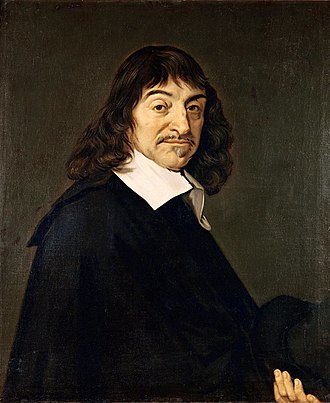 1596 – 1650 · French
René Descartes
Mind is thinking, unextended substance; body is extended, unthinking — two substances interacting at the pineal gland.
Read the full argument → - 8
 1632 – 1677 · Dutch
Baruch Spinoza
Mind and body are one thing seen under two attributes — thought and extension.
Read the full argument → - 9
 1646 – 1716 · German-language
Gottfried Wilhelm Leibniz
Mind and body do not interact at all; God synchronized them like two perfect clocks.
Read the full argument → - 10
 1711 – 1776 · British & Irish
David Hume
There is no mental substance to relate to the body — only a bundle of perceptions.
Read the full argument → - 11
 1788 – 1860 · German-language
Arthur Schopenhauer
My body is the Will seen from outside; my will is my body felt from inside.
Read the full argument → - 12
 1889 – 1976 · German-language
Martin Heidegger
The question is wrongly posed: we are not minds inside bodies but being-in-the-world, already involved with things and others.
Read the full argument →
Today’s version — how does the brain produce consciousness? — is David Chalmers’s “hard problem”. Notice how many modern positions were anticipated: Aristotle’s hylomorphism, Spinoza’s dual-aspect monism, the Buddhist process view, Avicenna’s thought experiment.
Explore Next
related by shared connectionsDoes God Exist?
The proofs, the refutations, the wagers and the leaps — the great argument about God from the Upanishads to Nietzsche.
What Is the Self?
From ātman to anattā, from the cogito to the bundle, from Kierkegaard’s task of becoming oneself to Sartre’s nothingness.
Rationalism vs. Empiricism
The great quarrel of early modern philosophy — does knowledge come from reason or from experience? Kant tried to end it.
What Is Time?
Flux and permanence, the moving image of eternity, Augustine’s puzzle, Kant’s form of intuition, eternal recurrence, Heidegger’s temporality.
What Can We Know?
The relay race of epistemology — from Plato’s Cave to Kant’s categories, via Descartes’ demon and Hume’s billiard balls.

Al-Ghazālī
Theologian, jurist and mystic whose Incoherence of the Philosophers attacked Avicenna’s Aristotelianism, anticipated Hume on causation, and whose spiritual autobiography records a crisis of doubt.