Existentialism is less a doctrine than a mood and a set of questions: What does it mean to exist as a finite, free, mortal individual in a world without guaranteed meaning? How should I face anxiety, death, the absurd, other people’s gaze? What is authentic living, and what is self-deception?
Its ancestors were a Danish Christian, Søren Kierkegaard, and a Russian novelist, Fyodor Dostoevsky; its prophet was Friedrich Nietzsche; its systematic thinker was Martin Heidegger, building on Husserl’s phenomenology; its public face in post-war Paris was Jean-Paul Sartre, with Simone de Beauvoir; and its most beloved writer, though he rejected the label, was Albert Camus. See Existentialism.
Key ideas
- Existence precedes essence — Existence Precedes Essence.
- Anxiety — the dizziness of freedom (Anxiety).
- Bad faith — fleeing one’s freedom (Bad Faith).
- Being-toward-death — Dasein.
- The absurd — The Absurd.
- The leap of faith — The Leap of Faith.
Literature as philosophy
More than any other philosophy, existentialism lived in novels and plays: Notes from Underground, The Trial, Nausea, No Exit, The Stranger, The Plague, Waiting for Godot. Many of its best ideas are scenes: Sisyphus at the Foot of the Mountain, Meursault and the Chaplain, Before the Law, The Grand Inquisitor.
Read the quarrel at the heart of the movement: Sartre vs. Camus.
Map of Influence
who answered whom, inside this roomThinkers & Authors
8
Søren Kierkegaard
The melancholy Dane, father of existentialism, who set the passionate individual against Hegel’s System and faith against reason — “truth is subjectivity”.
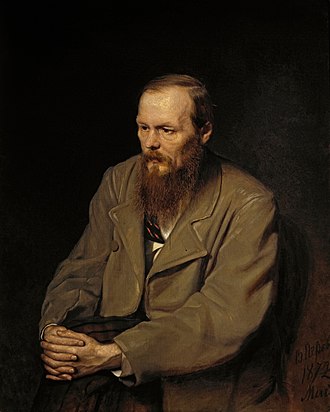
Fyodor Dostoevsky
The Russian novelist of the abyss — crime, faith, freedom, suffering — whose characters argue philosophy with their lives. Nietzsche called him the only psychologist he had anything to learn from.

Friedrich Nietzsche
Philosopher with a hammer who announced the death of God, unmasked the genealogy of morality, and called for new values — the will to power, eternal recurrence, the Übermensch, amor fati.

Franz Kafka
Prague insurance clerk whose parables of guilt, bureaucracy and metamorphosis became the defining images of modern anxiety — and the word “Kafkaesque”.

Martin Heidegger
The philosopher of Being, who argued that the West had forgotten the question of what it means to be, and analysed human existence (Dasein) as thrown, anxious, being-toward-death.

Jean-Paul Sartre
The face of French existentialism — existence precedes essence, we are condemned to be free, and hell is other people.

Simone de Beauvoir
French existentialist philosopher and novelist whose The Second Sex (1949) — “One is not born, but rather becomes, a woman” — founded modern feminist philosophy, and whose ethics of ambiguity argued that my freedom requires the freedom of others.

Albert Camus
Algerian-born novelist and essayist of the absurd and of revolt — “There is but one truly serious philosophical problem, and that is suicide.”
Works
4Fear and Trembling
Kierkegaard’s meditation, under the pseudonym Johannes de Silentio, on Abraham’s willingness to sacrifice Isaac — is faith higher than ethics?

Notes from Underground
A spiteful, hyper-conscious ex-official rants from his “mousehole” against reason, progress and the Crystal Palace — often called the first existentialist novel.
The Myth of Sisyphus
Camus’s essay on the absurd — why not suicide? — ending with the image of Sisyphus pushing his rock, happy.
The Stranger
Camus’s first novel — Meursault, who will not pretend to feel what he does not feel, kills an Arab on a beach and is condemned for not weeping at his mother’s funeral.
Schools & Movements
3Existentialism
The philosophy of the existing individual — freedom, anxiety, authenticity, the absurd — running from Kierkegaard and Dostoevsky through Nietzsche and Heidegger to Sartre and Camus.
Phenomenology
Husserl’s method of describing experience exactly as it appears — “to the things themselves!” — which Heidegger and Sartre turned toward existence.
Absurdism
Camus’s position — the conflict between our longing for meaning and the world’s silence cannot be resolved, only lived with in lucid revolt.
Coming to the Library
15 pages being writtenVoices
quotations from this traditionGod is dead. God remains dead. And we have killed him.
Gott ist tot! Gott bleibt tot! Und wir haben ihn getödtet!
He who fights with monsters should look to it that he himself does not become a monster. And if you gaze long into an abyss, the abyss also gazes into you.
Wer mit Ungeheuern kämpft, mag zusehn, dass er nicht dabei zum Ungeheuer wird. Und wenn du lange in einen Abgrund blickst, blickt der Abgrund auch in dich hinein.
What does not kill me makes me stronger.
Was mich nicht umbringt, macht mich stärker.
He who has a why to live for can bear almost any how.
Hat man sein warum? des Lebens, so verträgt man sich fast mit jedem wie?
My formula for greatness in a human being is amor fati — that one wants nothing to be different, not forward, not backward, not in all eternity.
Man is a rope, tied between beast and overman — a rope over an abyss.
One must still have chaos in oneself to be able to give birth to a dancing star.
There are no facts, only interpretations.
Become who you are.
Werde, der du bist.
Without music, life would be a mistake.
Ohne Musik wäre das Leben ein Irrtum.
Life can only be understood backwards; but it must be lived forwards.
Anxiety is the dizziness of freedom.