The term is Albert Camus‘s, but the experience is old. Tertullian found faith credible because it was foolish; Søren Kierkegaard calls faith “the absurd”; Franz Kafka‘s heroes live inside it. Camus’s answer — neither suicide nor the leap of faith, but revolt — is condensed in one sentence: “one must imagine Sisyphus happy.”
Thinkers & Authors
6
Tertullian
Fiery early Christian writer from Carthage, father of Latin theology, remembered for setting faith against philosophy — “What has Athens to do with Jerusalem?”
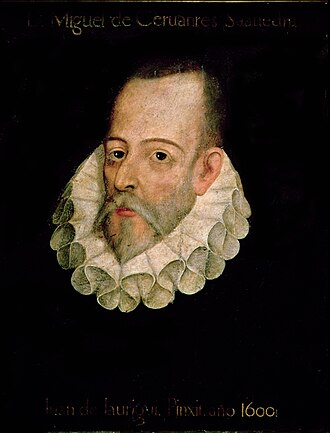
Miguel de Cervantes
Soldier, captive, tax collector and the father of the modern novel — whose Don Quixote made a deluded old knight and his earthy squire the most famous pair in literature.

Søren Kierkegaard
The melancholy Dane, father of existentialism, who set the passionate individual against Hegel’s System and faith against reason — “truth is subjectivity”.

Franz Kafka
Prague insurance clerk whose parables of guilt, bureaucracy and metamorphosis became the defining images of modern anxiety — and the word “Kafkaesque”.

Samuel Beckett
Irish playwright, novelist and poet who wrote in English and French, the master of minimalism and the absurd — Waiting for Godot made a play in which “nothing happens, twice” into the defining drama of the twentieth century.

Albert Camus
Algerian-born novelist and essayist of the absurd and of revolt — “There is but one truly serious philosophical problem, and that is suicide.”
Works
6
Don Quixote
Cervantes’s comic masterpiece about a country gentleman driven mad by chivalric romances, who sets out as a knight-errant with his squire Sancho Panza — often called the first modern novel and the greatest ever written.
Fear and Trembling
Kierkegaard’s meditation, under the pseudonym Johannes de Silentio, on Abraham’s willingness to sacrifice Isaac — is faith higher than ethics?

The Trial
Josef K. is arrested one morning without having done anything wrong, and spends a year trying to understand an invisible court — until two men take him to a quarry and kill him “like a dog”.

The Metamorphosis
Gregor Samsa, a travelling salesman, wakes one morning transformed into a monstrous vermin — and his family’s duty slowly curdles into disgust and relief.
The Myth of Sisyphus
Camus’s essay on the absurd — why not suicide? — ending with the image of Sisyphus pushing his rock, happy.
The Stranger
Camus’s first novel — Meursault, who will not pretend to feel what he does not feel, kills an Arab on a beach and is condemned for not weeping at his mother’s funeral.
Ideas
1Schools & Movements
2Existentialism
The philosophy of the existing individual — freedom, anxiety, authenticity, the absurd — running from Kierkegaard and Dostoevsky through Nietzsche and Heidegger to Sartre and Camus.
Absurdism
Camus’s position — the conflict between our longing for meaning and the world’s silence cannot be resolved, only lived with in lucid revolt.
Debates
1Characters
3Gregor Samsa
The travelling salesman who wakes as a giant insect and remains, inside, more human than the family that comes to find him a burden.
Josef K.
A bank officer arrested on his thirtieth birthday for an unnamed crime, who spends a year failing to reach the court that has already judged him.
Meursault
Camus’s “stranger” — a clerk in Algiers who will not say more than he feels, kills a man on a beach, and goes to the guillotine opening himself to “the gentle indifference of the world”.
Great Scenes
8Abraham on Mount Moriah
Kierkegaard’s obsessive retelling of Genesis 22 — Abraham rising early to sacrifice Isaac — as the test case of faith beyond ethics.
Before the Law
A man from the country asks to be admitted to the Law; the doorkeeper says “not now”; he waits his whole life — and learns as he dies that this door was meant only for him.
The Death of Cordelia
Lear enters carrying his hanged daughter, howling, searching for her breath with a mirror and a feather — “Never, never, never, never, never.”
The Dover Cliff
Edgar leads his blind father to a “cliff” that isn’t there, lets him leap, and convinces him he has survived by a miracle — curing his despair with a theatrical trick.
Meursault and the Chaplain
On the eve of execution, Meursault explodes at the prison chaplain’s certainty — and finds peace in the “gentle indifference of the world”.
Sisyphus at the Foot of the Mountain
Condemned to roll his rock eternally uphill, Sisyphus pauses as it falls back — and Camus imagines him, in that moment of consciousness, happy.
To Be, or Not to Be
Hamlet’s soliloquy weighing life against death — the most famous speech in English, and a compressed treatise on suicide, fear and the paralysis of thought.
Tomorrow, and Tomorrow, and Tomorrow
Macbeth, told that his wife is dead, delivers the bleakest speech in Shakespeare — life is a walking shadow, a tale told by an idiot, signifying nothing.
Great Questions
1Lines to Remember
13 quotationsThere is but one truly serious philosophical problem, and that is suicide.
Il n'y a qu'un problème philosophique vraiment sérieux — c'est le suicide.
Context & when to use it
Whether life is worth living is the fundamental question — everything else is secondary.
To bring any abstract debate back to what matters; pair with Hamlet’s “To be or not to be”.
The struggle itself toward the heights is enough to fill a man’s heart. One must imagine Sisyphus happy.
La lutte elle-même vers les sommets suffit à remplir un cœur d'homme. Il faut imaginer Sisyphe heureux.
Context & when to use it
The absurd hero, conscious of his fate, is superior to it.
For meaning without metaphysics, perseverance, the dignity of repetitive work.
Mother died today. Or maybe yesterday, I don’t know.
Aujourd'hui, maman est morte. Ou peut-être hier, je ne sais pas.
Context & when to use it
For emotional detachment, the flatness of the absurd.
I opened myself to the gentle indifference of the world.
Je m'ouvrais pour la première fois à la tendre indifférence du monde.
Context & when to use it
For peace after giving up hope; acceptance without consolation.
Someone must have slandered Josef K., for one morning, without having done anything wrong, he was arrested.
Context & when to use it
For arbitrary power, bureaucracy, guilt without crime.
As Gregor Samsa awoke one morning from uneasy dreams he found himself transformed in his bed into a monstrous vermin.
Als Gregor Samsa eines Morgens aus unruhigen Träumen erwachte, fand er sich in seinem Bett zu einem ungeheueren Ungeziefer verwandelt.
Context & when to use it
For alienation, sudden loss of identity, becoming a burden.
No one else could ever be admitted here, since this gate was made only for you. I am now going to shut it.
Context & when to use it
For missed chances, waiting for permission, the path only you could walk.
Ever tried. Ever failed. No matter. Try again. Fail again. Fail better.
Context & when to use it
For persistence — honestly understood.
⚠ Beckett’s context is bleak, not motivational — it is about the impossibility of art succeeding.
You must go on. I can’t go on. I’ll go on.
Context & when to use it
For endurance without hope.
They give birth astride of a grave, the light gleams an instant, then it’s night once more.
Context & when to use it
For the brevity of life.
To be, or not to be: that is the question: Whether ‘tis nobler in the mind to suffer The slings and arrows of outrageous fortune, Or to take arms against a sea of troubles, And by opposing end them?
Context & when to use it
Hamlet, alone (he thinks), weighs whether to endure life’s suffering or end it — and why fear of the afterlife stops us.
Any debate about suicide, nihilism, meaning, or choosing between endurance and action. Philosophy, literature and Shakespeare in one line.
Life’s but a walking shadow, a poor player That struts and frets his hour upon the stage And then is heard no more. It is a tale Told by an idiot, full of sound and fury, Signifying nothing.
Context & when to use it
On hearing of his wife’s death, near his own end.
The definitive line for nihilism and meaninglessness — the absurd before Camus.
Look, your worship, those things over there aren’t giants, they’re windmills, and what seem to be their arms are the sails.
Context & when to use it
For the realist’s reply to the idealist — and for tilting at windmills.
Sententiae
phrases in the originalCredo quia absurdum
Origin. Popularly attributed to Tertullian (c. 155–220 CE). What he actually wrote, in De Carne Christi 5, about the death and resurrection of Christ, is “credibile est, quia ineptum est … certum est, quia impossibile” — “it is credible because it is foolish … it is certain because it is impossible.” — Tertullian
⚠ The exact words “credo quia absurdum” never appear in Tertullian; the sharpened slogan circulated centuries later. Kierkegaard’s leap of faith made the attitude famous again.
When faith is defended precisely by its defiance of reason — and for the paradox at the heart of the absurd.
Il faut imaginer Sisyphe heureux
Origin. Camus, last line of The Myth of Sisyphus (1942). — Albert Camus
For meaning in the struggle itself.
Explore Next
related by shared connections
Jean-Paul Sartre
The face of French existentialism — existence precedes essence, we are condemned to be free, and hell is other people.
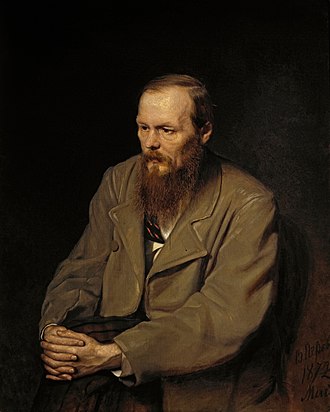
Fyodor Dostoevsky
The Russian novelist of the abyss — crime, faith, freedom, suffering — whose characters argue philosophy with their lives. Nietzsche called him the only psychologist he had anything to learn from.

Augustine of Hippo
North African bishop, convert, and the most influential Christian thinker of the Latin West — inventor of the autobiography of the inner self.

Friedrich Nietzsche
Philosopher with a hammer who announced the death of God, unmasked the genealogy of morality, and called for new values — the will to power, eternal recurrence, the Übermensch, amor fati.
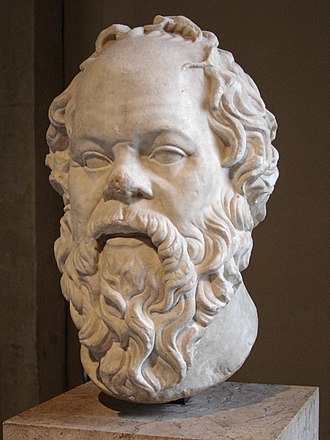
Socrates
The Athenian gadfly who wrote nothing, claimed to know nothing, questioned everyone — and was put to death for it, becoming philosophy’s martyr.

King Lear
An old king divides his kingdom between the daughters who flatter him and banishes the one who loves him — and is stripped of everything on a heath in a storm.