- 1
 c. 800–700 BCE · Indian
Yājñavalkya
To know the Self, which is deathless — “what should I do with that which will not make me immortal?”
Read the full argument → - 2
 c. 563–483 BCE · Indian
Gautama Buddha
To end suffering by ending craving, through the Eightfold Path — and to be compassionate toward all beings.
Read the full argument → - 3
 551–479 BCE · Chinese
Confucius
To become fully human through learning, ritual and humane relationships — the life of the jūnzǐ.
Read the full argument → - 4
 c. 571–471 BCE · Chinese
Laozi
To live in harmony with the Dao — simple, yielding, without forcing.
Read the full argument → - 5
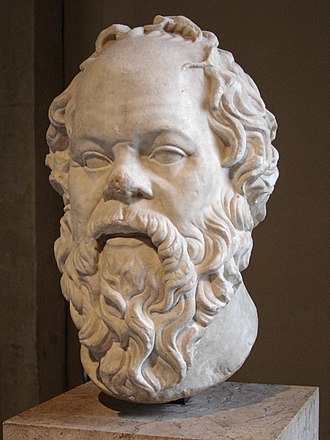 470–399 BCE · Ancient Greek
Socrates
To examine oneself and care for the soul — “the unexamined life is not worth living”.
Read the full argument → - 6
 384–322 BCE · Ancient Greek
Aristotle
Eudaimonia — flourishing through virtuous activity, friendship, and above all contemplation.
Read the full argument → - 7
 341–270 BCE · Ancient Greek
Epicurus
Tranquillity — freedom from pain and fear, with friends and simple pleasures.
Read the full argument → - 8
 121 – 180 · Roman & Latin
Marcus Aurelius
To do your work as a human being, act justly, accept what you cannot change, and remember you are mortal.
Read the full argument → - 9
 354 – 430 · Patristic & Medieval
Augustine of Hippo
To rest in God — the heart is restless until it does.
Read the full argument → - 10
 1564 – 1616 · British & Irish
William Shakespeare
Macbeth says it is “a tale told by an idiot, signifying nothing”; Lear learns, too late, that it is love.
Read the full argument → - 11
 1828 – 1910 · Russian
Leo Tolstoy
At fifty, rich and famous, he could not answer “why live?” — and found the answer in the faith of simple people.
Read the full argument → - 12
 1788 – 1860 · German-language
Arthur Schopenhauer
There is no meaning; life swings between pain and boredom. The only escape is art, compassion and denial of the will.
Read the full argument → - 13
 1813 – 1855 · Scandinavian
Søren Kierkegaard
To become a self before God — not by thinking, but by choosing and believing.
Read the full argument → - 14
 1844 – 1900 · German-language
Friedrich Nietzsche
There is no given meaning — so create it. Say yes to life so fully you would will it to recur eternally.
Read the full argument → - 15
 1913 – 1960 · French
Albert Camus
The universe is silent — but revolt, freedom and passion are enough. One must imagine Sisyphus happy.
Read the full argument → - 16
 1905 – 1980 · French
Jean-Paul Sartre
Existence precedes essence; life has no meaning until you give it one by your choices.
Read the full argument →
Three great families: meaning is given (by God, by the Self’s identity with Brahman, by nature’s order); meaning is achieved (by virtue, cultivation, tranquillity); meaning is made (by choice, will and revolt). See the lens Death & Meaning and the theme Nihilism.
Explore Next
related by shared connectionsHow Should We Face Death?
Naciketas at Death’s door, Socrates’ hemlock, Epicurus’s argument, the Stoics’ rehearsal, Hamlet’s skull, Ivan Ilyich’s scream, Heidegger’s being-toward-death.
What Is Beauty — and What Is Art For?
From Plato’s ladder of love and Aristotle’s catharsis to Kant’s disinterested pleasure, Schopenhauer’s music and Nietzsche’s Apollo and Dionysus.
What Is the Self?
From ātman to anattā, from the cogito to the bundle, from Kierkegaard’s task of becoming oneself to Sartre’s nothingness.
Does God Exist?
The proofs, the refutations, the wagers and the leaps — the great argument about God from the Upanishads to Nietzsche.

Martin Heidegger
The philosopher of Being, who argued that the West had forgotten the question of what it means to be, and analysed human existence (Dasein) as thrown, anxious, being-toward-death.
What Is Time?
Flux and permanence, the moving image of eternity, Augustine’s puzzle, Kant’s form of intuition, eternal recurrence, Heidegger’s temporality.