

Contents · 13 sections · 18 min
Socrates in Five Ideas
the essentialsSocratic ignorance
The oracle said no one was wiser than Socrates. He concluded his wisdom lay only in knowing that he did not know — while others thought they knew what they did not.
The elenchus
Ask “what is courage? what is justice?”, examine the answer, expose its contradictions, and leave the speaker in aporia — honest puzzlement, the beginning of wisdom.
Virtue is knowledge
No one does wrong willingly; wrongdoing comes from ignorance of the good.
Care of the soul
The most important thing is not wealth or reputation but making one’s soul as good as possible.
The examined life
The unexamined life is not worth living for a human being.
Socrates wrote nothing. He held no office, founded no school, charged no fees, and claimed to know nothing of importance. He spent his life in the streets, gymnasia and workshops of Athens asking people what they meant by the words they used — courage, justice, piety, beauty, love — and showing them, usually to their annoyance, that they did not know. For this he was tried, condemned and executed in 399 BCE at about seventy. And from that life and that death came the whole tradition of Western philosophy: Plato, Aristotle, the Stoics, the Cynics, the Sceptics, and every later thinker who has believed that a human life must be examined to be worth living.
He is also a puzzle. Everything we know about him comes from others — from his student Plato, who made him the hero of most of his dialogues; from the soldier and historian Xenophon; from the comic playwright Aristophanes, who mocked him; and from scraps in Aristotle and later writers. Their portraits differ. This essay sets out what can be known of the man, the method and the ideas; tells the story of the trial and death; and follows his long afterlife.
The sources and the Socratic problem
Four witnesses
- Aristophanes, The Clouds (423 BCE): written when Socrates was about forty-five. A comedy in which “Socrates” runs a “Thinkery” (phrontistērion), hangs in a basket to contemplate the heavens, teaches students to make the weaker argument defeat the stronger, and replaces Zeus with the Clouds and “Vortex”. It ends with the Thinkery burned down. It is a caricature — mixing Socrates with the natural philosophers and the sophists — but it shows how he looked to ordinary Athenians.
- Plato (c. 428–348): wrote some thirty dialogues in which Socrates usually leads the conversation. The early ones (Apology, Crito, Euthyphro, Laches, Charmides, Lysis, Protagoras, Gorgias) are generally thought closest to the historical man; in the middle and late dialogues, Socrates becomes the spokesman for Plato’s own doctrines.
- Xenophon (c. 430–354): soldier, historian and admirer, who wrote the Memorabilia (recollections), an Apology, a Symposium and the Oeconomicus. His Socrates is a wise, practical, pious and somewhat conventional moralist, giving sensible advice on household management and friendship — less brilliant, less ironic than Plato’s.
- Aristotle (384–322): never knew Socrates, but distinguishes his views from Plato’s. Socrates, he says, was concerned with ethics, sought universal definitions and used inductive arguments — but, unlike Plato, did not make the universals “separate” (Metaphysics 1078b).
The problem
The Socratic problem is the question of how to reconstruct the historical Socrates from these conflicting sources. Since the nineteenth century, scholars have tended to trust Plato’s early dialogues most, supplemented by Aristotle’s testimony. Gregory Vlastos (Socrates: Ironist and Moral Philosopher, 1991) drew a sharp line between “Socrates E” (of the early dialogues), a moral philosopher who disavows knowledge and refutes his interlocutors, and “Socrates M” (of the middle dialogues), a metaphysician who holds the theory of Forms and the immortality of the soul — that is, Plato. Others (Charles Kahn, Plato and the Socratic Dialogue, 1996) argued that even the early dialogues are Platonic constructions, and that the historical Socrates is beyond reach. Still others note that the “Socratic dialogue” was a genre practised by many of his followers — Antisthenes, Aeschines, Phaedo, Euclides — of which only Plato’s and Xenophon’s survive.
The wise conclusion: there is a recognizable figure common to the sources — poor, ugly, tough, ironic, obsessively questioning, morally serious, religiously unusual, and fatally irritating — and a set of ideas that are attributed to him with reasonable confidence.
The man
Origins
Socrates was born in Athens around 470/469 BCE, in the deme of Alopece, to Sophroniscus, a stonemason or sculptor, and Phaenarete, a midwife. He may have practised his father’s trade early on; a later tradition (doubtful) credited him with a statue of the Graces on the Acropolis. He grew up in the city’s golden age — the age of Pericles, the Parthenon, Aeschylus and Sophocles — and lived through its catastrophe, the Peloponnesian War (431–404).
Appearance
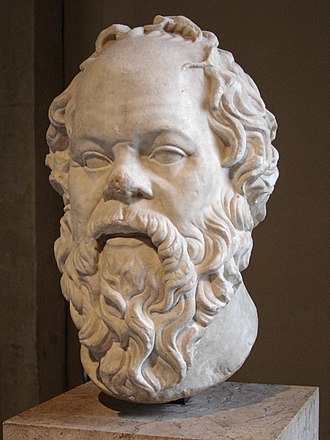
Every source agrees that he was strikingly ugly: snub-nosed, with protruding eyes, thick lips and a pot belly. In Xenophon’s Symposium he argues, playfully, that his features are actually the most beautiful because most useful — bulging eyes see sideways, a flat nose doesn’t block vision, thick lips are better for kissing. In Plato’s Symposium, Alcibiades compares him to the statues of Silenus sold in shops — grotesque on the outside, but opening to reveal images of gods within — and to the satyr Marsyas, who enchanted with his flute as Socrates enchants with bare words.
Habits
He went barefoot winter and summer and wore the same cloak year-round. He was indifferent to wealth and comfort. He could drink everyone under the table without getting drunk; at the end of the Symposium, after a night of drinking, he is the only one left awake, and goes off to spend the day as usual. He sometimes fell into trances: at the military campaign at Potidaea, says Alcibiades, he stood still from dawn to dawn, thinking, while the curious soldiers dragged their bedding out to watch him.
Soldier
Socrates served as a hoplite (heavy infantryman) in at least three campaigns: Potidaea (432), where he saved Alcibiades’ life and declined the prize for bravery in his favour; Delium (424), where, in the Athenian rout, he retreated with such calm that, says Alcibiades, “he stalked along like a pelican”, looking about coolly so that no one dared attack him; and Amphipolis (422).
Family
He married Xanthippe, much younger than he, and had three sons, two still small at his death. Later tradition made Xanthippe a shrew — Diogenes Laertius has her empty a chamber-pot over his head, and Socrates remark, “Didn’t I say that Xanthippe’s thunder would end in rain?” — but in Plato’s Phaedo she appears grieving at the prison with their youngest child in her arms.
The daimonion
Socrates claimed to have, from childhood, a divine sign (daimonion), an inner voice that sometimes warned him not to do something — never urging him on. It stopped him from going into politics. On the day of his trial, he notes, it never once opposed him — a sign, he concludes, that what was happening to him was good (Apology 40a–c). Whether this was a mystical experience, a figure of speech for intuition, or something else, it contributed to the charge of introducing “new divinities”.
Politics
Socrates avoided politics as far as he could, but twice his duty brought him into conflict with power. In 406, by lot, he was among the council’s presiding officers when the Assembly demanded that eight generals be tried collectively — illegally — for failing to rescue survivors after the naval battle of Arginusae; Socrates alone opposed the motion. In 404, under the oligarchy of the Thirty Tyrants, he was ordered with four others to arrest Leon of Salamis for execution; the others went, Socrates simply went home. Only the fall of the Thirty, he says, saved him from death (Apology 32a–e).
The mission
The oracle
In the Apology, Socrates explains the origin of his strange career. His friend Chaerephon went to the oracle of Apollo at Delphi and asked whether anyone was wiser than Socrates. The priestess answered: no one.
Socrates was baffled; he knew he was not wise. So he set out to refute the oracle by finding someone wiser. He went to a politician reputed wise, questioned him, and found that he “thinks he knows something when he does not, whereas I, as I do not know, do not think I do either” (21d). He tried the poets — who, he found, wrote fine things not by wisdom but by a kind of inspiration, like prophets, without understanding what they said. He tried the craftsmen — who did know their crafts, but thought this made them wise in the greatest matters too.
He concluded that the god meant: “this one of you, O men, is wisest, who, like Socrates, understands that his wisdom is worth nothing” (23b). From then on he regarded his questioning as a service to the god — and it made him poor and hated.
The gadfly
He compared himself to a gadfly sent by the god to sting the city, “a great and noble horse which is somewhat sluggish because of its size and needs to be stirred up” (30e). And he described his message:
Most excellent man, you are an Athenian, a citizen of the greatest city with the greatest reputation for both wisdom and power; are you not ashamed of your eagerness to possess as much wealth, reputation and honours as possible, while you do not care for nor give thought to wisdom or truth, or the best possible state of your soul? (29d–e)
Care for the soul (epimeleia tēs psuchēs) is the core of the Socratic mission.
The method
The elenchus
Socrates’ characteristic method is the elenchus — “cross-examination” or “refutation”. Its typical shape:
- Someone — often an expert or a confident young man — asserts something: “Courage is endurance of the soul” (Laches); “Piety is what the gods love” (Euthyphro).
- Socrates secures the speaker’s agreement to further premises: “Is courage something fine?” “Is foolish endurance fine?”
- He shows that these premises, together with the original claim, lead to a contradiction.
- The speaker must abandon or revise the claim — and the cycle begins again.
Since the elenchus only shows inconsistency, never truth directly, scholars have debated how Socrates can claim to have learned anything positive from it (the “problem of the elenchus”). One answer: over many conversations, some beliefs (e.g. that it is worse to do wrong than to suffer it) always survive refutation, while their denials always lead to contradiction — giving them a kind of tested reliability.
The “What is X?” question
Socrates asks for definitions: not examples of courage, but what courage is — the single “form” (eidos) by which all courageous acts are courageous. When Euthyphro answers that piety is prosecuting wrongdoers, as he is doing, Socrates replies that he asked for the one form, not one of many pious things. This search for universals — Aristotle credits Socrates with being the first to undertake it seriously — is a turning point in the history of thought.
Aporia
Most early dialogues end in aporia — impasse, perplexity. The interlocutor realizes he does not know what he thought he knew. Socrates presents this as progress: someone who knows that he does not know is better placed to learn. In the Meno, the slave boy, having been led into aporia, is “better off” and will now “be glad to search”.
Irony
Socrates’ irony (eirōneia) was famous in antiquity — and resented. He praises his interlocutors extravagantly, professes ignorance while dismantling experts, claims to be a lover of handsome youths while resisting their advances. Is his disavowal of knowledge sincere or a pose? Vlastos distinguished “complex irony”: Socrates means what he says in one sense (he has no certain knowledge of the most important things) and not in another (he has moral convictions he would die for). Søren Kierkegaard‘s dissertation, On the Concept of Irony with Continual Reference to Socrates (1841), made Socratic irony the beginning of subjectivity — the individual’s infinite negative freedom against the established order.
Midwifery
In Plato’s Theaetetus (149a–151d), Socrates compares himself to his mother: a midwife of ideas. He himself is barren of wisdom, but he can help others give birth to their thoughts and test whether they are genuine or “wind-eggs”. The god compels him to deliver but forbids him to beget. This image — the teacher as midwife — inspired the “Socratic method” of education.
The ideas
Though he professed ignorance, Socrates in the early dialogues holds a set of striking convictions — the “Socratic paradoxes”.
Virtue is knowledge
To be good is to know what is good. All the virtues — courage, temperance, justice, piety — are ultimately one: knowledge of good and evil (Protagoras, Laches). Courage, for example, is knowledge of what is truly to be feared and what is not.
No one does wrong willingly
Since everyone desires what is (or seems) good for them, anyone who does wrong does so out of ignorance — mistaking evil for good. Weakness of will (akrasia) — knowing the better and doing the worse — is impossible; what looks like it is really a failure of measurement, like misjudging the size of distant objects (Protagoras 352a–358d). Aristotle later objected that this “contradicts the plain phenomena”.
It is worse to do wrong than to suffer it
In the Gorgias, Socrates defends against Polus and Callicles the claim that doing injustice harms the doer’s soul more than suffering injustice harms the victim — and that the wrongdoer who escapes punishment is more wretched than one who is punished, as a sick man who avoids the doctor is worse off.
No harm can come to a good man
“A good man cannot be harmed either in life or in death” (Apology 41d): since the only true harm is harm to the soul, and only one’s own wrongdoing can damage it, no external misfortune — poverty, exile, death — is a real evil.
Never return wrong for wrong
In the Crito (49b–d), Socrates argues that one must never do wrong, even in retaliation — “neither to return a wrong nor to do evil to anyone, whatever one may suffer at their hands.” Socrates notes that few people will ever agree with this; it was a radical break from the traditional Greek ethics of helping friends and harming enemies.
The examined life
The unexamined life is not worth living for a human being. (Apology 38a)
Not merely that unexamined lives are less good: that they lack what makes a life human.
The trial
The charges
In 399 BCE, Socrates was prosecuted by three men: Meletus, a young poet, the nominal accuser; Anytus, a prominent democratic politician; and Lycon, an orator. The indictment, preserved by Diogenes Laertius:
Socrates is guilty of refusing to recognize the gods recognized by the state and of introducing other new divinities. He is also guilty of corrupting the young. The penalty demanded is death.
The real reasons
Behind the legal charges lay politics. Several of Socrates’ associates had betrayed Athens: Alcibiades, brilliant and unscrupulous, who defected to Sparta; Critias, leader of the murderous Thirty Tyrants; Charmides, also among the Thirty. The democracy, restored in 403, had passed an amnesty forbidding prosecutions for acts under the Thirty, so the charge could not be political — but the jurors remembered. Socrates’ habit of criticizing democracy (why choose rulers by lot, when no one chooses a ship’s pilot by lot?) did not help. And Aristophanes’ Clouds had fixed his image as a sophist who taught young men to disrespect their fathers and the gods.
The defence
Plato’s Apology (see The Apology of Socrates) presents Socrates’ speech. He refuses to plead for mercy, bring his weeping children before the jury, or flatter. He tells the story of the oracle, cross-examines Meletus (who is reduced to claiming that Socrates believes in no gods at all — which contradicts the charge of introducing new ones), and declares that he will not stop philosophizing even if acquitted on that condition: “Men of Athens, I am grateful and I am your friend, but I will obey the god rather than you” (29d).
The verdict and the penalty
The jury of 501 citizens convicted him by a narrow margin — about 280 to 220. Socrates remarked that if only thirty votes had gone the other way he would have been acquitted. In Athenian procedure, the prosecution proposed a penalty (death) and the defendant a counter-penalty. Socrates proposed — what he deserved — free meals for life in the Prytaneum, an honour given to Olympic victors and benefactors of the city. Then, at his friends’ urging, he offered a fine of thirty minae, which Plato and others would guarantee. The jury voted for death by a larger margin than for conviction.
His final words to the jurors who condemned him: they have killed him to avoid giving an account of their lives, but others will come to examine them more harshly. To those who acquitted him: death is either a dreamless sleep — “a wonderful gain”, since a whole eternity would seem no more than one night — or a journey to the place of the dead, where he could converse with Homer, Hesiod and the heroes, and examine them too. “Now the hour to part has come. I go to die, you go to live. Which of us goes to the better lot is known to no one, except the god” (42a).
The death
The delay and the escape plan
Executions were forbidden while the sacred ship sent annually to Delos was away; it had been garlanded the day before the trial, so Socrates spent about a month in prison. He received visitors, wrote verses (versifying Aesop’s fables and a hymn to Apollo, because a recurring dream had told him to “make music”). In Plato’s Crito, his old friend Crito arrives at dawn with a plan for escape; the guards are bribed. Socrates refuses: to escape would be to do wrong to the Laws of Athens, which brought him into being and to which he had agreed by living under them for seventy years.
The last day
Plato’s Phaedo narrates the final day. Socrates’ friends gather; Xanthippe and the child are sent away weeping. Socrates rubs his leg, freed from fetters, and remarks how pleasure and pain are strangely joined. All day he argues for the immortality of the soul, calling philosophy a “practice for dying and being dead”. He bathes so that the women will not have to wash his corpse. The jailer, a kind man, weeps as he brings the hemlock. Socrates asks if he may pour a libation from it (no — there is just enough), prays for a happy journey, and drinks it “quite readily and cheerfully”. His friends break down; he rebukes them: he had sent the women away to avoid such scenes. He walks until his legs are heavy, then lies down; the poison numbs him from the feet upward. Then he uncovers his face:
Crito, we owe a cock to Asclepius. Pay it and do not neglect it. (118a)
“Such was the end of our friend,” Phaedo concludes, “a man who, we would say, was of all those we have known the best, and also the wisest and the most just.” See The Death of Socrates.
The last words have been endlessly interpreted. Asclepius was the god of healing; a cock was offered in thanks for a cure. Was death the cure for life, as Friedrich Nietzsche darkly suggested (“Socrates was sick of life”)? Or thanks for the healing of the friends’ souls by philosophy? Or simply a pious man’s last scruple?
The image
Jacques-Louis David’s painting The Death of Socrates (1787) fixed the image for modern Europe: Socrates, muscular and luminous, raising his hand toward the heavens as he reaches for the cup, his disciples collapsing in grief around him, Plato as an old man at the foot of the bed (though historically he was absent).
The Socratic schools
Socrates left no doctrine, so his followers drew very different lessons:
- Plato — the Academy, the Forms, the immortal soul.
- Antisthenes — virtue is sufficient for happiness; contempt for pleasure and convention. He is the ancestor of the Cynics, whose most famous member, Diogenes of Sinope, lived in a jar, carried a lamp in daylight “looking for an honest man”, and was called “Socrates gone mad”.
- Aristippus of Cyrene — pleasure is the good; founder of the Cyrenaics.
- Euclides of Megara — combined Socrates with Parmenides; the Megarian school of logic.
- Xenophon — Socrates as practical moralist.
Later, the Stoics took Socrates as their model sage — virtue as knowledge, the indifference of external goods, the calm acceptance of death; and the Academic Sceptics took his disavowal of knowledge as their warrant for suspending judgment.
Socrates through the ages
Antiquity
Cicero said Socrates “called philosophy down from the heavens and set it in the cities, and introduced it into homes, and compelled it to ask about life and morals” (Tusculan Disputations V.10). The early Christian apologist Justin Martyr counted him among those who lived “with the Logos” before Christ — a Christian before Christ, martyred like Christ. Erasmus later wrote, half-seriously, “Saint Socrates, pray for us.”
Enlightenment
For the Enlightenment, Socrates was the martyr of free thought against superstition and intolerance — Voltaire wrote a play about him. Hegel saw his death as a genuine tragedy: two rights in collision, the right of the state and its traditional morality, and the right of the subjective, reflecting individual; Socrates was the principle of subjective freedom bursting into the Greek world, which had to destroy him and was destroyed by what he represented.
Kierkegaard
Søren Kierkegaard loved Socrates above all philosophers. Socrates’ irony, his refusal to give results, his “maieutic” method of making the other discover the truth inwardly, became the model for Kierkegaard’s own “indirect communication” through pseudonyms. “That noble rogue”, he called him.
Nietzsche
Friedrich Nietzsche was obsessed with Socrates — “so close to me that I am almost always fighting him”. In The Birth of Tragedy Socrates is the “theoretical man” whose optimism about reason killed tragedy. In Twilight of the Idols, “The Problem of Socrates”: Socrates was ugly, plebeian, a decadent whose instincts were in anarchy, who invented dialectic as a weapon of the weak and made reason a tyrant — “reason = virtue = happiness” — to save himself. And yet Nietzsche admired him as a seducer of the young, a great erotic, and admitted: “Socrates, just to confess it, is so close to me that I am almost always fighting a battle with him.”
Modern times
John Stuart Mill: “It is better to be a human being dissatisfied than a pig satisfied; better to be Socrates dissatisfied than a fool satisfied” (Utilitarianism, 1863). Martin Luther King Jr. invoked Socrates in his “Letter from Birmingham Jail” (1963) as the model of creative tension — the gadfly who forces a society to face what it would rather ignore — and of civil disobedience accepted with its penalty. I. F. Stone’s The Trial of Socrates (1988) took the side of Athenian democracy against an anti-democratic Socrates; most scholars find this one-sided.
Socrates and the Buddha
Socrates and the Gautama Buddha lived a few decades apart, at the two ends of the Indo-European world, in what Karl Jaspers called the Axial Age. Both wrote nothing; both are known through disciples’ records; both taught by dialogue and question; both disclaimed metaphysical speculation in favour of the urgent task of transforming the self; both died calmly, with final words addressed to followers. The comparison can be overdone — Socrates’ rational questioning and the Buddha’s meditative path are very different practices — but it is illuminating.
Key terms
- Elenchus
- Socratic cross-examination that tests a belief by exposing its inconsistencies.
- Aporia
- Perplexity, impasse — the productive state of knowing that one does not know.
- Eirōneia
- Irony; feigned ignorance and dissembling praise.
- Daimonion
- Socrates' inner divine sign, which warned him against certain actions.
- Maieutics
- The art of midwifery — helping others bring forth their own ideas.
Using Socrates in conversation
- The examined life: “The unexamined life is not worth living.”
- Intellectual humility: Socrates was wise because he knew he did not know — and the experts who thought they knew were not. (Correct anyone who quotes “I know that I know nothing” as his exact words.)
- Definitions: when a debate stalls, ask the Socratic question — “but what do you mean by justice (or freedom, fairness, merit)?”
- Civil disobedience: the Apology (obey God rather than you) versus the Crito (do not flee the Laws).
Socrates in two minutes
The Athenian gadfly who wrote nothing, claimed to know nothing, questioned everyone — and was put to death for it, becoming philosophy’s martyr.
- Socratic ignorance. The oracle said no one was wiser than Socrates. He concluded his wisdom lay only in knowing that he did not know — while others thought they knew what they did not.
- The elenchus. Ask “what is courage? what is justice?”, examine the answer, expose its contradictions, and leave the speaker in aporia — honest puzzlement, the beginning of wisdom.
- Virtue is knowledge. No one does wrong willingly; wrongdoing comes from ignorance of the good.
- Care of the soul. The most important thing is not wealth or reputation but making one’s soul as good as possible.
- The examined life. The unexamined life is not worth living for a human being.
Answering: — · Answered by: Plato, Epictetus, Søren Kierkegaard, Friedrich Nietzsche
Curiosities
did you know?- Socrates never wrote a single word of philosophy.
- At the battle of Delium he retreated so calmly that, Alcibiades said, no enemy dared attack him.
- He proposed, as his ‘punishment’, free meals for life at public expense.
- His last words were a request to pay a debt of a rooster to the god of healing.
Questions to Argue About
debate club →- Is the unexamined life really not worth living?
- Should you obey a law you believe is unjust?
- Can anyone do wrong knowingly?
- Is it worse to do injustice than to suffer it?
Sententiae
phrases in the originalGnōthi seauton
Origin. Inscribed in the forecourt of the Temple of Apollo at Delphi; Socrates made it the charge of his philosophy (Plato, Phaedrus 229e, Charmides 164d). — Socrates
⚠ Originally probably meant “know your place — you are mortal, not a god”, not introspection.
For self-knowledge, humility, the starting point of wisdom.
Aporia
Origin. The state Socrates leaves his partners in at the end of the early dialogues — they realize they don’t know what they thought they knew. — Socrates
For honest bewilderment as the beginning of thought.
Hen oida hoti ouden oida
Origin. A later Greek slogan summarizing Socrates in Plato’s Apology (21d). — Socrates
⚠ Socrates never says this in Plato. His claim is subtler — he does not think he knows what he does not know.
For intellectual humility — and for correcting someone who quotes it as Socrates’ exact words.
Explore Next
related by shared connections
Marcus Aurelius
Roman emperor and Stoic philosopher whose private notebook, the Meditations, is the most intimate record of a mind trying to be good while ruling the world.

Blaise Pascal
Mathematician, physicist, inventor and Christian apologist whose fragmentary Pensées confront the misery and greatness of the human being — the thinking reed — and propose the Wager.
Zhuangzi
The wittiest of Chinese philosophers — the butterfly dreamer, sceptic, and teller of tales — who mocked fixed perspectives and taught the free and easy wandering of a mind attuned to the Dao.

Albert Camus
Algerian-born novelist and essayist of the absurd and of revolt — “There is but one truly serious philosophical problem, and that is suicide.”
The Apology of Socrates
Plato’s account of Socrates’ defence speech at his trial in 399 BCE — a manifesto for the philosophical life.
Stoicism
The Hellenistic and Roman philosophy of virtue, reason and acceptance — happiness lies in what is up to us, our judgments and choices, not in external things.