

Contents · 4 sections · 3 min
Aurelius in Six Ideas
the essentialsThe morning reflection
Begin each day expecting to meet the ungrateful, the arrogant, the deceitful — and remember they are your kin, and cannot harm you.
The view from above
Picture the whole of time and the whole of substance; your life is a speck. Alexander and his mule-driver ended in the same place.
Impermanence
Everything flows like a river; soon you will have forgotten all, and all will have forgotten you.
The inner citadel
The mind free from passions is a fortress; nothing outside can enter unless you let it.
What is good for the hive
What is not good for the swarm is not good for the bee. We are made for cooperation, like feet, hands and eyelids.
The obstacle is the way
The impediment to action advances action; what stands in the way becomes the way.
Marcus Annius Verus was born in Rome in 121 CE into a wealthy and powerful family. The emperor Hadrian noticed the serious, truthful boy — he nicknamed him Verissimus, “most truthful” — and arranged for his adoption by the future emperor Antoninus Pius. Marcus was educated by the best teachers of the age, including the rhetorician Fronto and the Stoic Junius Rusticus, who lent him the discourses of Epictetus. He became emperor in 161, sharing the throne at first with his adoptive brother Lucius Verus.
His reign was a long ordeal: war with Parthia in the east; a devastating pandemic (the “Antonine Plague”, probably smallpox) brought back by the legions, which killed millions; floods and famine; and from 166, war against Germanic tribes — the Marcomanni, Quadi and Sarmatians — across the Danube. Marcus spent most of his last decade on campaign. He died in 180, probably at Vindobona (Vienna) or Sirmium, and was succeeded by his son Commodus.
The Meditations
During the northern campaigns, Marcus kept a notebook in Greek, of reflections addressed to himself — reminders, exhortations, quotations, observations. We call it the Meditations; its manuscript title is Ta eis heauton, “Things to Himself”. See Meditations. It is not a treatise but a spiritual exercise: the same thoughts repeated in new forms, as one practises scales.
Book I is a unique document: a list of what he learned from each of his family, teachers and friends — from his grandfather “good morals and the government of my temper”; from Rusticus “to read carefully, not to be satisfied with a superficial understanding”; from his adoptive father Antoninus “mildness of temper, and unchangeable resolution… no vainglory in respect to what men call honours”.
Recurring themes
Expect difficult people.
Begin the morning by saying to yourself: I shall meet with the busybody, the ungrateful, arrogant, deceitful, envious, unsocial. All these things happen to them by reason of their ignorance of what is good and evil… I can neither be injured by any of them, nor can I be angry with my kinsman, nor hate him; for we are made for cooperation. (2.1)
Impermanence and the view from above. “Alexander the Great and his mule-driver both died, and the same thing happened to both” (6.24). “Think of the whole universe of matter and how small your share; of all time, and how brief and fleeting the moment assigned to you” (5.24).
Death. “Do not act as if you were going to live ten thousand years. Death hangs over you. While you live, while it is in your power, be good” (4.17). “It is not death that a man should fear, but he should fear never beginning to live” (often quoted; the closest text is 12.1).
The obstacle. “The impediment to action advances action. What stands in the way becomes the way” (5.20).
The present. “Each person lives only this present moment; the rest of life is either past or uncertain” (3.10).
Do the job. “At dawn, when you have trouble getting out of bed, tell yourself: I have to go to work — as a human being” (5.1).
Revenge. “The best revenge is not to be like that” (6.6).
The philosopher-king?
Marcus seems to fulfil Plato’s dream of the philosopher-king — and his reign shows its limits. He was conscientious, just, merciful by the standards of his time; but he persecuted Christians (the martyrs of Lyon died in 177), and he made his unstable son co-emperor and heir, ending the century-old practice of adopting the best man. Commodus’s misrule began Rome’s decline.
Influence
The Meditations was little known until printed in 1558; since then it has been a constant companion of statesmen and soldiers — Frederick the Great, Goethe, John Stuart Mill, Bill Clinton and James Mattis among its readers — and of anyone trying to keep their composure under pressure. Its modern revival through “modern Stoicism” made it a bestseller nearly two thousand years after it was written for no reader but its author.
Curiosities
did you know?- He wrote the Meditations in Greek, in army camps on the Danube, during the Marcomannic Wars.
- He never intended them for publication; their original title was something like ‘To Himself’.
- His son and successor, Commodus, was one of the worst emperors in Roman history — the villain of the film Gladiator.
Questions to Argue About
debate club →- Can a person be a philosopher and wield absolute power?
- Does remembering your insignificance make you better or more passive?
Explore Next
related by shared connections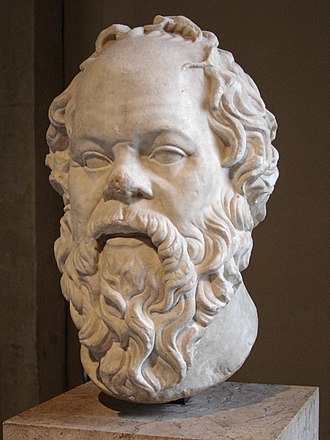
Socrates
The Athenian gadfly who wrote nothing, claimed to know nothing, questioned everyone — and was put to death for it, becoming philosophy’s martyr.

Seneca
Roman Stoic, playwright and statesman — tutor and adviser to Nero — whose letters on time, death, anger and friendship are among the most readable works of ancient philosophy.

Michel de Montaigne
The inventor of the essay, who made himself the subject of his book — sceptical, curious, tolerant, candid — and asked, “Que sais-je?” — What do I know?

Epicurus
The gentle materialist who taught that pleasure — understood as the absence of pain and fear — is the goal of life, and that death is nothing to us.

The Odyssey
Homer’s epic of Odysseus’s ten-year journey home from Troy — monsters, witches, the underworld and a household besieged — the archetype of every adventure, every homecoming and every clever hero.

Kaṭha Upaniṣad
The story of the boy Naciketas, who goes to the house of Death and asks what happens after death — receiving the teaching of the immortal Self.