German literature’s great myth is Faust, the scholar who sells his soul for knowledge and experience — Goethe spent sixty years on his version. Around Goethe and Schiller, Weimar became the centre of a classical culture devoted to Bildung — the formation of the self — while the Romantics (Novalis, the Schlegels, Hölderlin) sought the infinite in nature and longing. Kleist’s stories record a “Kant crisis” (see Immanuel Kant); Heine’s lyric irony; Büchner’s Woyzeck.
The twentieth century: Rilke’s Duino Elegies, Thomas Mann’s Magic Mountain and Doctor Faustus, Hesse’s Siddhartha and Steppenwolf, and above all Franz Kafka — The Trial, The Metamorphosis — whose name became an adjective for the modern labyrinth of guilt and bureaucracy.
Map of Influence
who answered whom, inside this roomThinkers & Authors
4
Friedrich Heinrich Jacobi
German critic of the Enlightenment who sparked the Pantheism Controversy and gave philosophy the word “nihilism”.
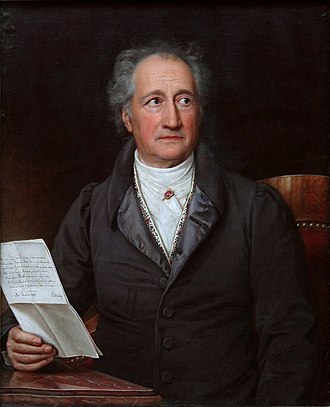
Johann Wolfgang von Goethe
Germany’s greatest writer — poet, novelist, dramatist, scientist and statesman — whose Faust is the modern myth of the striving soul, and whose life was itself treated as a work of art.

Friedrich Nietzsche
Philosopher with a hammer who announced the death of God, unmasked the genealogy of morality, and called for new values — the will to power, eternal recurrence, the Übermensch, amor fati.

Franz Kafka
Prague insurance clerk whose parables of guilt, bureaucracy and metamorphosis became the defining images of modern anxiety — and the word “Kafkaesque”.
Works
4
Faust
Goethe’s two-part dramatic poem of the scholar who wagers his soul with Mephistopheles that no moment of pleasure will ever satisfy him — the defining myth of modern restless striving.
Thus Spoke Zarathustra
Nietzsche’s prophetic prose-poem — Zarathustra descends from his mountain to teach the Übermensch, the will to power and eternal recurrence.

The Trial
Josef K. is arrested one morning without having done anything wrong, and spends a year trying to understand an invisible court — until two men take him to a quarry and kill him “like a dog”.

The Metamorphosis
Gregor Samsa, a travelling salesman, wakes one morning transformed into a monstrous vermin — and his family’s duty slowly curdles into disgust and relief.
Characters
3Gregor Samsa
The travelling salesman who wakes as a giant insect and remains, inside, more human than the family that comes to find him a burden.
Josef K.
A bank officer arrested on his thirtieth birthday for an unnamed crime, who spends a year failing to reach the court that has already judged him.
Zarathustra
Nietzsche’s prophet who, after ten years in mountain solitude, descends to teach mankind the Übermensch — and finds no one ready to listen.
Great Scenes
3Before the Law
A man from the country asks to be admitted to the Law; the doorkeeper says “not now”; he waits his whole life — and learns as he dies that this door was meant only for him.
The Madman with the Lantern
Nietzsche’s parable of the madman who runs into the marketplace at noon with a lantern crying “I seek God!” — and announces that we have killed him.
Lordship and Bondage
Hegel’s parable — two self-consciousnesses fight for recognition to the death; one yields and becomes slave; but the slave, through fear and labour, wins the truer freedom.
Coming to the Library
19 pages being writtenVoices
quotations from this traditionGod is dead. God remains dead. And we have killed him.
Gott ist tot! Gott bleibt tot! Und wir haben ihn getödtet!
He who fights with monsters should look to it that he himself does not become a monster. And if you gaze long into an abyss, the abyss also gazes into you.
Wer mit Ungeheuern kämpft, mag zusehn, dass er nicht dabei zum Ungeheuer wird. Und wenn du lange in einen Abgrund blickst, blickt der Abgrund auch in dich hinein.
What does not kill me makes me stronger.
Was mich nicht umbringt, macht mich stärker.
He who has a why to live for can bear almost any how.
Hat man sein warum? des Lebens, so verträgt man sich fast mit jedem wie?
My formula for greatness in a human being is amor fati — that one wants nothing to be different, not forward, not backward, not in all eternity.
Man is a rope, tied between beast and overman — a rope over an abyss.
One must still have chaos in oneself to be able to give birth to a dancing star.
There are no facts, only interpretations.
Become who you are.
Werde, der du bist.
Without music, life would be a mistake.
Ohne Musik wäre das Leben ein Irrtum.
A book must be the axe for the frozen sea within us.
Ein Buch muss die Axt sein für das gefrorene Meer in uns.
Someone must have slandered Josef K., for one morning, without having done anything wrong, he was arrested.