Some novels are stories; some are arguments with faces. This room gathers the novels and novellas in the library — books in which ideas are given bodies and tested to destruction: Raskolnikov’s theory, Ivan’s rebellion, the Underground Man’s freedom, Bazarov’s nihilism, Gregor Samsa’s metamorphosis, Meursault’s indifference.
Works
15The Jātakas
547 stories of the Buddha’s previous lives — as a hare, a monkey king, a merchant, a prince — told to illustrate the virtues that lead to awakening. India’s great treasury of folk tales, carved on stūpas and painted in caves.
The Pañcatantra
The ancient Indian book of animal fables written to teach princes the art of practical wisdom (nīti) — the jackals Karaṭaka and Damanaka, the monkey and the crocodile, the lion and the hare — translated into more languages than almost any book except the Bible.

Don Quixote
Cervantes’s comic masterpiece about a country gentleman driven mad by chivalric romances, who sets out as a knight-errant with his squire Sancho Panza — often called the first modern novel and the greatest ever written.

Candide
Voltaire’s comic philosophical tale, in which a naïve young man and his optimist tutor suffer every disaster the eighteenth century could offer — ending with “we must cultivate our garden”.

Fathers and Sons
Turgenev’s novel of the generation gap — the nihilist Bazarov against the old liberal Kirsanovs — which gave Russia the word “nihilist”.
What Is to Be Done?
Chernyshevsky’s prison-written utopian novel of “new people” and rational egoism — badly written, enormously influential, the target of Dostoevsky’s Underground Man.

Notes from Underground
A spiteful, hyper-conscious ex-official rants from his “mousehole” against reason, progress and the Crystal Palace — often called the first existentialist novel.
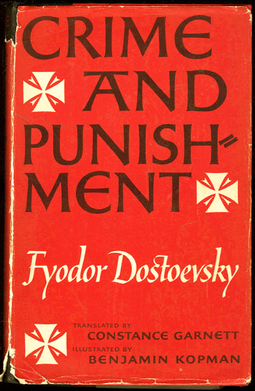
Crime and Punishment
A poor ex-student in St Petersburg murders an old pawnbroker to prove he is an “extraordinary man” — and is undone not by the police but by his own conscience and by Sonya’s love.

Demons
Dostoevsky’s prophetic political novel — a provincial town possessed by revolutionary nihilists, the murder of one of their own, and the hollow charisma of Stavrogin.

The Brothers Karamazov
Dostoevsky’s last and greatest novel — a murdered father, three brothers (the sensualist, the intellectual, the saint), and the deepest debate about God and evil in literature.

The Death of Ivan Ilyich
Tolstoy’s novella of a respectable judge who, dying of a trivial injury, realizes that his correct, comfortable life was a lie — and finds, at the last moment, the light.

The Trial
Josef K. is arrested one morning without having done anything wrong, and spends a year trying to understand an invisible court — until two men take him to a quarry and kill him “like a dog”.

The Metamorphosis
Gregor Samsa, a travelling salesman, wakes one morning transformed into a monstrous vermin — and his family’s duty slowly curdles into disgust and relief.
Godān
Premchand’s last and greatest novel (1936) — the life and death of Hori, a poor peasant who longs only to own a cow, crushed by debt, caste, landlords and priests — the epic of the Indian village under colonial rule.
The Stranger
Camus’s first novel — Meursault, who will not pretend to feel what he does not feel, kills an Arab on a beach and is condemned for not weeping at his mother’s funeral.
Characters
12Alyosha Karamazov
The youngest brother, novice of the elder Zosima, “the hero” of the novel — who answers Ivan’s arguments not with refutation but with a kiss.
Yevgeny Bazarov
Turgenev’s young doctor-nihilist who rejects art, love and every authority — and dies of a cut finger, having loved and lost.
Gregor Samsa
The travelling salesman who wakes as a giant insect and remains, inside, more human than the family that comes to find him a burden.
Ivan Ilyich Golovin
A successful, decent, utterly conventional judge who learns, dying, that he never really lived.
Ivan Karamazov
The rational, tormented middle brother who “returns his ticket” to God’s world and authors the Grand Inquisitor — and whose idea that “everything is permitted” kills his father.
Josef K.
A bank officer arrested on his thirtieth birthday for an unnamed crime, who spends a year failing to reach the court that has already judged him.
Alexei Kirillov
The engineer in Demons who reasons that if God does not exist, man must become God — and that the supreme act of self-will is suicide.
Meursault
Camus’s “stranger” — a clerk in Algiers who will not say more than he feels, kills a man on a beach, and goes to the guillotine opening himself to “the gentle indifference of the world”.
Rodion Raskolnikov
Impoverished ex-student who murders a pawnbroker to prove he is an “extraordinary man” beyond morality — and is broken and reborn by his conscience.
Nikolai Stavrogin
The magnetic, empty aristocrat at the centre of Demons — everyone’s idol, nobody’s master, strength without belief.
Sonya Marmeladova
The meek young prostitute who reads Raskolnikov the raising of Lazarus and follows him to Siberia — Dostoevsky’s image of redemptive love.
The Underground Man
Dostoevsky’s nameless, spiteful, hyper-conscious narrator who rebels against reason, progress and his own interests to prove he is free.
Great Scenes
5Before the Law
A man from the country asks to be admitted to the Law; the doorkeeper says “not now”; he waits his whole life — and learns as he dies that this door was meant only for him.
Rebellion — Returning the Ticket
Ivan tells Alyosha true stories of tortured children and declares that no future harmony could be worth one child’s tear — so he respectfully returns his ticket.
The Grand Inquisitor
Ivan Karamazov’s prose-poem — Christ returns to sixteenth-century Seville, and the aged Cardinal Inquisitor imprisons him, explaining that humanity cannot bear the freedom He offered.
Meursault and the Chaplain
On the eve of execution, Meursault explodes at the prison chaplain’s certainty — and finds peace in the “gentle indifference of the world”.
Sonya Reads Lazarus
In her bare room, by a candle-end, the prostitute Sonya reads the murderer Raskolnikov the Gospel story of the raising of Lazarus.
Coming to the Library
10 pages being writtenVoices
quotations from this traditionMother died today. Or maybe yesterday, I don’t know.
Aujourd'hui, maman est morte. Ou peut-être hier, je ne sais pas.
I opened myself to the gentle indifference of the world.
Je m'ouvrais pour la première fois à la tendre indifférence du monde.
Someone must have slandered Josef K., for one morning, without having done anything wrong, he was arrested.
As Gregor Samsa awoke one morning from uneasy dreams he found himself transformed in his bed into a monstrous vermin.
Als Gregor Samsa eines Morgens aus unruhigen Träumen erwachte, fand er sich in seinem Bett zu einem ungeheueren Ungeziefer verwandelt.
No one else could ever be admitted here, since this gate was made only for you. I am now going to shut it.
If there is no God and no immortality, then everything is permitted.
It’s not God that I don’t accept, Alyosha, only I most respectfully return Him the ticket.
The whole world of knowledge is not worth that child’s prayer to “dear, kind God”!
Feed men, and then ask of them virtue!
Nothing has ever been more insupportable for a man and a human society than freedom.
Each of us is guilty before all, for all, and I more than the others.
What is hell? I maintain that it is the suffering of being unable to love.