Contents · 9 sections · 14 min
Key Ideas
The “extraordinary man” theory — great men (Napoleon) have the right to step over blood for a higher idea.
Utilitarian arithmetic — kill one useless louse, save a hundred lives with her money.
The murder as experiment on the self — “did I murder the old woman? I murdered myself.”
Sonya — the prostitute-saint who reads him the raising of Lazarus.
Porfiry Petrovich — the detective-psychologist who knows and waits.
Svidrigailov — Raskolnikov’s dark double, who has “stepped over” with no remorse — and shoots himself.
Suffering as the road to rebirth.
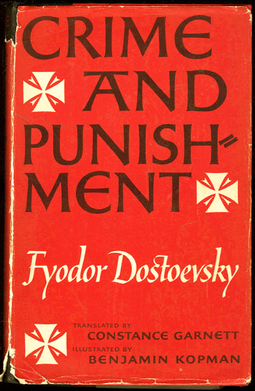
Crime and Punishment (1866) is the story of a murder told from inside the murderer’s mind. A brilliant, starving ex-student kills an old pawnbroker with an axe to prove a theory — that extraordinary people have the right to step over moral law — and then spends six hundred pages discovering, in fever, terror, and the company of a meek young prostitute, that he was wrong about the theory and wrong about himself. It is a psychological thriller (the reader knows the murderer from the start; the suspense is whether he will confess), a philosophical novel about utilitarianism, nihilism and the “great man”, a portrait of the poverty of St Petersburg, and a Christian story of resurrection.
This page tells the whole story — you need not have read it — and then explains its ideas, characters, and afterlife.
At a glance
| Author | Fyodor Dostoevsky |
| Published | Serialized in The Russian Messenger, January–December 1866 |
| Setting | St Petersburg, a heat-wave in July 1865; the epilogue in Siberia |
| Structure | Six parts and an epilogue; Part One ends with the murder |
| Original title | Преступление и наказание — prestuplenie, literally “a stepping-across” |
| Key themes | The extraordinary man; utilitarian reasoning; guilt and conscience; suffering and redemption; poverty; the city |
The characters
Russian names have three parts and many diminutives. Here they are with the forms you will meet.
- Rodion Romanovich Raskolnikov (Rodya, Rodka) — 23, former law student, proud, generous, isolated, feverish. His name evokes raskol, “schism”. See Rodion Raskolnikov.
- Pulkheria Alexandrovna — his mother; Avdotya Romanovna (Dunya, Dounia) — his beautiful, strong-willed sister.
- Dmitri Prokofich Razumikhin — his loyal, noisy, warm-hearted friend; his name suggests razum, “reason”.
- Alyona Ivanovna — the old pawnbroker, a usurer; Lizaveta Ivanovna — her gentle, simple half-sister.
- Semyon Zakharovich Marmeladov — a drunken ex-official; Katerina Ivanovna — his consumptive, proud wife; Sofya Semyonovna (Sonya, Sonechka) — his daughter from his first marriage, who has become a prostitute to feed the family. See Sonya Marmeladova.
- Porfiry Petrovich — the investigating magistrate: plump, playful, brilliant.
- Arkady Ivanovich Svidrigailov — Dunya’s former employer, a wealthy, depraved, fascinating sensualist — Raskolnikov’s dark double.
- Pyotr Petrovich Luzhin — Dunya’s fiancé, a pompous, calculating lawyer.
- Andrei Semyonovich Lebezyatnikov — a foolish young “progressive”, parody of the nihilists.
Plot summary
The murder
July, a stifling heat-wave in St Petersburg. Raskolnikov, who has dropped out of university and lives in a tiny garret “more like a cupboard than a room”, slips past his landlady, to whom he owes rent, and walks — exactly 730 steps — to the flat of Alyona Ivanovna, an old moneylender. He pawns his father’s watch. It is a “rehearsal”. He is contemplating something he cannot yet name to himself.
In a tavern he meets Marmeladov, a drunken former clerk, who tells him, in one of Dostoevsky’s great monologues, how his daughter Sonya went out on the “yellow ticket” (a prostitute’s licence) to save the family from starvation, how he has drunk away even her money, and how he believes God will forgive even him on the Last Day: “Ye swine! made in the Image of the Beast… but come ye also!” Raskolnikov takes him home and sees the family’s misery: the consumptive Katerina Ivanovna, the starving children. He leaves some coins on the windowsill.
The next morning a letter from his mother: his sister Dunya has been slandered after rejecting the advances of her employer Svidrigailov (whose wife Marfa Petrovna then cleared her name), and has now become engaged to Luzhin, a prosperous lawyer of forty-five — a marriage that will help Rodya finish his studies. Raskolnikov sees immediately that Dunya is selling herself for him, as Sonya sold herself for her family. He will not allow it.
He has a terrible dream from his childhood: a drunken peasant flogs a little old mare to death in front of a jeering crowd, while the boy Rodya runs to kiss her bleeding muzzle. He wakes in horror: “Can it be that I shall really take an axe?”
Then chance seems to decide for him. In the Haymarket he overhears that Lizaveta, the pawnbroker’s half-sister, will be away from home at seven the next evening. And he remembers a conversation he once overheard in a tavern between a student and an officer: kill that useless, harmful old woman, take her money, and with it do a thousand good deeds — “one death, and a hundred lives in exchange — it’s simple arithmetic!”
The next evening he steals an axe from the porter’s lodge, hides it in a loop sewn inside his coat, and goes to the flat. He gives the old woman a fake pledge wrapped tightly, and while she struggles with the string, he brings the axe down on her head with the blunt side, again and again. He fumbles for the keys and rummages in her trunk. Then Lizaveta walks in — the door was unlatched. He kills her too, with the blade. People come up the stairs and knock; he hides behind the door, holding it shut, as they try the bell; they go down for the porter; he slips out, hides in an empty flat being painted, and escapes into the street. Home, he collapses in fever.
Fever
Summoned to the police station — only, it turns out, about his unpaid rent — he faints when he hears the murder discussed. He hides the stolen purse and trinkets under a stone in a courtyard without even looking at them. He falls ill for four days, nursed by Razumikhin and the servant Nastasya, delirious. He wanders the city, almost confessing to a police clerk, Zametov, in a café: “And what if it was I who killed the old woman and Lizaveta?”
He witnesses Marmeladov run over by a carriage, carries him home, and watches him die in Sonya’s arms. He gives Katerina Ivanovna all the money his mother sent him for the funeral. For a moment he feels alive again: “Life is real! haven’t I lived just now?”
The article
His mother and sister arrive in Petersburg. Raskolnikov is cold and strange with them; he orders Dunya to break off with Luzhin. Razumikhin falls in love with Dunya.
Raskolnikov visits Porfiry Petrovich, the investigating magistrate, on the pretext of recovering his pawned watch. Porfiry has read an article Raskolnikov published months earlier, “On Crime”. In it, Raskolnikov argued that humanity is divided into two classes: the ordinary — the material, who must live in obedience — and the extraordinary, who have the gift “to utter a new word”, and who have the right — not an official right, but an inner one — to “step over” obstacles, even over blood, if their idea requires it. Kepler and Newton would have been justified in removing a hundred people who stood in the way of their discoveries; Lycurgus, Solon, Mohammed and Napoleon were all criminals, shedding blood to establish new laws.
Porfiry, playful and probing, asks: how do you tell which is which? And did you, when writing it, consider yourself extraordinary? “Did you not, perhaps, consider yourself a Napoleon?” Raskolnikov leaves certain that Porfiry suspects him. A stranger in the street calls him “murderer!”
That night he dreams he returns to the flat and strikes the old woman again and again — and she laughs, silently.
He wakes to find Svidrigailov sitting in his room.
Svidrigailov and Sonya
Svidrigailov, whose wife has just died (rumour says he poisoned or beat her), has come to Petersburg in pursuit of Dunya. He is cynical, witty, frank about his debaucheries, and strangely gentle. He tells Raskolnikov he sees ghosts — his wife has visited him three times — and offers a vision of eternity: “We always imagine eternity as an idea that cannot be understood, something immense. But why must it be immense? Instead of all that, what if it’s one little room, like a bath-house in the country, black and grimy and spiders in every corner, and that’s all eternity is?”
Luzhin, insulted by Raskolnikov at a family meeting, is dismissed by Dunya.
Raskolnikov goes to Sonya’s room — a strange, irregular room in the tailor Kapernaumov’s flat — and torments her: what will happen to the children when Katerina Ivanovna dies? Will Polenka, the little girl, go the same way? Does God help her? “What does God do for you?” “He does everything,” she whispers. He sees on her table a New Testament — given to her by Lizaveta — and demands she read him the story of Lazarus. Trembling, she reads; her voice rings out at “I am the resurrection and the life… Lazarus, come forth!” He kneels and kisses her foot: “I did not bow down to you, I bowed down to all the suffering of humanity.” He promises to tell her who killed Lizaveta. See Sonya Reads Lazarus.
Next door, unknown to them, Svidrigailov has been listening through the wall.
At the police station, Porfiry plays a long cat-and-mouse game with Raskolnikov, hinting, teasing, confessing his methods — let the suspect run around like a moth around a candle; he will come back on his own. Raskolnikov nearly breaks. Then an astonishing interruption: Mikolka, a house-painter who had been working in the empty flat, bursts in and confesses to the murders.
Confession to Sonya
Luzhin, seeking revenge on Raskolnikov, slips a hundred-rouble note into Sonya’s pocket during Katerina Ivanovna’s chaotic funeral dinner and accuses her of theft. Lebezyatnikov, who saw him do it, exposes him. But Katerina Ivanovna, evicted, goes mad, drags her children through the streets begging, and dies of a haemorrhage.
Raskolnikov goes to Sonya and confesses. He struggles to explain why: not for money — he never even looked at what he stole; not to help his mother; not even, finally, for humanity:
I wanted to become a Napoleon, that’s why I killed her… I wanted to find out then and quickly whether I was a louse like everybody else or a man. Whether I can step over or not… whether I am a trembling creature or whether I have the right.
And then: “Did I murder the old woman? I murdered myself, not her! I crushed myself once for all, for ever.”
Sonya flings her arms around him: “What have you done to yourself!… There is no one, no one in the whole world now so unhappy as you!” She tells him what to do:
Go at once, this very minute, stand at the cross-roads, bow down, first kiss the earth which you have defiled, and then bow down to all the world and say to all men aloud, “I am a murderer!” Then God will send you life again.
She gives him her cypress cross. Svidrigailov, listening again through the wall, now knows everything.
Porfiry and Svidrigailov
Porfiry visits Raskolnikov in his garret and tells him plainly: “You killed them.” Mikolka’s confession is false — the painter is an Old Believer who wants to take on suffering. Porfiry has no proof, but he urges Raskolnikov to confess, which will reduce his sentence: “Become a sun and all will see you.” “Suffering is a great thing… there is an idea in suffering.”
Svidrigailov lures Dunya to his rooms, tells her what he overheard, offers to save her brother if she will give herself to him, and locks the door. Dunya takes out a revolver and fires at him — the bullet grazes his head; she fires again, and the gun misfires. Svidrigailov asks: “So you don’t love me? And never could?” “Never.” He gives her the key and lets her go. That night he wanders the city in the rain, gives money away (to Sonya, to his fifteen-year-old fiancée’s family), has nightmares in a cheap hotel — a drowned girl, a five-year-old child with a depraved smile — and at dawn, in front of a fireman wearing an Achilles helmet, shoots himself in the head: “When they ask you, tell them I’ve gone to America.”
Raskolnikov says goodbye to his mother and sister, goes to the Haymarket, kneels and kisses the earth — the crowd laughs — and then, at the police station, after hesitating at the door, sees Sonya waiting outside, turns back, and confesses: “It was I who killed the old pawnbroker woman and her sister Lizaveta with an axe and robbed them.”
Siberia
Because he confessed, and because of evidence of his past generosity (he had supported a consumptive fellow student and his father; he had saved two children from a fire), he is sentenced to only eight years of penal servitude in Siberia. Sonya follows him and lives in the town, helping the convicts, who come to love her. His mother dies; Dunya marries Razumikhin.
In prison Raskolnikov is cold, proud, isolated, still not repenting: he regrets only that he failed, that he confessed. The convicts hate him; once they attack him as an “atheist”. During Lent he falls ill and dreams of a plague: microscopic creatures — trichinae — endowed with intelligence and will, infect people, who become convinced that they alone possess the truth; whole cities and nations go mad, cannot agree on what is good and evil, kill each other; the world perishes, except a few pure people.
Then one spring morning on the bank of the wide river, Sonya comes and sits beside him:
How it happened he did not know. But all at once something seemed to seize him and fling him at her feet. He wept and threw his arms round her knees… They wanted to speak, but could not; tears stood in their eyes… They were renewed by love; the heart of each held infinite sources of life for the heart of the other.
Under his pillow lies the New Testament. “But that is the beginning of a new story — the story of the gradual renewal of a man… That might be the subject of a new story, but our present story is ended.”
The ideas
The extraordinary man
Raskolnikov’s theory is a fusion of ideas in the air in the 1860s: Napoleon worship (Napoleon III’s History of Julius Caesar, 1865, argued that great men have a right to stand above the law); Hegel’s “world-historical individuals”, who trample innocent flowers on their way; and a crude social Darwinism. Twenty years later, Friedrich Nietzsche would develop a far subtler version — the Übermensch and the “master morality” — and Nietzsche admired Dostoevsky as a psychologist. See Will to Power.
Dostoevsky does not refute the theory by argument. Raskolnikov’s real refutation is that he cannot live with what he has done. He is not a Napoleon; a Napoleon “would not have suffered”. The idea fails in the conscience and the body — in fever, nightmares, isolation.
Utilitarian arithmetic
The overheard tavern argument — one useless old woman for a hundred lives — is a parody of radical utilitarianism, the ethics of the Russian “new men” (Nikolai Chernyshevsky and the Rational Egoism Dostoevsky attacked in Notes from Underground). The novel’s answer: real human beings are not quantities. The “useless” old woman had a half-sister, Lizaveta, who was gentle and pious — and the murderer killed her too. Theories that treat persons as units in a calculation will always find a Lizaveta behind the door.
Nihilism
Raskolnikov is a “nihilist” in the sense of Russian Nihilism: he rejects God, tradition and conventional morality and trusts only his reason. Svidrigailov is the nihilist who has truly gone all the way — he has stepped over every line and found only boredom, spiders, and a revolver. Lebezyatnikov is the comic version, earnestly parroting progressive slogans. See Nihilism.
Guilt and conscience
The title is misleading: the “punishment” is not Siberia but what happens inside Raskolnikov from the moment of the crime — alienation from everyone he loves, paranoia, illness, the unbearable weight of a secret. Dostoevsky called the novel “the psychological account of a crime”. See Guilt & Redemption.
Suffering and resurrection
Sonya, Porfiry, Mikolka and the convicts all speak of suffering as something to be accepted — “there is an idea in suffering”. The Lazarus story structures the novel: Raskolnikov is dead in his tomb (his garret, his idea) and must be raised. Many readers find the epilogue’s sudden resurrection unconvincing; others think it is the point — grace is not earned by argument.
The city
Dostoevsky’s St Petersburg — the Haymarket, the canals, the yellow wallpaper, the stifling heat, the stench of drink, the stairwells and courtyards — is a character in its own right: a city of poverty, overcrowding and isolation that breeds feverish ideas. You can still walk Raskolnikov’s route from Stolyarny Lane to the pawnbroker’s flat.
Doubles and mirrors
Dostoevsky surrounds Raskolnikov with characters who reflect possibilities of himself:
| Character | Reflects |
|---|---|
| Svidrigailov | Where the theory leads if you have no conscience — boredom and suicide |
| Sonya | Another who has “stepped over” (into prostitution) — but for others, in humility, with faith |
| Razumikhin | Reason and warmth without pride — what Raskolnikov could have been |
| Luzhin | Rational egoism in its petty, bourgeois form |
| Mikolka | The peasant who wants to take on suffering for its own sake |
| Porfiry | The intellect that understands without judging |
Afterlife
- Films: Robert Bresson’s Pickpocket (1959) transposes it to Paris; Lev Kulidzhanov’s Soviet version (1970); Aki Kaurismäki’s Finnish version (1983); Woody Allen’s Match Point (2005) imagines a Raskolnikov who gets away with it.
- Literature: Camus’s The Stranger, Nabokov’s Lolita (narrated by a murderer), Patricia Highsmith’s Ripley novels, and countless crime novels in which the reader knows the killer from the start.
- The detective: Porfiry Petrovich is the ancestor of every intellectual detective who catches the killer by psychology rather than evidence — notably TV’s Lieutenant Columbo.
Keywords
- Prestuplenie
- "Crime" — literally a stepping-across, a transgression.
- The extraordinary man
- Raskolnikov's theory that great men may step over moral law.
- Louse
- Raskolnikov's word for the ordinary person — and, finally, for himself.
- The yellow ticket
- The licence of a registered prostitute in tsarist Russia.
- Haymarket (Sennaya)
- The squalid market square at the heart of the novel's Petersburg.
- Trichinae dream
- The epilogue's vision of a plague of self-certain ideas destroying humanity.
Using Crime and Punishment in conversation
- On “the greater good”: Raskolnikov’s arithmetic — and Lizaveta behind the door.
- On self-destruction: “I murdered myself, not her.”
- On great-man theories: a Napoleon “would not have suffered”.
- On confession and healing: Sonya’s crossroads.
Crime and Punishment in two minutes
An idea can kill — and the punishment begins inside the murderer before any court convicts him.
A poor ex-student in St Petersburg murders an old pawnbroker to prove he is an “extraordinary man” — and is undone not by the police but by his own conscience and by Sonya’s love.
- The “extraordinary man” theory — great men (Napoleon) have the right to step over blood for a higher idea.
- Utilitarian arithmetic — kill one useless louse, save a hundred lives with her money.
- The murder as experiment on the self — “did I murder the old woman? I murdered myself.”
- Sonya — the prostitute-saint who reads him the raising of Lazarus.
- Porfiry Petrovich — the detective-psychologist who knows and waits.
- Svidrigailov — Raskolnikov’s dark double, who has “stepped over” with no remorse — and shoots himself.
- Suffering as the road to rebirth.
“I wanted to find out then and quickly whether I was a louse like everybody else or a man.” — Part V, ch. 4
Characters
2Rodion Raskolnikov
Impoverished ex-student who murders a pawnbroker to prove he is an “extraordinary man” beyond morality — and is broken and reborn by his conscience.
Sonya Marmeladova
The meek young prostitute who reads Raskolnikov the raising of Lazarus and follows him to Siberia — Dostoevsky’s image of redemptive love.
Great Scenes
1Lines to Remember
3 quotationsI wanted to find out then and quickly whether I was a louse like everybody else or a man.
Context & when to use it
Raskolnikov’s confession to Sonya — the murder was a test of whether he dared to “step over”.
For the will to power, the Napoleonic complex, ideas that kill.
Did I murder the old woman? I murdered myself, not her! I crushed myself once for all, for ever.
Context & when to use it
To Sonya. The crime destroyed the criminal.
For how evil acts deform the doer; guilt as self-destruction.
Pain and suffering are always inevitable for a large intelligence and a deep heart.
Context & when to use it
In conversation with Porfiry about his article on extraordinary men.
For the price of depth and sensitivity.
Explore Next
related by shared connections
Demons
Dostoevsky’s prophetic political novel — a provincial town possessed by revolutionary nihilists, the murder of one of their own, and the hollow charisma of Stavrogin.

Notes from Underground
A spiteful, hyper-conscious ex-official rants from his “mousehole” against reason, progress and the Crystal Palace — often called the first existentialist novel.

Nikolai Chernyshevsky
Radical critic and author of What Is to Be Done? — the utopian novel of “rational egoism” that inspired Lenin and provoked Dostoevsky’s Underground Man.

The Brothers Karamazov
Dostoevsky’s last and greatest novel — a murdered father, three brothers (the sensualist, the intellectual, the saint), and the deepest debate about God and evil in literature.

Candide
Voltaire’s comic philosophical tale, in which a naïve young man and his optimist tutor suffer every disaster the eighteenth century could offer — ending with “we must cultivate our garden”.
Russian Nihilism
The 1860s movement of young Russian radicals who rejected tradition, religion, art and authority in the name of science, utility and the people.