Raskolnikov is not a monster. He gives his last kopecks to the Marmeladovs, saves children from a fire (we learn at the trial), and loves his mother and sister. That is the horror: the murder comes from a theory, not a character.
His double, Svidrigailov, has truly stepped beyond good and evil — and finds only boredom and a vision of eternity as a country bathhouse full of spiders. Raskolnikov’s salvation comes through Sonya and through suffering.
How to use him: whenever someone argues that great ends justify any means, that some people “don’t count”, or that a clever enough theory can override conscience.
Lines to Remember
3 quotationsI wanted to find out then and quickly whether I was a louse like everybody else or a man.
Context & when to use it
Raskolnikov’s confession to Sonya — the murder was a test of whether he dared to “step over”.
For the will to power, the Napoleonic complex, ideas that kill.
Did I murder the old woman? I murdered myself, not her! I crushed myself once for all, for ever.
Context & when to use it
To Sonya. The crime destroyed the criminal.
For how evil acts deform the doer; guilt as self-destruction.
Pain and suffering are always inevitable for a large intelligence and a deep heart.
Context & when to use it
In conversation with Porfiry about his article on extraordinary men.
For the price of depth and sensitivity.
Explore Next
related by shared connectionsEdmund
Gloucester’s illegitimate son — the brilliant, charming, self-made villain of King Lear, who worships Nature as amoral force and scorns “the plague of custom”.
Sonya Reads Lazarus
In her bare room, by a candle-end, the prostitute Sonya reads the murderer Raskolnikov the Gospel story of the raising of Lazarus.

Macbeth
Shakespeare’s shortest tragedy — a brave soldier, prompted by witches and his wife, murders his king and wades so deep in blood that life becomes “a tale told by an idiot”.
Rational Egoism
Chernyshevsky’s doctrine that people always act from self-interest, and that enlightened self-interest will make everyone good.
Nikolai Stavrogin
The magnetic, empty aristocrat at the centre of Demons — everyone’s idol, nobody’s master, strength without belief.
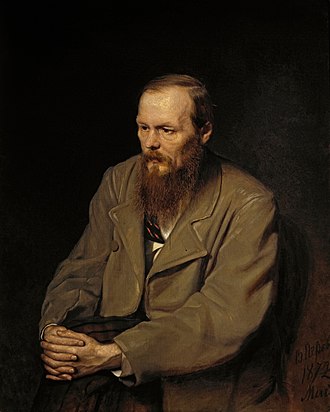
Fyodor Dostoevsky
The Russian novelist of the abyss — crime, faith, freedom, suffering — whose characters argue philosophy with their lives. Nietzsche called him the only psychologist he had anything to learn from.