No country’s philosophy has been more ambitious — or more consequential — than Germany’s between 1781 and 1945. It began when Immanuel Kant, provoked by Hume, argued that the mind shapes the world it experiences. His successors — Fichte, Schelling and Georg Wilhelm Friedrich Hegel (German Idealism) — tried to complete his revolution by deriving everything from reason or Spirit. Arthur Schopenhauer found behind appearances a blind Will; Karl Marx turned Hegel’s dialectic into a theory of history and revolution; Friedrich Nietzsche announced the death of God and attacked morality itself. In the twentieth century, Husserl’s Phenomenology and Martin Heidegger‘s question of Being reshaped European thought — and Heidegger’s Nazism cast a shadow over it.
A chain of answers
| Thinker | Answered | With |
|---|---|---|
| Kant | Hume | The categories — the mind legislates to nature |
| Hegel | Kant | Drop the thing-in-itself; reality is Spirit knowing itself |
| Schopenhauer | Hegel, Kant | The thing-in-itself is Will; life is suffering |
| Marx | Hegel | Turn the dialectic “right side up” — material history |
| Kierkegaard (Danish) | Hegel | The system forgets the existing individual |
| Nietzsche | Schopenhauer, Kant, Christianity | Affirm life; revalue all values |
| Heidegger | Descartes, Nietzsche | The forgotten question of Being |
Follow the chain on the Atlas or in the thread What Can We Know?.
Map of Influence
who answered whom, inside this roomThinkers & Authors
8
Immanuel Kant
The philosopher who tried to end the war between rationalism and empiricism by asking what the mind itself contributes to experience — the “Copernican revolution” in philosophy.

Friedrich Heinrich Jacobi
German critic of the Enlightenment who sparked the Pantheism Controversy and gave philosophy the word “nihilism”.
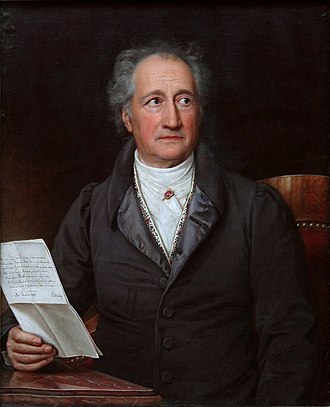
Johann Wolfgang von Goethe
Germany’s greatest writer — poet, novelist, dramatist, scientist and statesman — whose Faust is the modern myth of the striving soul, and whose life was itself treated as a work of art.

Georg Wilhelm Friedrich Hegel
The philosopher of Spirit and dialectic, for whom reality is a rational process working itself out through contradiction in history — “the real is the rational”.

Arthur Schopenhauer
The great pessimist, who said the thing-in-itself is blind, insatiable Will, that life swings like a pendulum between pain and boredom, and that art, compassion and renunciation are our only escape.

Karl Marx
Philosopher, economist and revolutionary who turned Hegel’s dialectic into historical materialism — the history of all hitherto existing society is the history of class struggles.

Friedrich Nietzsche
Philosopher with a hammer who announced the death of God, unmasked the genealogy of morality, and called for new values — the will to power, eternal recurrence, the Übermensch, amor fati.

Martin Heidegger
The philosopher of Being, who argued that the West had forgotten the question of what it means to be, and analysed human existence (Dasein) as thrown, anxious, being-toward-death.
Works
10
Critique of Pure Reason
Kant’s masterwork, asking what reason can know without experience — and answering that it can know the forms of all possible experience, but nothing beyond.
Prolegomena to Any Future Metaphysics
Kant’s short, clearer restatement of the first Critique, where he credits Hume with waking him from his dogmatic slumber.
Critique of Practical Reason
Kant’s second Critique — the moral law is a fact of reason, and through it we know we are free.
Phenomenology of Spirit
Hegel’s first masterpiece — the “voyage of discovery” of consciousness through sense-certainty, self-consciousness, reason, spirit and religion to absolute knowing.

Faust
Goethe’s two-part dramatic poem of the scholar who wagers his soul with Mephistopheles that no moment of pleasure will ever satisfy him — the defining myth of modern restless striving.
The World as Will and Representation
Schopenhauer’s single great work — the world is my representation; in itself it is Will; and the Will is the source of all suffering.
The Gay Science
Nietzsche’s most joyful book — where God is first declared dead, the madman runs into the marketplace, and the thought of eternal recurrence first appears.
Thus Spoke Zarathustra
Nietzsche’s prophetic prose-poem — Zarathustra descends from his mountain to teach the Übermensch, the will to power and eternal recurrence.
Beyond Good and Evil
Nietzsche’s “prelude to a philosophy of the future” — an attack on the prejudices of philosophers, from Plato to Kant, and a sketch of the free spirit.
On the Genealogy of Morality
Nietzsche’s three essays tracing “good and evil”, guilt, and the ascetic ideal back to their hidden, all-too-human origins.
Ideas
13Synthetic a priori
Judgments that are informative about the world yet knowable independently of experience. Kant’s master question was how they are possible.
The Thing-in-Itself
Reality as it is independently of how it appears to us — for Kant, thinkable but never knowable.
The Categorical Imperative
Kant’s supreme principle of morality — act only on maxims you could will as universal laws; treat humanity always as an end, never merely as a means.
The Copernican Revolution
Kant’s reversal — instead of the mind conforming to objects, objects must conform to the mind’s forms of knowing.
Dialectic
The movement of thought — and for Hegel, of reality — through contradiction toward a richer unity.
Geist (Spirit)
Hegel’s name for reality as self-knowing mind unfolding through nature, history, culture and philosophy.
The Will
Schopenhauer’s name for the thing-in-itself — a blind, aimless, insatiable striving that expresses itself in everything, from gravity to human desire.
The Death of God
Nietzsche’s announcement that belief in God has become unbelievable — and that with Him the foundations of Western morality have gone.
Eternal Recurrence
Nietzsche’s thought-experiment — would you will to live your life again, every moment, infinitely? The supreme test of affirming life.
The Übermensch
Nietzsche’s “overman” — the human being who, after the death of God, creates new values and affirms life wholly.
Will to Power
Nietzsche’s idea that the basic drive of all life is not survival but growth, mastery, self-overcoming.
Master and Slave Morality
Nietzsche’s genealogy — “good/bad” was the self-affirmation of nobles; “good/evil” was invented by the resentful weak to revenge themselves on the strong.
Dasein
Heidegger’s term for the human being — “being-there” — the entity whose own being is an issue for it.
Schools & Movements
2German Idealism
The extraordinary philosophical movement after Kant — Fichte, Schelling, Hegel — that tried to complete his revolution by showing reality itself to be the work of mind or Spirit.
Phenomenology
Husserl’s method of describing experience exactly as it appears — “to the things themselves!” — which Heidegger and Sartre turned toward existence.
Coming to the Library
15 pages being writtenVoices
quotations from this traditionGod is dead. God remains dead. And we have killed him.
Gott ist tot! Gott bleibt tot! Und wir haben ihn getödtet!
He who fights with monsters should look to it that he himself does not become a monster. And if you gaze long into an abyss, the abyss also gazes into you.
Wer mit Ungeheuern kämpft, mag zusehn, dass er nicht dabei zum Ungeheuer wird. Und wenn du lange in einen Abgrund blickst, blickt der Abgrund auch in dich hinein.
What does not kill me makes me stronger.
Was mich nicht umbringt, macht mich stärker.
He who has a why to live for can bear almost any how.
Hat man sein warum? des Lebens, so verträgt man sich fast mit jedem wie?
My formula for greatness in a human being is amor fati — that one wants nothing to be different, not forward, not backward, not in all eternity.
Man is a rope, tied between beast and overman — a rope over an abyss.
One must still have chaos in oneself to be able to give birth to a dancing star.
There are no facts, only interpretations.
Become who you are.
Werde, der du bist.
Without music, life would be a mistake.
Ohne Musik wäre das Leben ein Irrtum.
Language is the house of Being. In its home man dwells.
Two things fill the mind with ever new and increasing admiration and awe, the more often and steadily we reflect upon them: the starry heavens above me and the moral law within me.
Zwei Dinge erfüllen das Gemüt mit immer neuer und zunehmender Bewunderung und Ehrfurcht, je öfter und anhaltender sich das Nachdenken damit beschäftigt: der bestirnte Himmel über mir und das moralische Gesetz in mir.