

Contents · 4 sections · 4 min
Goethe in Five Ideas
the essentialsStriving
“Whoever strives with all his might, him we can redeem” — the restless human urge to experience and know is Faust’s sin and his salvation.
Bildung
The formation of the self through experience, culture and error — the ideal of Wilhelm Meister and of Goethe’s own life.
Weltliteratur
He coined “world literature” — the idea that national literatures were giving way to a common literature of humanity.
Metamorphosis
In botany he sought the “primal plant” (Urpflanze) — all plant forms as transformations of the leaf.
Against Newton
His Theory of Colours (1810) studied colour as experienced, not as physics — wrong about optics, prophetic about perception.
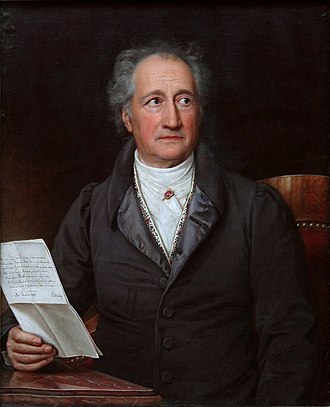
Johann Wolfgang von Goethe was the last universal genius of Europe: the greatest German poet, a novelist who changed the European novel twice, a dramatist whose Faust is the central myth of modern striving, a scientist who discovered a bone in the human jaw and challenged Newton on colour, a civil servant who ran a small state’s mines, roads and finances, and a sage to whom the whole of Europe made pilgrimage. Napoleon, meeting him, said simply: “Vous êtes un homme” — “You are a man.”
Life
Frankfurt and Sturm und Drang
Goethe was born on 28 August 1749 in Frankfurt am Main, the son of a wealthy, pedantic lawyer and a lively, much younger mother. He studied law at Leipzig and Strasbourg, where he met the critic Herder, who taught him to love Shakespeare, folk song, Homer and Ossian. His play Götz von Berlichingen (1773), about a rebellious knight, and his epistolary novel The Sorrows of Young Werther (1774) launched the Sturm und Drang (“Storm and Stress”) movement of passionate rebellion against Enlightenment rationalism. Werther — the story of a sensitive young man who falls hopelessly in love with a woman engaged to another and shoots himself — was a European sensation; young men dressed in Werther’s blue coat and yellow waistcoat, and some, it was said, imitated his suicide.
Weimar
In 1775 the eighteen-year-old Duke Karl August invited Goethe to the small duchy of Saxe-Weimar, where he stayed for the rest of his life. He became a minister — responsible for mines, roads, finance and the army — and for ten years wrote little of note, absorbed in administration and an intense, platonic relationship with Charlotte von Stein.
In 1786 he fled secretly to Italy for nearly two years — Rome, Naples, Sicily — and was reborn as a classicist, devoted to Greek and Roman form, sensuous fulfilment and natural science. Returning, he took the young flower-maker Christiane Vulpius as his partner (they married only in 1806), scandalizing Weimar society.
From 1794 until Schiller’s death in 1805, his friendship and collaboration with the poet Friedrich Schiller created Weimar Classicism, the summit of German literature. In these years and after, he wrote Wilhelm Meister’s Apprenticeship (1795–96), the model of the Bildungsroman (novel of formation); Hermann and Dorothea; Elective Affinities (1809), a novel of marriage and chemical attraction; his autobiography Poetry and Truth; the West-Eastern Divan (1819), poems inspired by the Persian poet Hafiz; and, throughout, Faust.
The sage
In old age Goethe was a European institution. Visitors came from everywhere; his secretary Johann Peter Eckermann recorded their talks in the Conversations with Goethe (1836), which Nietzsche called “the best German book there is”. He coined the term Weltliteratur — world literature — reading Persian, Chinese and Indian works in translation. He finished Faust Part Two in 1831, sealed it, and directed that it be published only after his death. He died on 22 March 1832; his reported last words were “Mehr Licht!” — “More light!”
Thought
Nature and metamorphosis
Goethe was a serious natural scientist. In anatomy he identified the intermaxillary bone in humans (1784), evidence of continuity between humans and animals. In botany, The Metamorphosis of Plants (1790) argued that all parts of a plant are transformations of a single form, the leaf — an idea of morphological unity that anticipates evolutionary thinking. In his Theory of Colours (1810), he attacked Newton’s analysis of white light into spectral colours; physicists consider his optics wrong, but his account of colour as experienced — after-images, coloured shadows, the psychology of colour — inspired painters (Turner) and philosophers (Wittgenstein’s Remarks on Colour).
Spinoza and the whole
Goethe found peace in Baruch Spinoza, whose vision of God-or-Nature as one whole (Deus sive Natura) matched his own sense of the divine in nature. He distrusted abstract systems, including Kant’s and Hegel’s, preferring “delicate empiricism” — patient observation until the phenomenon reveals its own law.
Bildung
The ideal of Bildung — self-formation through experience, error, love, art and work — is Goethe’s great contribution to modern culture. Wilhelm Meister follows a young man who wants to be an actor and gradually finds his place in the world; the novel created the genre of the Bildungsroman (Dickens’s David Copperfield, Joyce’s Portrait of the Artist, Mann’s Magic Mountain).
Influence
Goethe stands behind German Romanticism and Idealism — Georg Wilhelm Friedrich Hegel and Schelling admired him; Arthur Schopenhauer worked with him on colours; Friedrich Nietzsche called him “the last German before whom I feel reverence” and his model of the integrated human being. Beethoven, Schubert, Schumann, Liszt, Berlioz (The Damnation of Faust), Gounod (Faust), Mahler (the Eighth Symphony sets the end of Faust) set him to music. Freud said Goethe’s essay on nature made him choose medicine. Thomas Mann wrote a novel about him (Lotte in Weimar) and a modern Doctor Faustus.
Using Goethe in conversation
- On striving: “Whoever strives with all his might, him we can redeem.”
- On theory and life: “Grey, dear friend, is all theory, and green the golden tree of life.”
- On self-formation: Bildung — becoming oneself through experience.
- On culture: “Weltliteratur” — world literature.
Curiosities
did you know?- The Sorrows of Young Werther (1774) was blamed for a wave of copycat suicides — the ‘Werther effect’ is still a term in psychology.
- Napoleon read Werther seven times and met Goethe in 1808, greeting him: ‘Vous êtes un homme!’
- He worked on Faust for about sixty years, finishing Part Two months before his death.
- His last words are reported as ‘Mehr Licht!’ — ‘More light!’
Questions to Argue About
debate club →- Is restless striving a virtue or a curse?
- Can a life be a work of art?
In Their Own Words
4 quotationsTwo souls, alas, dwell in my breast, and each wants to separate from the other.
Zwei Seelen wohnen, ach! in meiner Brust, die eine will sich von der andern trennen.
Context & when to use it
For inner conflict between earthly desire and higher aspiration.
Grey, dear friend, is all theory, and green the golden tree of life.
Grau, teurer Freund, ist alle Theorie, und grün des Lebens goldner Baum.
Context & when to use it
For life over abstraction — with a wink about who says it.
⚠ Spoken by the devil, mocking a student — not Goethe’s sincere verdict on theory.
In the beginning was the Deed.
Im Anfang war die Tat.
Context & when to use it
Faust, translating John’s Gospel, rejects “Word”, “Mind” and “Power” for “Deed”.
For action over words.
Whoever strives with all his might, him we can redeem.
Wer immer strebend sich bemüht, den können wir erlösen.
Context & when to use it
For striving as a moral ideal.
Explore Next
related by shared connectionsWhat Is Beauty — and What Is Art For?
From Plato’s ladder of love and Aristotle’s catharsis to Kant’s disinterested pleasure, Schopenhauer’s music and Nietzsche’s Apollo and Dionysus.
Are We Free?
Fate, karma, determinism, compatibilism, radical freedom — the long argument over whether we choose what we do.
What Is Time?
Flux and permanence, the moving image of eternity, Augustine’s puzzle, Kant’s form of intuition, eternal recurrence, Heidegger’s temporality.
Meghadūta (The Cloud Messenger)
Kālidāsa’s lyric poem of 111 verses in which an exiled yakṣa asks a monsoon cloud to carry a message of love to his wife in the Himālaya — describing, as the cloud flies north, all of India alive with longing.
What Can We Know?
The relay race of epistemology — from Plato’s Cave to Kant’s categories, via Descartes’ demon and Hume’s billiard balls.
German Idealism
The extraordinary philosophical movement after Kant — Fichte, Schelling, Hegel — that tried to complete his revolution by showing reality itself to be the work of mind or Spirit.