Ivan collects newspaper stories: Turkish soldiers bayoneting babies; a little girl locked by her educated parents in a freezing privy all night, beating her breast with her tiny fist and weeping to “dear, kind God”; a general who sets his hounds on an eight-year-old serf boy before his mother’s eyes.
He accepts God. He even accepts that in the end there may be a harmony in which everything is explained and the mother embraces her son’s torturer. But “I don’t want harmony… too high a price is asked for harmony… And so I hasten to give back my entrance ticket.” He asks Alyosha: if you were building the edifice of human destiny to make people happy, and you had to torture to death one tiny creature to do it, would you consent? Alyosha says softly: “No, I wouldn’t consent.”
Camus called this “metaphysical rebellion”. Dostoevsky spent the next book trying to answer it.
Lines to Remember
2 quotationsIt’s not God that I don’t accept, Alyosha, only I most respectfully return Him the ticket.
Context & when to use it
After listing the tortures of children, Ivan refuses a harmony bought with their tears.
For the problem of evil, or for rejecting any utopia whose price is innocent suffering.
The whole world of knowledge is not worth that child’s prayer to “dear, kind God”!
Context & when to use it
On the little girl locked in the freezing privy by her parents.
When abstractions are used to justify concrete cruelty.
Explore Next
related by shared connectionsIvan Karamazov
The rational, tormented middle brother who “returns his ticket” to God’s world and authors the Grand Inquisitor — and whose idea that “everything is permitted” kills his father.
Alyosha Karamazov
The youngest brother, novice of the elder Zosima, “the hero” of the novel — who answers Ivan’s arguments not with refutation but with a kiss.
The Grand Inquisitor
Ivan Karamazov’s prose-poem — Christ returns to sixteenth-century Seville, and the aged Cardinal Inquisitor imprisons him, explaining that humanity cannot bear the freedom He offered.

Voltaire
The wittiest man of the Enlightenment — playwright, historian, satirist and campaigner against intolerance — whose Candide demolished Leibnizian optimism and whose cry was “Écrasez l’infâme!”
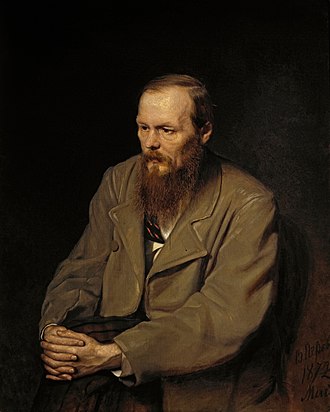
Fyodor Dostoevsky
The Russian novelist of the abyss — crime, faith, freedom, suffering — whose characters argue philosophy with their lives. Nietzsche called him the only psychologist he had anything to learn from.

Candide
Voltaire’s comic philosophical tale, in which a naïve young man and his optimist tutor suffer every disaster the eighteenth century could offer — ending with “we must cultivate our garden”.