Ivan is twenty-four, a successful writer of articles, and he does not deny God. What he cannot accept is God’s world, in which children are tortured. He would rather remain with his unavenged suffering and unquenched indignation, “even if I were wrong”. See Rebellion — Returning the Ticket and The Grand Inquisitor.
His formula — without immortality there is no virtue, so “everything is permitted” (всё позволено) — is taken literally by the servant Smerdyakov, who kills their father. Ivan breaks under the knowledge and is visited by the devil: a seedy gentleman who embodies all Ivan’s worst thoughts.
Lines to Remember
3 quotationsIf there is no God and no immortality, then everything is permitted.
Context & when to use it
Ivan’s argument that without immortality there is no ground for virtue — first reported by Miusov, later echoed by Dmitri and fatally taken up by Smerdyakov.
The classic statement of moral nihilism; to ask whether ethics needs God.
⚠ The exact sentence “If God does not exist, everything is permitted” is not in the novel. It is a compression of several passages.
It’s not God that I don’t accept, Alyosha, only I most respectfully return Him the ticket.
Context & when to use it
After listing the tortures of children, Ivan refuses a harmony bought with their tears.
For the problem of evil, or for rejecting any utopia whose price is innocent suffering.
The whole world of knowledge is not worth that child’s prayer to “dear, kind God”!
Context & when to use it
On the little girl locked in the freezing privy by her parents.
When abstractions are used to justify concrete cruelty.
Sententiae
phrases in the originalVsyo pozvoleno
Origin. The Brothers Karamazov (1880) — the conclusion attributed to Ivan’s theory if there is no God and no immortality. — Fyodor Dostoevsky, The Brothers Karamazov
⚠ The full sentence “if God does not exist, everything is permitted” does not appear verbatim.
For moral nihilism and its consequences.
Explore Next
related by shared connectionsRebellion — Returning the Ticket
Ivan tells Alyosha true stories of tortured children and declares that no future harmony could be worth one child’s tear — so he respectfully returns his ticket.
The Grand Inquisitor
Ivan Karamazov’s prose-poem — Christ returns to sixteenth-century Seville, and the aged Cardinal Inquisitor imprisons him, explaining that humanity cannot bear the freedom He offered.
Tukārām
The 17th-century Marathi saint-poet, a grocer of the Śūdra caste, whose thousands of abhaṅgas to Viṭṭhal of Pandharpur — honest, anguished, joyful, scornful of hypocrisy — are the most loved poems in Marathi.
A Confession
Tolstoy’s account of his mid-life crisis — at the height of fame he could not answer “why live?” and nearly killed himself, until he found meaning in the faith of simple people.
Rāmcaritmānas
Tulsīdās’s 16th-century retelling of the Rāmāyaṇa in Avadhī Hindi — 12,800 lines of devotional epic that made Rāma the God of North India, recited daily, staged every year as Rāmlīlā, and loved more than any other book in Hindi.
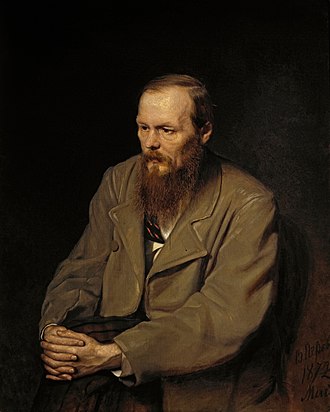
Fyodor Dostoevsky
The Russian novelist of the abyss — crime, faith, freedom, suffering — whose characters argue philosophy with their lives. Nietzsche called him the only psychologist he had anything to learn from.