Contents · 5 sections · 3 min
Key Ideas
Rāma is the supreme God, born as a man out of love for his devotees.
The name of Rāma is greater than Rāma.
Devotion (bhakti) is the easiest path in the Kali age.
Rāma-rājya — the ideal reign of justice and happiness.
Sītā’s fire-ordeal is to the “shadow Sītā”; the real Sītā was protected by Agni.
The Rāmcaritmānas (“The Lake of the Deeds of Rāma”) is an epic poem in Avadhī, a dialect of Hindi, composed by Tulsīdās between 1574 and about 1577. It retells the story of Rāma, following the outline of Vālmīki’s Sanskrit The Rāmāyaṇa but transforming it into a work of passionate devotion (bhakti): Rāma is not only an ideal prince but the supreme God, incarnate out of love for his devotees, and every episode becomes an occasion for praising his grace. Written in the language of the people, in the rhythmic caupāī quatrains punctuated by dohā couplets, it became the most popular religious book of North India — recited in full in nine-day or month-long readings (pāṭh), sung in the evenings in villages, quoted in proverbs, and performed every autumn in the Rāmlīlā plays that culminate at Dussehra with the burning of giant effigies of Rāvaṇa.
Structure
The poem has seven books (kāṇḍas) following Vālmīki: Bāl (childhood), Ayodhyā, Araṇya (forest), Kiṣkindhā, Sundar (“beautiful”, Hanumān’s journey), Laṅkā (the war) and Uttar (the aftermath). It is framed as a set of nested dialogues — the god Śiva telling the story to his wife Pārvatī; the crow-sage Kākabhuśuṇḍi telling it to Garuḍa; the sage Yājñavalkya to Bharadvāja; and Tulsī to his readers — symbolised as the four ghāṭs of the “lake” of Rāma’s deeds.
How it differs from Vālmīki
Tulsī’s Rāma is consistently divine, and the story is shaped by devotion:
- In the Bāl Kāṇḍa, Tulsī adds a lyrical scene in Janaka’s garden, where Rāma and Sītā see each other for the first time before the bow contest — a love at first sight absent in Vālmīki.
- The Ayodhyā Kāṇḍa — the exile — is the emotional heart of the poem, with its picture of Bharata’s grief and devotion, and of the humble boatman Kevaṭ, who insists on washing Rāma’s feet before ferrying him across the Ganges, in case their dust turns his boat into a woman (as it had turned the stone Ahalyā back into a woman).
- In the Araṇya Kāṇḍa, Tulsī has Rāma ask Sītā to hide in the fire before the golden deer appears, leaving a “shadow Sītā” to be abducted — so that the real Sītā is never touched by Rāvaṇa, and the later fire-ordeal only restores her. This softens the most troubling episode of the original.
- Śabarī, the tribal woman who offers Rāma berries she has tasted, becomes an emblem of devotion that transcends caste and purity: Rāma tells her that he recognises only one kinship — that of devotion.
- The Sundar Kāṇḍa celebrates Hanumān as the ideal devotee.
- The Uttar Kāṇḍa omits Sītā’s banishment and ends with Rāma’s ideal reign, Rāma-rājya, and long teachings on devotion, knowledge and the Kali age.
Teaching
Tulsī’s theology reconciles the formless and the formed God: “There is no difference between the nirguṇa and the saguṇa; the formless, unseen, unborn becomes saguṇa out of love for his devotees, as water becomes ice.” The name of Rāma is supreme; devotion is the easiest path in the Kali age; and the humble devotee is dearer to God than the learned.
Significance
The Mānas is among the most influential books ever written in India. It fixed the image of Rāma for hundreds of millions, gave Hindi many of its proverbs, and shaped the ethics of family loyalty, obedience and devotion in North Indian culture. Gandhi called it the greatest book of devotional literature; the Indian television Ramayan of 1987–88 drew heavily on it. It has also been criticised by Dalit and feminist readers for upholding caste and patriarchal norms.
In conversation
Raghukul rīt sadā cali āī, prāṇ jāhuṃ baru bacanu na jāī — “this has always been the way of Raghu’s line: let life go, but never a promise.” The most quoted line in Hindi on keeping one’s word.
Curiosities
did you know?- Gita Press of Gorakhpur has printed tens of millions of copies — it is among the best-selling books in Indian history.
- The Sundar Kāṇḍa is recited on its own as a prayer for strength, especially on Tuesdays.
- Many proverbs in Hindi come from it — ‘prāṇ jāye par vacan na jāye’ (let life go, but never a promise).
Questions to Argue About
debate club →- Did Tulsīdās improve the Rāmāyaṇa, or soften it?
Explore Next
related by shared connectionsVālmīki
The ādikavi — “first poet” — to whom the Rāmāyaṇa is attributed; by legend a highway robber who became a sage, and whose grief at the death of a bird became the first verse.
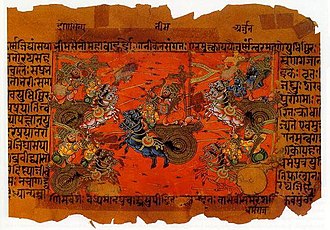
The Mahābhārata
The great epic of India — the war between the Pāṇḍavas and the Kauravas, cousins fighting for a kingdom — and, at about 100,000 couplets, the longest poem ever composed, containing the Bhagavad Gītā and almost the whole of Indian thought on dharma.
Tukārām
The 17th-century Marathi saint-poet, a grocer of the Śūdra caste, whose thousands of abhaṅgas to Viṭṭhal of Pandharpur — honest, anguished, joyful, scornful of hypocrisy — are the most loved poems in Marathi.
Alyosha Karamazov
The youngest brother, novice of the elder Zosima, “the hero” of the novel — who answers Ivan’s arguments not with refutation but with a kiss.

Kālidāsa
The greatest poet and dramatist of classical Sanskrit — author of Śakuntalā, The Cloud Messenger and the Birth of Kumāra — whose art of love, nature and longing made him “the Shakespeare of India”.
Aśoka
The Mauryan emperor (r. c. 268–232 BCE) who, after the slaughter of his conquest of Kaliṅga, turned to Buddhism and governed by “dhamma” — non-violence, tolerance and welfare — proclaimed in edicts carved on rocks and pillars across India. His lion capital is India’s emblem; his wheel is on its flag.