Contents · 9 sections · 15 min
Key Ideas
Dharma is subtle (dharmasya tattvaṃ nihitaṃ guhāyām) — its truth is hidden in a cave.
Duty against conscience — Arjuna’s despair and Kṛṣṇa’s answer in the Gītā.
The tragic hero who chooses loyalty over truth — Karṇa.
The cost of victory — the winners inherit a graveyard.
Fate (daiva) against human effort (puruṣakāra).
Non-violence (ahiṃsā) as the highest dharma — announced in an epic of slaughter.
The Mahābhārata (“the great [story of the] Bhāratas”) is one of the two Sanskrit epics of ancient India, with the The Rāmāyaṇa, and the longest poem ever composed: about 100,000 couplets (ślokas) — some 1.8 million words — in eighteen books. Its core story is a dynastic struggle between two branches of the Kuru family, the five Pāṇḍava brothers and their hundred cousins the Kauravas, for the throne of Hastināpura, ending in an eighteen-day war on the plain of Kurukṣetra in which almost everyone is killed. Around this story, over perhaps eight centuries (roughly 400 BCE–400 CE), accumulated an encyclopaedia of Indian life and thought — myths, genealogies, love stories, philosophical dialogues, treatises on statecraft and law, and the The Bhagavad Gītā. Traditionally attributed to the sage Vyāsa, who is himself a character in it, it calls itself the “fifth Veda”, and its central question is dharma — the right way to live, which it insists is “subtle”, hidden, and tragically divided against itself.
Background
Text and composition
The epic was composed orally by bards (sūtas) and Brahmin reciters, expanding over centuries. Its earliest layers may reflect events in the late Vedic period (c. 1000–800 BCE) among the Kuru and Pañcāla peoples of the upper Ganges plain; the text reached something near its final form by about 400 CE. It survives in hundreds of manuscripts in many scripts; the Critical Edition of the Bhandarkar Oriental Research Institute in Pune (1933–1966) reconstructed a text of about 75,000 verses.
It is framed as a story within a story within a story. The bard Ugraśravas tells it to sages gathered in the Naimiṣa forest; he heard it at the snake sacrifice of King Janamejaya, great-grandson of Arjuna, where it was recited by Vaiśaṃpāyana, a disciple of Vyāsa. Within the main story, characters constantly tell other stories — the famous episode of Nala and Damayantī, the tale of Sāvitrī who outwits Death, a version of the Rāma story — so that the epic is a vast forest of narratives.
Vyāsa
Kṛṣṇa Dvaipāyana Vyāsa, the “arranger”, is credited with compiling the Vedas and composing the epic. He is also the biological grandfather of both the Pāṇḍavas and the Kauravas, appearing at crucial moments as a counsellor and seer.
Plot summary
The origins of the Kuru dynasty
King Śaṃtanu of Hastināpura falls in love with the river goddess Gaṅgā, who agrees to marry him on condition that he never question her. She drowns their first seven sons at birth; when he protests at the eighth, she leaves, taking the child — who returns as the brilliant prince Devavrata. Later, Śaṃtanu falls in love with Satyavatī, a fisherman’s daughter, whose father demands that her sons inherit the throne. To make his father’s marriage possible, Devavrata renounces the throne and takes a terrible vow of lifelong celibacy, so that he will have no heirs to dispute it. For this vow (bhīṣma, “terrible”), he is known ever after as Bhīṣma, and is granted the boon of choosing the time of his own death.
Satyavatī’s sons die young without heirs. To continue the line, she calls on her own son by an earlier union, Vyāsa, to father children with the two widowed queens. One shuts her eyes in fear at the ascetic’s ugly appearance, and her son Dhṛtarāṣṭra is born blind; the other turns pale, and her son Pāṇḍu is born pale. A maidservant gives birth to the wise Vidura.
Because Dhṛtarāṣṭra is blind, Pāṇḍu becomes king. But Pāṇḍu, cursed by a sage he shot while the sage was mating in the form of a deer, will die if he makes love. He retires to the forest with his wives, Kuntī and Mādrī. Kuntī possesses a mantra to summon gods to father children. Through it, she bears Yudhiṣṭhira (son of Dharma, god of righteousness), Bhīma (son of Vāyu, the wind) and Arjuna (son of Indra, king of the gods); Mādrī bears the twins Nakula and Sahadeva (sons of the Aśvins). These are the five Pāṇḍavas. Earlier, as an unmarried girl, Kuntī had tested the mantra on the sun god Sūrya, and bore a son, Karṇa, born with golden armour and earrings, whom she abandoned in a basket on the river. He was found and raised by a charioteer, Adhiratha, and his wife Rādhā.
Meanwhile, Dhṛtarāṣṭra’s wife Gāndhārī, who blindfolded herself for life in solidarity with her blind husband, bears a hundred sons — the Kauravas — the eldest being Duryodhana, at whose birth jackals howled and asses brayed.
Rivalry and the house of lac
When Pāṇḍu dies (making love to Mādrī, who joins him on the funeral pyre), Kuntī brings the five boys to Hastināpura, where they are raised with their cousins. Both sets of princes learn arms from the Brahmin warrior Droṇa. Arjuna becomes the greatest archer of the age. In a famous test, Droṇa asks each student what he sees on the target — a wooden bird in a tree. The others see the tree, the leaves, the bird; Arjuna sees only the bird’s eye.
Another episode reveals Droṇa’s darker side: a tribal boy, Ekalavya, refused as a student because of his low birth, learns archery by practising before a clay image of Droṇa, and becomes better than Arjuna. Droṇa demands as his fee the boy’s right thumb — and Ekalavya cuts it off.
At a tournament where the princes display their skills, Karṇa appears and matches Arjuna’s every feat, then challenges him to single combat. He is mocked as a charioteer’s son, unfit to fight a prince. Duryodhana makes him king of Aṅga on the spot, winning his undying loyalty. Neither Karṇa nor the Pāṇḍavas know that he is their eldest brother.
Duryodhana, jealous of the Pāṇḍavas’ popularity and Yudhiṣṭhira’s claim as heir, plots to kill them, building a palace of lacquer at Vāraṇāvata to burn with them inside. Warned by Vidura, they escape through a tunnel and live in disguise as Brahmins in the forest; the world believes them dead.
Draupadī
King Drupada of Pañcāla holds a contest (svayaṃvara) for his daughter Draupadī, born from a sacrificial fire: suitors must string a massive bow and hit a target through a revolving device, looking only at its reflection. Karṇa rises, but Draupadī declares she will not marry a charioteer’s son. Arjuna, disguised as a Brahmin, succeeds. The brothers return home and call to their mother that they have won a great prize; Kuntī, without looking, tells them to share it equally. Because a mother’s word cannot be false, Draupadī becomes the wife of all five brothers.
The Pāṇḍavas, revealed as alive, are given half the kingdom — a wilderness, Khāṇḍavaprastha, which they transform into the splendid city of Indraprastha (near modern Delhi). Here they are joined by their cousin Kṛṣṇa, prince of the Yādavas of Dvārakā and an incarnation of the god Viṣṇu, who becomes Arjuna’s dearest friend. Yudhiṣṭhira performs the royal consecration sacrifice (rājasūya), proclaiming himself emperor. At his palace, built by the demon architect Maya, Duryodhana mistakes a crystal floor for water and a pool for floor and falls in; Draupadī and Bhīma laugh at him.
The dice game
Humiliated and envious, Duryodhana, with his uncle Śakuni, a master of loaded dice, invites Yudhiṣṭhira to a game of dice at Hastināpura. Yudhiṣṭhira, bound by a code that forbids refusing a challenge, and weak for gambling, plays. He loses his wealth, his kingdom, his brothers one by one, himself — and finally stakes and loses Draupadī.
Duryodhana’s brother Duḥśāsana drags Draupadī, who is menstruating and wearing a single garment, by her hair into the assembly hall. She asks a question that silences the court: did Yudhiṣṭhira lose himself first, or her? If he had already lost himself, had he any right to stake her? The elders — Bhīṣma, Droṇa, Dhṛtarāṣṭra — say dharma is subtle; no one answers. Karṇa calls her a whore, since she has five husbands. Duryodhana bares his thigh to her. Duḥśāsana begins to strip her — but as he pulls, her sari endlessly lengthens; in later versions this is the grace of Kṛṣṇa, to whom she prays. Bhīma vows to break Duryodhana’s thigh and drink Duḥśāsana’s blood. Terrible omens appear. The frightened blind king offers Draupadī boons; she frees her husbands.
But Yudhiṣṭhira is summoned to a second game — and loses again. The penalty: thirteen years of exile, twelve in the forest and the thirteenth incognito; if discovered in the last year, they must repeat the exile.
Exile
The twelve forest years are filled with adventures and tales. Arjuna obtains divine weapons from Śiva and Indra. Bhīma meets his half-brother Hanumān. Sages tell stories to console them, including the tale of Nala, who also lost his kingdom at dice, and Sāvitrī, whose devotion persuades Yama, god of death, to return her husband. In the Yakṣa’s questions, a spirit at a lake kills four brothers who drink without answering his riddles; Yudhiṣṭhira answers them all — “What is the greatest wonder? Day after day countless people die, yet the living think themselves immortal” — and wins his brothers’ lives.
In the thirteenth year, the Pāṇḍavas live in disguise at the court of King Virāṭa: Yudhiṣṭhira as a dice-master, Bhīma as a cook, Arjuna as a eunuch dance teacher, the twins as grooms and cowherd, Draupadī as a maid. When the king’s brother-in-law Kīcaka attempts to rape Draupadī, Bhīma kills him. At the end of the year, Arjuna reveals himself and routs a Kaurava cattle raid single-handed.
The failed embassy
The thirteen years over, the Pāṇḍavas demand their kingdom back. Duryodhana refuses. Kṛṣṇa goes as an envoy to seek peace, asking for only five villages. Duryodhana replies he will not give them as much land as would fit on the point of a needle, and tries to seize Kṛṣṇa, who reveals his cosmic form.
Kṛṣṇa offers the two sides a choice: one may have his vast army, the other himself — unarmed, as a counsellor. Duryodhana chooses the army; Arjuna chooses Kṛṣṇa, who will be his charioteer.
Before the war, Kṛṣṇa and then Kuntī reveal to Karṇa that he is the eldest Pāṇḍava; if he joins them, he will be king, and Draupadī his wife. Karṇa refuses: Duryodhana gave him honour when everyone scorned him, and he will not betray his friend. He promises Kuntī only that he will spare four of her sons; he will fight Arjuna, and “either way you will still have five sons”. He has already, out of generosity, given away his divine armour and earrings to Indra, disguised as a Brahmin.
The Bhagavad Gītā
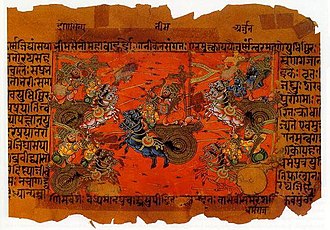
The two vast armies face each other at Kurukṣetra. Arjuna asks Kṛṣṇa to drive the chariot between them, sees his grandfather Bhīṣma, his teacher Droṇa, his cousins and friends, and collapses in despair: “I do not want to kill them, even if they kill me.” Kṛṣṇa’s answer, eighteen chapters long, is the The Bhagavad Gītā: the self is eternal and cannot be killed; a warrior must do his duty (svadharma); action must be done without attachment to its fruits; and all things rest in God, whose terrible universal form Arjuna is shown (The Universal Form). Arjuna takes up his bow. See Arjuna.
The war
The war lasts eighteen days, each side led by a succession of commanders.
- Bhīṣma commands the Kauravas for ten days, invincible. The Pāṇḍavas learn from him — he tells them himself — that he will not fight Śikhaṇḍin, who was born a woman (the reincarnation of Ambā, a princess Bhīṣma had wronged). Arjuna shoots from behind Śikhaṇḍin; Bhīṣma falls, pierced by so many arrows that his body rests on them above the ground. He chooses to wait on his bed of arrows for the auspicious season to die.
- Droṇa commands next. He is unbeatable while armed. Kṛṣṇa devises a trick: Bhīma kills an elephant named Aśvatthāman — the name of Droṇa’s son — and the Pāṇḍavas shout that Aśvatthāman is dead. Droṇa asks Yudhiṣṭhira, who has never told a lie. Yudhiṣṭhira says, “Aśvatthāman is dead” — and adds, softly, “the elephant”, drowned by the noise of conches. At that moment, his chariot, which had always floated a finger’s breadth above the ground, touches the earth. Droṇa lays down his weapons and is beheaded.
- Arjuna’s young son Abhimanyu penetrates the Kaurava’s wheel formation (cakravyūha), which he knew how to enter but not how to leave, and is surrounded and killed by several warriors at once, against the rules of war.
- Bhīma fulfils his vow, killing Duḥśāsana and drinking his blood.
- Karṇa commands. In his final duel with Arjuna, his chariot wheel sinks into the earth (a curse), and he has forgotten the mantra for his divine weapon (another curse). He asks Arjuna to wait, by the rules of war, while he frees the wheel. Kṛṣṇa urges Arjuna: where was Karṇa’s dharma when Draupadī was dragged into the hall, when Abhimanyu was murdered? Arjuna shoots him as he struggles with the wheel.
- On the last day, Duryodhana hides in a lake. In a final mace duel, Bhīma, at Kṛṣṇa’s signal, strikes him below the navel — against the rules — and breaks his thigh, fulfilling his vow. Balarāma, Kṛṣṇa’s brother, is outraged at the foul blow.
The night massacre
That night, Droṇa’s son Aśvatthāman, with two other survivors, enters the sleeping Pāṇḍava camp and slaughters everyone: Draupadī’s brother, and her five sons by the Pāṇḍavas. The Pāṇḍavas themselves, away with Kṛṣṇa, survive. Aśvatthāman unleashes an ultimate weapon at the unborn child in the womb of Abhimanyu’s widow; Kṛṣṇa revives the stillborn child, Parīkṣit, the only heir, and curses Aśvatthāman to wander the earth for three thousand years, bleeding and diseased.
The lament and the teaching
The women walk across the battlefield, littered with corpses eaten by jackals and vultures. Gāndhārī, who has lost all hundred sons, curses Kṛṣṇa: since he could have prevented the war and did not, his own clan will destroy itself, and he will die alone in the forest. Kṛṣṇa accepts.
Kuntī reveals at last that Karṇa was their brother. Yudhiṣṭhira, overcome, curses all women never to be able to keep a secret.
Yudhiṣṭhira, now king, is crushed by grief and guilt, and wants to renounce the world. His brothers, Draupadī and the sages argue with him. Finally they go to Bhīṣma on his bed of arrows, who instructs him at enormous length — in the Śānti and Anuśāsana Parvas, about a quarter of the entire epic — on the duties of kings, the dharma of emergencies, the paths to liberation, Sāṃkhya and Yoga. Then, as the sun turns north, Bhīṣma dies.
The end
Yudhiṣṭhira performs a horse sacrifice. After fifteen years, the old blind king Dhṛtarāṣṭra, Gāndhārī and Kuntī retire to the forest, where they die in a forest fire. Thirty-six years after the war, Gāndhārī’s curse is fulfilled: Kṛṣṇa’s Yādava clan, drunk, destroys itself with iron clubs; Kṛṣṇa, sitting in the forest in meditation, is shot in the foot by a hunter who mistakes him for a deer, and dies. Arjuna’s powers fade; he can no longer string his bow.
The Pāṇḍavas set the young Parīkṣit on the throne and set out on their last journey, walking north towards the Himālaya and Mount Meru, followed by a dog. One by one they fall: Draupadī first (for loving Arjuna more than the others), then Sahadeva (pride in wisdom), Nakula (pride in beauty), Arjuna (pride in valour), and Bhīma (gluttony and pride in strength). Yudhiṣṭhira walks on, followed only by the dog. Indra arrives in his chariot to carry him bodily to heaven, but tells him to leave the dog behind. Yudhiṣṭhira refuses to abandon a creature that has been faithful to him. The dog reveals himself as Dharma, Yudhiṣṭhira’s father, who has been testing him.
In heaven, Yudhiṣṭhira finds Duryodhana seated in glory — and his brothers and Draupadī nowhere. He is led to them through a stinking, gloomy hell; hearing their cries, he chooses to stay with them rather than return to heaven. The illusion vanishes: it was a final test. All are united in heaven.
Characters
- Yudhiṣṭhira — eldest Pāṇḍava, son of Dharma; just, truthful, indecisive, a compulsive gambler; the epic’s study of a good man in a world where goodness fails.
- Bhīma — immense strength, appetite, rage and loyalty; Draupadī’s avenger.
- Arjuna — the greatest archer; Kṛṣṇa’s friend; the recipient of the Gītā. See Arjuna.
- Nakula and Sahadeva — the twins.
- Draupadī — fire-born, proud, wronged, wife of the five; her question in the dice hall is the moral centre of the epic.
- Kṛṣṇa — god incarnate, charioteer, strategist; inscrutable, playful, ruthless.
- Duryodhana — the eldest Kaurava; envious, proud, brave, loyal to friends; he dies believing he has lived a warrior’s life and goes to heaven.
- Karṇa — the abandoned son; generous, proud, humiliated, tragically loyal; for many readers, the epic’s true hero.
- Bhīṣma — the grandfather; his vow sacrifices his life to a principle and ruins three generations.
- Droṇa — teacher of both sides; brilliant and petty.
- Gāndhārī — who blindfolded herself; her curse on Kṛṣṇa ends the Yādavas.
- Kuntī — mother of the Pāṇḍavas, keeper of the secret of Karṇa.
- Dhṛtarāṣṭra — the blind king, who loves his son too much to restrain him; his blindness is moral as well as physical.
- Vidura — the wise half-brother, the voice of counsel ignored.
- Śakuni — the uncle with the loaded dice.
- Aśvatthāman — Droṇa’s son, the night murderer, cursed to wander forever.
Themes
Dharma
The epic’s central concept, dharma, means law, duty, righteousness, the order of things — and the Mahābhārata’s achievement is to show it as subtle (sūkṣma) and conflicting. Bhīṣma’s vow, kept absolutely, enables disaster; Yudhiṣṭhira’s adherence to the gambler’s code destroys his family; the Pāṇḍavas win only by violating the rules of war, at Kṛṣṇa’s urging. “The truth of dharma is hidden in a cave,” says Yudhiṣṭhira. See Morality.
Fate and effort
Characters repeatedly debate whether events are determined by fate (daiva), time (kāla) or human effort. Kṛṣṇa tells Arjuna that the warriors are “already slain” by him as Time; yet Arjuna must act. See Fate & Necessity.
The futility of war
The epic tells a war of extermination and then mourns it. The victors inherit a ruin; Yudhiṣṭhira’s coronation is joyless. Its final teachings point toward renunciation and non-violence (ahiṃsā paramo dharmaḥ — “non-violence is the highest dharma”).
Women’s voices
Draupadī, Gāndhārī, Kuntī and the women of the Strī Parva give the epic some of its strongest moral critiques.
Philosophy in the epic
Besides the Gītā, the Mahābhārata contains the Mokṣadharma (“dharma of liberation”) in the Śānti Parva, an anthology of early Sāṃkhya, Yoga and Vedānta; the Anugītā, a sequel to the Gītā; the Sanatsujātīya, on death and immortality; and the Viṣṇu Sahasranāma (the thousand names of Viṣṇu), widely recited today. It is a primary source for the history of Indian philosophy.
Reception and influence
The epic has been retold in every Indian language — Pampa’s Kannada (10th century), the Tamil Villiputtūrār Bhāratam, Kāśīrām Dās’s Bengali — and across Southeast Asia, from Javanese shadow-puppet theatre (wayang) to the reliefs of Angkor Wat. Kālidāsa’s Śakuntalā develops one of its stories (see Kālidāsa). Modern retellings include Shivaji Sawant’s Mrityunjaya (from Karṇa’s point of view), Irawati Karve’s Yuganta, S. L. Bhyrappa’s Parva, Chitra Banerjee Divakaruni’s The Palace of Illusions (Draupadī’s voice), Shashi Tharoor’s satirical The Great Indian Novel, and Peter Brook’s play. Gandhi read the Gītā as a teaching of non-violence; others read it as a call to righteous war.
Key terms
- Dharma
- Duty, law, righteousness — the order that the epic shows to be subtle and divided.
- Kṣatriya
- The warrior class, whose dharma is to fight.
- Svayaṃvara
- A bride's choice of husband at a contest.
- Dharmayuddha
- "War of dharma" — a righteous war fought by rules.
- Avatāra
- The descent of a god — Kṛṣṇa as Viṣṇu.
Using the Mahābhārata in conversation
- On moral dilemmas: “The truth of dharma is hidden in a cave.”
- On mortality: the Yakṣa’s question — the greatest wonder is that people think themselves immortal.
- On half-truths: Yudhiṣṭhira’s “Aśvatthāman is dead… (the elephant)”.
- On loyalty: Karṇa choosing his friend over his brothers.
हिन्दी संस्करण · 3,494 शब्द ·
महाभारत (“भरतवंशियों की महान कथा”) भारत के दो संस्कृत महाकाव्यों में, रामायण के साथ, एक है, और अब तक रचित सबसे लंबा काव्य: लगभग एक लाख श्लोक (श्लोक) — लगभग 18 लाख शब्द — अठारह पर्वों में। इसकी मूल कथा कुरु वंश की दो शाखाओं, पाँच पांडव भाइयों और उनके सौ चचेरे भाइयों कौरवों, के बीच हस्तिनापुर के सिंहासन के लिए संघर्ष है, जो कुरुक्षेत्र के मैदान में अठारह दिन के युद्ध में समाप्त होता है, जिसमें लगभग सब मारे जाते हैं। इस कथा के चारों ओर, लगभग आठ शताब्दियों में (मोटे तौर पर 400 ई.पू.–400 ई.), भारतीय जीवन और चिंतन का विश्वकोश जमा हुआ — मिथक, वंशावलियाँ, प्रेम-कथाएँ, दार्शनिक संवाद, राजनीति और विधि पर ग्रंथ, और भगवद्गीता। परंपरागत रूप से ऋषि व्यास को श्रेय दिया जाने वाला, जो स्वयं उसमें एक पात्र हैं, यह स्वयं को “पाँचवाँ वेद” कहता है, और इसका केंद्रीय प्रश्न धर्म है — जीने का सही मार्ग — जिसे यह “सूक्ष्म”, छिपा हुआ और दुखांत रूप से अपने ही विरुद्ध बँटा हुआ दिखाता है।
पृष्ठभूमि
पाठ और रचना
महाकाव्य का गायन सूतों (चारण-कथावाचकों) और वैदिक पाठकों ने किया, और यह शताब्दियों में बढ़ता गया। इसकी सबसे पुरानी परतें शायद उत्तर-वैदिक काल (लगभग 1000–800 ई.पू.) के कुरु और पांचाल लोगों की घटनाओं को प्रतिबिंबित करती हैं; पाठ लगभग 400 ई. तक अपने अंतिम रूप के निकट पहुँच गया था। यह अनेक लिपियों की सैकड़ों पांडुलिपियों में बचा है; पुणे के भंडारकर प्राच्य अनुसंधान संस्थान का समीक्षात्मक संस्करण (1933–1966) लगभग 75,000 श्लोकों का पाठ पुनर्निर्मित करता है।
यह कथा के भीतर कथा के भीतर कथा के रूप में ढाला गया है। सूत उग्रश्रवा इसे नैमिषारण्य में ऋषियों को सुनाते हैं; उन्होंने इसे राजा जनमेजय (अर्जुन के प्रपौत्र) के सर्प-यज्ञ में वैशंपायन से सुना था, जो व्यास के शिष्य थे। मुख्य कथा के भीतर पात्र निरंतर दूसरी कथाएँ सुनाते हैं — नल-दमयंती का प्रसिद्ध आख्यान, यम को जीतने वाली सावित्री की कथा, रामकथा का एक रूप — जिससे महाकाव्य कथाओं का विशाल वन बन जाता है।
व्यास
कृष्ण द्वैपायन व्यास, “संकलनकर्ता”, को वेदों के संकलन और महाकाव्य की रचना का श्रेय दिया जाता है। वे पांडवों और कौरवों दोनों के जैविक पितामह भी हैं, जो संकट के क्षणों में सलाहकार और ऋषि के रूप में प्रकट होते हैं।
कथा-सार
कुरु वंश का आरंभ
हस्तिनापुर के राजा शांतनु को नदी-देवी गंगा से प्रेम हो जाता है, जो इस शर्त पर विवाह करती हैं कि वे उनसे कभी प्रश्न न करेंगे। वे अपने पहले सात पुत्रों को जन्म पर डुबो देती हैं; आठवें पर जब शांतनु विरोध करते हैं, वे बालक को लेकर चली जाती हैं — जो बाद में तेजस्वी राजकुमार देवव्रत बनकर लौटता है। बाद में शांतनु को सत्यवती, एक मछुआरे की पुत्री, से प्रेम होता है, जिसके पिता माँग करते हैं कि उसके पुत्र उत्तराधिकारी बनें। अपने पिता का विवाह संभव करने के लिए देवव्रत राजसिंहासन त्याग देते हैं और आजीवन ब्रह्मचर्य की भीषण प्रतिज्ञा लेते हैं, ताकि उनके कोई संतान न हो जो इसका विरोध करे। इस प्रतिज्ञा (भीषण) के कारण वे भीष्म कहलाते हैं, और उन्हें अपनी मृत्यु का समय चुनने का वरदान मिलता है।
सत्यवती के पुत्र निःसंतान युवावस्था में मर जाते हैं। वंश चलाने के लिए वे अपने पूर्व-पुत्र व्यास को बुलाती हैं कि वे दो विधवा रानियों से संतान उत्पन्न करें। एक तपस्वी का कुरूप रूप देखकर भय से आँखें बंद कर लेती है, और उसका पुत्र धृतराष्ट्र अंधा जन्मता है; दूसरी पीली पड़ जाती है, और उसका पुत्र पांडु पांडु-वर्ण जन्मता है। एक दासी से बुद्धिमान विदुर जन्म लेते हैं।
धृतराष्ट्र अंधे हैं, इसलिए पांडु राजा बनते हैं। पर पांडु को शाप है — मृग-रूप में रति करते एक ऋषि को उन्होंने मार दिया था — कि जब भी वे संभोग करेंगे उनकी मृत्यु होगी। वे अपनी पत्नियों कुंती और माद्री के साथ वन चले जाते हैं। कुंती के पास देवताओं को बुलाकर संतान पाने का मंत्र है। उससे वे युधिष्ठिर (धर्म के पुत्र), भीम (वायु के पुत्र) और अर्जुन (इंद्र के पुत्र) को जन्म देती हैं; माद्री अश्विनी-कुमारों के पुत्र जुड़वाँ नकुल और सहदेव को। ये पाँच पांडव हैं। पहले, कुँवारी कन्या के रूप में, कुंती ने सूर्य देव पर मंत्र आज़माया था, और एक पुत्र कर्ण पाया, जो स्वर्ण कवच-कुंडल के साथ जन्मा, जिसे उन्होंने टोकरी में नदी में बहा दिया। उसे सारथी अधिरथ और उसकी पत्नी राधा ने पाला।
इस बीच धृतराष्ट्र की पत्नी गांधारी, जिन्होंने पति की अंधता से एकात्म होने के लिए जीवन भर आँखों पर पट्टी बाँध ली, सौ पुत्रों — कौरवों — को जन्म देती हैं, जिनमें ज्येष्ठ दुर्योधन है, जिसके जन्म पर सियार चीखे और गधे रेंके।
प्रतिद्वंद्विता और लाक्षागृह
पांडु की मृत्यु पर (माद्री के साथ संभोग करते हुए, जो उनकी चिता पर सती हो जाती हैं), कुंती पाँचों बालकों को हस्तिनापुर लाती हैं, जहाँ वे चचेरे भाइयों के साथ पलते हैं। दोनों पक्षों के राजकुमार ब्राह्मण योद्धा द्रोण से शस्त्र-विद्या सीखते हैं। अर्जुन अपने युग का सर्वश्रेष्ठ धनुर्धर बनता है। एक प्रसिद्ध परीक्षा में द्रोण हर शिष्य से पूछते हैं कि वह लक्ष्य पर — वृक्ष पर लकड़ी की चिड़िया — क्या देखता है। दूसरे वृक्ष, पत्ते, चिड़िया देखते हैं; अर्जुन केवल चिड़िया की आँख।
एक और प्रसंग द्रोण का अँधेरा पक्ष दिखाता है: एक निषाद बालक, एकलव्य, जिसे नीच जन्म के कारण शिष्य बनाने से मना कर दिया गया था, द्रोण की मिट्टी की मूर्ति के सामने अभ्यास करके अर्जुन से भी श्रेष्ठ धनुर्धर बन जाता है। द्रोण गुरुदक्षिणा में उसका दाहिना अंगूठा माँगते हैं — और एकलव्य उसे काट देता है।
राजकुमारों की शस्त्र-प्रदर्शनी में कर्ण प्रकट होता है, अर्जुन के हर कौशल की बराबरी करता है, और उसे द्वंद्व की चुनौती देता है। उसे सारथी का पुत्र कहकर राजकुमार से लड़ने के अयोग्य ठहराया जाता है। दुर्योधन उसी क्षण उसे अंग का राजा बना देता है, और उसकी अटूट निष्ठा जीत लेता है। न कर्ण, न पांडव जानते हैं कि वह उनका ज्येष्ठ भाई है।
ईर्ष्यालु दुर्योधन, पांडवों की लोकप्रियता और युधिष्ठिर के युवराज होने के अधिकार से जला हुआ, उन्हें मारने का षड्यंत्र रचता है, वारणावत में लाख का महल बनवाकर उसमें उन्हें जलाने की योजना बनाता है। विदुर की चेतावनी पाकर वे सुरंग से भाग निकलते हैं और ब्राह्मण वेश में वन में रहते हैं; संसार उन्हें मृत मानता है।
द्रौपदी
पांचाल नरेश द्रुपद अपनी अग्नि-जन्मा पुत्री द्रौपदी के लिए स्वयंवर रखते हैं: वीरों को विशाल धनुष चढ़ाकर, घूमते यंत्र के भीतर से लक्ष्य को केवल प्रतिबिंब देखकर बेधना है। कर्ण उठता है, पर द्रौपदी घोषणा करती है कि वह सारथी-पुत्र से विवाह नहीं करेगी। ब्राह्मण वेश में अर्जुन सफल होता है। भाई घर लौटकर माँ से कहते हैं कि वे बड़ा उपहार लाए हैं; कुंती, बिना देखे, कहती है कि आपस में बराबर बाँट लो। क्योंकि माँ का वचन मिथ्या नहीं हो सकता, द्रौपदी पाँचों भाइयों की पत्नी बनती है।
जीवित प्रकट हुए पांडवों को आधा राज्य मिलता है — एक वीरान प्रदेश, खांडवप्रस्थ — जिसे वे भव्य नगर इंद्रप्रस्थ (दिल्ली के निकट) में बदल देते हैं। यहाँ उनके चचेरे भाई कृष्ण, द्वारका के यादव राजकुमार और विष्णु के अवतार, उनसे जुड़ते हैं और अर्जुन के सबसे प्रिय मित्र बनते हैं। युधिष्ठिर राजसूय यज्ञ करके स्वयं को सम्राट घोषित करते हैं। असुर-शिल्पी मय द्वारा बनाए उनके महल में दुर्योधन स्फटिक की भूमि को जल और जल को भूमि समझकर गिर पड़ता है; द्रौपदी और भीम उस पर हँसते हैं।
द्यूत-क्रीड़ा
अपमानित और ईर्ष्यालु दुर्योधन, अपने मामा शकुनि के साथ, जो भारित पासों का उस्ताद है, युधिष्ठिर को हस्तिनापुर में द्यूत-क्रीड़ा का निमंत्रण देता है। युधिष्ठिर, इस क्षत्रिय-नियम से बँधे कि चुनौती अस्वीकार न की जाए, और जुए की कमज़ोरी से ग्रस्त, खेलते हैं। वे अपना धन, राज्य, एक-एक करके भाई, स्वयं को, और अंत में द्रौपदी को हार जाते हैं।
दुर्योधन का भाई दुःशासन रजस्वला, एक वस्त्र में द्रौपदी को केशों से घसीटकर सभा में लाता है। वह एक ऐसा प्रश्न पूछती है जो सभा को मौन कर देता है: क्या युधिष्ठिर पहले स्वयं को हारे थे, या उसे? यदि वे पहले स्वयं को हार चुके थे, तो क्या उन्हें उसे दाँव पर लगाने का अधिकार था? बड़े — भीष्म, द्रोण, धृतराष्ट्र — कहते हैं कि धर्म सूक्ष्म है; कोई उत्तर नहीं देता। कर्ण उसे वेश्या कहता है, क्योंकि उसके पाँच पति हैं। दुर्योधन उसे अपनी जंघा दिखाता है। दुःशासन उसका वस्त्र खींचने लगता है — पर जैसे-जैसे खींचता है, उसकी साड़ी अनंत बढ़ती जाती है; बाद के रूपों में यह कृष्ण की कृपा है, जिनसे वह प्रार्थना करती है। भीम प्रतिज्ञा करता है कि वह दुर्योधन की जंघा तोड़ेगा और दुःशासन का रक्त पिएगा। भयंकर अपशकुन होते हैं। भयभीत अंधे राजा द्रौपदी को वर देते हैं; वह पतियों को मुक्त करा लेती है।
पर युधिष्ठिर को दूसरी द्यूत-क्रीड़ा के लिए बुलाया जाता है — और वे फिर हारते हैं। दंड: तेरह वर्ष का वनवास, बारह वन में, तेरहवाँ अज्ञातवास; यदि अंतिम वर्ष में पहचाने गए, तो वनवास फिर से।
वनवास
बारह वन-वर्ष साहसिक कार्यों और कथाओं से भरे हैं। अर्जुन शिव और इंद्र से दिव्यास्त्र पाता है। भीम अपने सौतेले भाई हनुमान से मिलता है। ऋषि उन्हें सांत्वना देने के लिए कथाएँ सुनाते हैं, जिनमें नल की कथा भी है, जो द्यूत में राज्य हारा था, और सावित्री की, जिसकी भक्ति यम को उसके पति को लौटाने के लिए प्रेरित करती है। यक्ष-प्रश्न में एक यक्ष जलाशय पर चार भाइयों को मार देता है जो उसके प्रश्नों का उत्तर दिए बिना पानी पीते हैं; युधिष्ठिर सबका उत्तर देते हैं — “सबसे बड़ा आश्चर्य क्या है? प्रतिदिन असंख्य प्राणी यम के घर जाते हैं, फिर भी जो शेष हैं वे सदा जीने की इच्छा करते हैं” — और भाइयों के प्राण लौटा पाते हैं।
तेरहवें वर्ष में पांडव राजा विराट के दरबार में वेश बदलकर रहते हैं: युधिष्ठिर पासों के उस्ताद, भीम रसोइये, अर्जुन नपुंसक नृत्य-शिक्षक, जुड़वाँ अश्वपाल और गोपाल, द्रौपदी दासी के रूप में। जब राजा के साले कीचक द्रौपदी से बलात्कार का प्रयास करते हैं, भीम उसे मार डालता है। वर्ष के अंत में अर्जुन अपना परिचय देकर कौरवों के गोधन-हरण को अकेले परास्त कर देता है।
विफल दौत्य
तेरह वर्ष बीतने पर पांडव अपना राज्य माँगते हैं। दुर्योधन मना करता है। कृष्ण शांति के लिए दूत बनकर जाते हैं, केवल पाँच गाँव माँगते हुए। दुर्योधन उत्तर देता है कि वह उन्हें सुई की नोक भर भूमि भी नहीं देगा, और कृष्ण को बंदी बनाने का प्रयास करता है, जो अपना विराट रूप प्रकट करते हैं।
कृष्ण दोनों पक्षों को चुनाव देते हैं: एक अपनी विशाल सेना ले, दूसरा स्वयं कृष्ण को, निःशस्त्र सलाहकार के रूप में। दुर्योधन सेना चुनता है; अर्जुन कृष्ण को, जो उसके सारथी बनेंगे।
युद्ध से पहले, कृष्ण और फिर कुंती कर्ण को बताते हैं कि वह ज्येष्ठ पांडव है; यदि वह उनके साथ आए, तो राजा बनेगा, और द्रौपदी उसकी रानी। कर्ण मना करता है: दुर्योधन ने उसे तब सम्मान दिया जब सबने तिरस्कार किया, और वह अपने मित्र के साथ विश्वासघात नहीं करेगा। वह कुंती को केवल यह वचन देता है कि उनके चार पुत्रों को छोड़ देगा; वह अर्जुन से लड़ेगा, “और किसी भी स्थिति में आपके पाँच पुत्र रहेंगे।” वह पहले ही उदारतावश अपना दिव्य कवच-कुंडल ब्राह्मण-वेशी इंद्र को दे चुका है।
भगवद्गीता
दोनों विशाल सेनाएँ कुरुक्षेत्र में आमने-सामने हैं। अर्जुन कृष्ण से रथ को उनके बीच ले चलने को कहता है, अपने पितामह भीष्म, गुरु द्रोण, चचेरे भाइयों और मित्रों को देखता है, और निराशा में ढह जाता है: “मैं इन्हें मारना नहीं चाहता, चाहे ये मुझे मार डालें।” कृष्ण का उत्तर, अठारह अध्यायों में, भगवद्गीता है: आत्मा अमर है और मारी नहीं जा सकती; योद्धा को अपना स्वधर्म निभाना चाहिए; कर्म फल की आसक्ति बिना होना चाहिए; और सब कुछ ईश्वर में स्थित है, जिसका भयावह विश्वरूप अर्जुन को दिखाया जाता है (विश्वरूप)। अर्जुन धनुष उठा लेता है। देखें अर्जुन।
युद्ध
युद्ध अठारह दिन चलता है, दोनों ओर सेनापतियों की शृंखला के साथ।
- भीष्म कौरवों के सेनापति के रूप में दस दिन अजेय रहते हैं। पांडवों को उनसे ही पता चलता है कि वे शिखंडी से नहीं लड़ेंगे, जो स्त्री जन्मा था (अंबा का पुनर्जन्म, जिसके साथ भीष्म ने अन्याय किया था)। अर्जुन शिखंडी के पीछे से बाण चलाता है; भीष्म गिरते हैं, इतने बाणों से बिंधे कि उनका शरीर धरती से ऊपर बाणों पर टिका है। वे अपनी शर-शय्या पर मृत्यु के उचित ऋतु की प्रतीक्षा करना चुनते हैं।
- द्रोण अगले सेनापति हैं। शस्त्र धारण किए वे अपराजेय हैं। कृष्ण युक्ति रचते हैं: भीम अश्वत्थामा नामक हाथी को मार देता है — द्रोण के पुत्र का नाम — और पांडव चिल्लाते हैं कि अश्वत्थामा मारा गया। द्रोण युधिष्ठिर से पूछते हैं, जिसने कभी झूठ नहीं बोला। युधिष्ठिर कहते हैं, “अश्वत्थामा मारा गया” — और धीरे से जोड़ते हैं “हाथी”, जो शंखों के शोर में डूब जाता है। उसी क्षण उनका रथ, जो सदा भूमि से एक अंगुल ऊपर चलता था, भूमि को छू लेता है। द्रोण शस्त्र त्याग देते हैं और उनका सिर काट दिया जाता है।
- अर्जुन का युवा पुत्र अभिमन्यु कौरवों के चक्रव्यूह में प्रवेश करता है, जिसमें घुसना वह जानता था पर निकलना नहीं, और युद्ध-नियमों के विरुद्ध कई योद्धाओं द्वारा एक साथ घिरकर मारा जाता है।
- भीम अपनी प्रतिज्ञा पूरी करता है, दुःशासन को मारकर उसका रक्त पीता है।
- कर्ण सेनापति बनता है। अर्जुन से अंतिम द्वंद्व में उसके रथ का पहिया भूमि में धँस जाता है (एक शाप), और वह दिव्यास्त्र का मंत्र भूल जाता है (दूसरा शाप)। वह युद्ध-नियमों के अनुसार अर्जुन से प्रतीक्षा करने को कहता है, जब तक वह पहिया निकाले। कृष्ण अर्जुन से कहते हैं: जब द्रौपदी को सभा में घसीटा गया, जब अभिमन्यु का वध हुआ, तब कर्ण का धर्म कहाँ था? अर्जुन पहिये से जूझते कर्ण को बाण से मार देता है।
- अंतिम दिन दुर्योधन एक सरोवर में छिप जाता है। गदा-युद्ध में भीम, कृष्ण के संकेत पर, नियमों के विरुद्ध उसकी नाभि के नीचे प्रहार करता है और जंघा तोड़ देता है, अपनी प्रतिज्ञा पूरी करते हुए। कृष्ण के भाई बलराम इस अनुचित प्रहार से क्रुद्ध हैं।
रात्रि-नरसंहार
उसी रात द्रोण का पुत्र अश्वत्थामा, दो अन्य बचे हुए योद्धाओं के साथ, सोते पांडव-शिविर में घुसकर सबका वध कर देता है: द्रौपदी का भाई, और पांडवों से उसके पाँच पुत्र। पांडव स्वयं, कृष्ण के साथ दूर होने के कारण, बच जाते हैं। अश्वत्थामा अभिमन्यु की विधवा के गर्भ में पल रहे शिशु पर ब्रह्मास्त्र छोड़ता है; कृष्ण मृत जन्मे शिशु परीक्षित को पुनर्जीवित करते हैं, जो एकमात्र उत्तराधिकारी है, और अश्वत्थामा को तीन हज़ार वर्ष रक्त बहाते, रोगी, भटकते रहने का शाप देते हैं।
विलाप और उपदेश
स्त्रियाँ युद्धक्षेत्र में चलती हैं, जो गिद्धों और सियारों द्वारा खाए जा रहे शवों से भरा है। गांधारी, जिसने अपने सौ पुत्र खो दिए, कृष्ण को शाप देती हैं: चूँकि वे युद्ध रोक सकते थे और नहीं रोका, उनका अपना वंश आपस में नष्ट हो जाएगा, और वे वन में अकेले मरेंगे। कृष्ण स्वीकार करते हैं।
कुंती अंततः बताती हैं कि कर्ण उनका भाई था। युधिष्ठिर, शोकाभिभूत, सब स्त्रियों को शाप देते हैं कि वे कभी कोई रहस्य न रख सकेंगी।
अब राजा बने युधिष्ठिर शोक और अपराध-बोध से कुचले हैं, और संसार त्यागना चाहते हैं। भाई, द्रौपदी और ऋषि उन्हें समझाते हैं। अंततः वे भीष्म के पास जाते हैं, जो शर-शय्या पर हैं, और वे उन्हें अत्यंत विस्तार से — शांति और अनुशासन पर्वों में, पूरे महाकाव्य का लगभग चौथाई — राजधर्म, आपद्धर्म, मोक्ष के मार्गों, सांख्य और योग पर उपदेश देते हैं। फिर, जब सूर्य उत्तरायण होता है, भीष्म देह त्यागते हैं।
अंत
युधिष्ठिर अश्वमेध यज्ञ करते हैं। पंद्रह वर्ष बाद वृद्ध अंधे राजा धृतराष्ट्र, गांधारी और कुंती वन चले जाते हैं, जहाँ वे दावाग्नि में देह त्यागते हैं। युद्ध के छत्तीस वर्ष बाद गांधारी का शाप फलीभूत होता है: कृष्ण का यादव कुल, मदिरा के नशे में, लोहे के मूसलों से स्वयं को नष्ट कर लेता है; कृष्ण वन में ध्यान में बैठे हैं कि एक व्याध उन्हें मृग समझकर पाँव में बाण मार देता है, और वे देह त्यागते हैं। अर्जुन की शक्तियाँ क्षीण हो जाती हैं; वह अब अपना धनुष चढ़ा नहीं पाता।
पांडव युवा परीक्षित को सिंहासन पर बिठाकर महाप्रस्थान पर निकलते हैं, हिमालय और मेरु की ओर उत्तर में चलते हुए, एक कुत्ता उनके पीछे। एक-एक करके वे गिरते हैं: पहले द्रौपदी (अर्जुन को अधिक प्रेम करने के कारण), फिर सहदेव (ज्ञान का अभिमान), नकुल (रूप का अभिमान), अर्जुन (शौर्य का अभिमान), और भीम (लोलुपता और बल का अभिमान)। युधिष्ठिर चलते जाते हैं, केवल कुत्ते के साथ। इंद्र रथ में आकर उन्हें सशरीर स्वर्ग ले जाना चाहते हैं, पर कहते हैं कि कुत्ते को छोड़ दो। युधिष्ठिर एक ऐसे प्राणी को छोड़ने से इनकार करते हैं जो उनका वफ़ादार रहा। कुत्ता धर्म के रूप में प्रकट होता है, युधिष्ठिर के पिता, जो उनकी परीक्षा ले रहे थे।
स्वर्ग में युधिष्ठिर दुर्योधन को वैभव में बैठा पाते हैं — और अपने भाइयों और द्रौपदी को कहीं नहीं। उन्हें एक दुर्गंधपूर्ण, अँधेरे नरक से होकर उन तक ले जाया जाता है; उनकी चीखें सुनकर वे स्वर्ग लौटने के बजाय उनके साथ रहने का निर्णय लेते हैं। माया हट जाती है: यह अंतिम परीक्षा थी। सब स्वर्ग में एक हो जाते हैं।
पात्र
- युधिष्ठिर — ज्येष्ठ पांडव, धर्म के पुत्र; न्यायप्रिय, सत्यवादी, अनिर्णायक, जुए के व्यसनी; ऐसे संसार में एक सज्जन की कथा जहाँ सज्जनता विफल होती है।
- भीम — अपार बल, भूख, क्रोध और निष्ठा; द्रौपदी के प्रतिशोधी।
- अर्जुन — सर्वश्रेष्ठ धनुर्धर; कृष्ण के मित्र; गीता के श्रोता। देखें अर्जुन।
- नकुल और सहदेव — जुड़वाँ।
- द्रौपदी — अग्नि-जन्मा, गर्वीली, अपमानित, पाँचों की पत्नी; द्यूत-सभा में उसका प्रश्न महाकाव्य का नैतिक केंद्र है।
- कृष्ण — ईश्वर अवतार, सारथी, रणनीतिज्ञ; रहस्यमय, लीलामय, निर्मम।
- दुर्योधन — ज्येष्ठ कौरव; ईर्ष्यालु, गर्वीला, वीर, मित्रों के प्रति निष्ठावान; वह यह मानकर मरता है कि उसने योद्धा का जीवन जिया, और स्वर्ग जाता है।
- कर्ण — परित्यक्त पुत्र; उदार, गर्वीला, अपमानित, दुखांत रूप से निष्ठावान; अनेक पाठकों के लिए महाकाव्य का सच्चा नायक।
- भीष्म — पितामह; उनकी प्रतिज्ञा एक सिद्धांत के लिए उनके जीवन का बलिदान करती है और तीन पीढ़ियों को नष्ट करती है।
- द्रोण — दोनों पक्षों के गुरु; प्रतिभाशाली और क्षुद्र।
- गांधारी — जिन्होंने आँखों पर पट्टी बाँधी; उनका शाप यादवों का अंत करता है।
- कुंती — पांडवों की माता, कर्ण के रहस्य की रक्षक।
- धृतराष्ट्र — अंधे राजा, जो अपने पुत्र को इतना चाहते हैं कि उसे रोक नहीं पाते; उनकी अंधता नैतिक भी है, शारीरिक भी।
- विदुर — बुद्धिमान सौतेले भाई, उपेक्षित परामर्शदाता का स्वर।
- शकुनि — भारित पासों वाले मामा।
- अश्वत्थामा — द्रोण का पुत्र, रात्रि-हत्यारा, सदा भटकने को शापित।
विषय
धर्म
महाकाव्य की केंद्रीय अवधारणा धर्म — विधि, कर्तव्य, धार्मिकता, वस्तुओं की व्यवस्था — है, और महाभारत की उपलब्धि इसे सूक्ष्म और परस्पर-विरोधी दिखाना है। भीष्म की प्रतिज्ञा, पूर्ण निष्ठा से निभाई गई, विनाश को संभव बनाती है; युधिष्ठिर का जुआरी की संहिता का पालन उनके परिवार को नष्ट करता है; पांडव धर्मयुद्ध केवल उसके नियम तोड़कर जीतते हैं, कृष्ण के आग्रह पर। “धर्म का तत्त्व गुफा में छिपा है,” युधिष्ठिर कहते हैं। देखें नैतिकता।
नियति और पुरुषार्थ
पात्र बार-बार बहस करते हैं कि घटनाएँ दैव, काल या मानव प्रयत्न से निर्धारित होती हैं। कृष्ण अर्जुन से कहते हैं कि योद्धा उनके द्वारा काल के रूप में “पहले ही मारे जा चुके हैं”; फिर भी अर्जुन को कर्म करना है। देखें नियति।
युद्ध की निरर्थकता
महाकाव्य संहार की कथा कहता है और फिर उस पर विलाप करता है। विजेताओं को खंडहर मिलता है; युधिष्ठिर का राज्याभिषेक आनंदहीन है। इसकी अंतिम शिक्षाएँ त्याग और अहिंसा की ओर संकेत करती हैं (अहिंसा परमो धर्मः)।
स्त्रियों के स्वर
द्रौपदी, गांधारी, कुंती और स्त्री पर्व की स्त्रियाँ महाकाव्य की कुछ सबसे सशक्त नैतिक आलोचनाएँ करती हैं।
महाकाव्य में दर्शन
गीता के अतिरिक्त महाभारत में शांति पर्व का मोक्षधर्म है, आरंभिक सांख्य, योग और वेदांत का संकलन; अनुगीता, गीता का उपसंहार; सनत्सुजातीय, मृत्यु और अमरता पर; और विष्णुसहस्रनाम (विष्णु के हज़ार नाम), आज व्यापक रूप से पढ़ा जाता है। यह भारतीय दर्शन के इतिहास का प्राथमिक स्रोत है।
ग्रहण और प्रभाव
महाकाव्य हर भारतीय भाषा में पुनः कहा गया है — पंप की कन्नड़ (दसवीं शताब्दी), तमिल विल्लिपुत्तूरार भारतम्, काशीराम दास की बांग्ला — और दक्षिण-पूर्व एशिया भर में, जावा की वायंग छाया-नाट्य से अंगकोर वाट की मूर्तियों तक। कालिदास का शकुंतला इसकी एक कथा विकसित करता है (कालिदास)। आधुनिक पुनर्कथनों में शिवाजी सावंत की मृत्युंजय (कर्ण की दृष्टि से), इरावती कर्वे की युगांत, एस. एल. भैरप्पा की पर्व, चित्रा बनर्जी दिवाकरुणी की द पैलेस ऑफ़ इल्यूज़न्स (द्रौपदी की आवाज़), शशि थरूर की व्यंग्यात्मक द ग्रेट इंडियन नॉवेल, और पीटर ब्रुक का नाटक हैं। गांधी ने गीता को अहिंसा की शिक्षा के रूप में पढ़ा; अन्य ने इसे धर्मयुद्ध का आह्वान माना।
बातचीत में महाभारत
नैतिक दुविधाओं के लिए: “धर्म का तत्त्व गुफा में छिपा है।” मृत्यु पर: यक्ष का प्रश्न — सबसे बड़ा आश्चर्य यह है कि लोग स्वयं को अमर मानते हैं। अर्धसत्य पर: युधिष्ठिर का “अश्वत्थामा मारा गया… (हाथी)।” निष्ठा पर: कर्ण का मित्र को भाइयों से ऊपर चुनना। और पूर्णता पर: “जो यहाँ है वह कहीं और भी हो सकता है; जो यहाँ नहीं है वह कहीं नहीं।”
The Mahābhārata in two minutes
Two sets of cousins fight for a kingdom in a war that destroys almost everyone — and in its ruins the epic asks what dharma, the right way to live, can possibly mean.
The great epic of India — the war between the Pāṇḍavas and the Kauravas, cousins fighting for a kingdom — and, at about 100,000 couplets, the longest poem ever composed, containing the Bhagavad Gītā and almost the whole of Indian thought on dharma.
- Dharma is subtle (dharmasya tattvaṃ nihitaṃ guhāyām) — its truth is hidden in a cave.
- Duty against conscience — Arjuna’s despair and Kṛṣṇa’s answer in the Gītā.
- The tragic hero who chooses loyalty over truth — Karṇa.
- The cost of victory — the winners inherit a graveyard.
- Fate (daiva) against human effort (puruṣakāra).
- Non-violence (ahiṃsā) as the highest dharma — announced in an epic of slaughter.
“Day after day countless creatures go to the abode of Death, yet those who remain wish to live forever. What can be more wonderful than this?” — Mahābhārata, Vana Parva (the Yakṣa's questions)
Curiosities
did you know?- The epic says of itself: “What is here may be found elsewhere; what is not here is nowhere” (yad ihāsti tad anyatra yan nehāsti na tat kvacit).
- Tradition says Vyāsa dictated it to Gaṇeśa, who agreed to write only if Vyāsa never paused; Vyāsa agreed only if Gaṇeśa understood every verse before writing it. Gaṇeśa broke off his own tusk to use as a pen.
- Peter Brook’s nine-hour stage version (1985) toured the world and was filmed in 1989.
- B. R. Chopra’s television serial (1988–90) emptied the streets of India on Sunday mornings.
- J. Robert Oppenheimer quoted the Gītā within it — ‘Now I am become Death, the destroyer of worlds’ — recalling the first atomic test.
Questions to Argue About
debate club →- Was Yudhiṣṭhira right to gamble — and to stake Draupadī?
- Is Karṇa the true hero of the Mahābhārata?
- Does Kṛṣṇa’s trickery in the war make him a villain, or does dharma sometimes require it?
- Can a war that destroys nearly everyone be called righteous (dharma-yuddha)?
Lines to Remember
3 quotationsDay after day countless creatures go to the abode of Death, yet those who remain wish to live forever. What can be more wonderful than this?
Context & when to use it
For denial of mortality.
What is here may be found elsewhere; what is not here is nowhere.
yad ihāsti tad anyatra yan nehāsti na tat kvacit
Context & when to use it
For a work that contains a world.
Non-violence is the highest dharma.
ahiṃsā paramo dharmaḥ
Context & when to use it
For non-violence — and the debate about its limits.
⚠ The epic also says violence in the service of dharma is a duty; the line continues in some versions with “and so is violence in the service of dharma”.
Explore Next
related by shared connectionsMeghadūta (The Cloud Messenger)
Kālidāsa’s lyric poem of 111 verses in which an exiled yakṣa asks a monsoon cloud to carry a message of love to his wife in the Himālaya — describing, as the cloud flies north, all of India alive with longing.
The Little Clay Cart
Śūdraka’s Sanskrit comedy of love, crime and revolution — a poor Brahmin merchant, a generous courtesan, a burglar with a theory of house-breaking, a vicious royal brother-in-law and a popular uprising — the most realistic and modern-feeling play of ancient India.
Arjuna
The Pāṇḍava archer who lays down his bow on the battlefield of Kurukṣetra rather than kill his kin — and receives the teaching of the Bhagavad Gītā.
The Universal Form
Arjuna asks to see Kṛṣṇa’s true form — and beholds the whole universe, all beings, all gods, and all the warriors rushing into Time’s blazing mouths.
Basavaṇṇa (Basava)
The 12th-century Kannada saint, poet and statesman who founded the Vīraśaiva (Liṅgāyat) movement — rejecting caste, temples, priests and the Vedas, preaching that work is worship and that every devotee carries Śiva on his body.
Rāmcaritmānas
Tulsīdās’s 16th-century retelling of the Rāmāyaṇa in Avadhī Hindi — 12,800 lines of devotional epic that made Rāma the God of North India, recited daily, staged every year as Rāmlīlā, and loved more than any other book in Hindi.