Kṛṣṇa grants Arjuna divine sight. “If the radiance of a thousand suns were to burst at once into the sky, that would be like the splendour of that mighty one.” Arjuna sees countless mouths and eyes, all the worlds within one body — and the warriors of both armies rushing into terrible jaws, some caught between the teeth with heads crushed.
Kṛṣṇa says: “I am Time (kāla), the mighty destroyer of worlds, come forth to annihilate them. Even without you, none of these warriors will survive.” (11.32) Arjuna, terrified, begs him to return to his gentle human form.
Lines to Remember
1 quotationsI am Time, the mighty destroyer of worlds, come forth to annihilate the peoples.
कालोऽस्मि लोकक्षयकृत्प्रवृद्धो लोकान्समाहर्तुमिह प्रवृत्तः
Context & when to use it
From the theophany of the universal form.
For the sublime terror of time and death. Oppenheimer’s paraphrase — “Now I am become Death, the destroyer of worlds.”
Explore Next
related by shared connectionsArjuna
The Pāṇḍava archer who lays down his bow on the battlefield of Kurukṣetra rather than kill his kin — and receives the teaching of the Bhagavad Gītā.
The Bhāgavata Purāṇa
The most beloved of the Purāṇas (c. 9th–10th century) — twelve books of devotion to Viṣṇu, culminating in the tenth book’s life of Kṛṣṇa: the butter-thief child, the cowherd, the lover of the gopīs, the god who dances with every devotee at once.
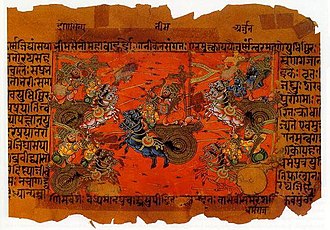
The Mahābhārata
The great epic of India — the war between the Pāṇḍavas and the Kauravas, cousins fighting for a kingdom — and, at about 100,000 couplets, the longest poem ever composed, containing the Bhagavad Gītā and almost the whole of Indian thought on dharma.
Jñāneśvar
The 13th-century Marathi saint-poet who, at about twenty, wrote the Jñāneśvarī — a 9,000-verse commentary on the Bhagavad Gītā in Marathi that founded Marathi literature and the Vārkarī devotional tradition — and entered living samādhi at twenty-one.
Madhva
The 13th-century philosopher from Udupi who founded Dvaita Vedānta — the uncompromising teaching that God, souls and matter are eternally distinct, and that Viṣṇu alone is independent.
Mahatma Gandhi
The leader of India’s independence movement and the philosopher of satyāgraha — “truth-force”, non-violent resistance — who turned the Jain and Hindu ideal of ahiṃsā into a method of mass politics, and whose ideas of truth, non-violence, self-rule and simplicity changed the twentieth century.