Contents · 6 sections · 12 min
Gandhi in Six Ideas
the essentialsTruth is God
He began by saying “God is Truth”; he ended by saying “Truth is God” — so that even an atheist could share his religion.
Satyāgraha
Truth-force, soul-force — resisting injustice by suffering rather than inflicting it, converting the opponent rather than defeating him.
Ahiṃsā
Non-violence not as weakness but as the strength of the brave — “an eye for an eye makes the whole world blind” (attributed).
Swarāj
Real self-rule is rule over oneself — not just the replacement of English rulers by Indian ones.
Sarvodaya
The welfare of all, beginning with the last and the least — his talisman.
Means and ends
“The means may be likened to a seed, the end to a tree” — bad means can never produce a good end.
Mohandas Karamchand Gandhi (2 October 1869 – 30 January 1948), known as Mahātmā (“great soul”) and Bāpū (“father”), was the leader of India’s struggle for independence from British rule and one of the most influential moral and political thinkers of the twentieth century. Trained as a lawyer in London, he spent twenty-one years in South Africa, where he developed satyāgraha (“holding firmly to truth”, “truth-force”) — a method of mass non-violent resistance to injustice through civil disobedience, non-cooperation and voluntary suffering. Returning to India in 1915, he transformed the Indian National Congress from an elite debating club into a mass movement of millions, leading the Non-Cooperation movement (1920–22), the Salt March (1930) and the Quit India movement (1942), which ended in independence in 1947. His political method was inseparable from a religious and ethical philosophy drawn from the The Bhagavad Gītā, the Jain ethic of ahiṃsā (Jainism), the Sermon on the Mount, Tolstoy, Ruskin and Thoreau: truth is God; non-violence is the means to truth; self-rule (swarāj) begins with rule over oneself; and the good of all (sarvodaya) is measured by the condition of the poorest. He was assassinated in 1948 by a Hindu nationalist who blamed him for the partition of India and for his conciliation of Muslims. His ideas inspired Martin Luther King Jr., Nelson Mandela, the Dalai Lama, Cesar Chavez, Aung San Suu Kyi and countless movements for civil rights and freedom.
Life
Childhood in Kathiawar
Gandhi was born in Porbandar, a small coastal princely state in Kathiawar, Gujarat, into a family of the Modh Baniā merchant caste; his father Karamchand was the chief minister (dīwān) of Porbandar and later Rajkot. His mother Putlībāī was deeply religious, devoted to fasting and vows, and belonged to the Praṇāmī sect, which drew on both Hindu and Islamic sources. Gujarat was a land of strong Jain influence, and Gandhi grew up among ideas of non-violence, vegetarianism, fasting and tolerance. He was a shy, mediocre student. At thirteen he was married to Kasturbā Makhanji, also thirteen; in his Autobiography he wrote with shame of his jealousy and lust as a young husband, and of his absence from his father’s deathbed because he was with his wife. He experimented secretly with meat-eating, smoking and petty theft, then confessed to his father in a letter, and was forgiven with tears — an early lesson, he said, in the power of confession and of love.
London
In 1888, aged eighteen, he sailed to London to study law at the Inner Temple, having vowed to his mother to abstain from wine, women and meat. He tried for a while to become an English gentleman — taking lessons in dancing, elocution and the violin — then gave it up for simplicity. He joined the London Vegetarian Society, met Theosophists who introduced him to the Bhagavad Gītā (which he first read in Edwin Arnold’s English translation, The Song Celestial) and to Arnold’s The Light of Asia, and read the New Testament: “the Sermon on the Mount went straight to my heart”. He was called to the bar in 1891 and returned to India, where he failed as a lawyer — at his first case in Bombay, too shy to speak, he sat down and returned the fee.
South Africa (1893–1914)
In 1893 he accepted a year’s contract with an Indian firm in Natal, South Africa. Within a week of arriving, travelling to Pretoria with a first-class ticket, he was ordered out of the first-class compartment at Pietermaritzburg because a white passenger objected to an Indian; refusing to move, he was thrown off the train and spent a freezing night in the waiting room. He later called it the turning point of his life: he decided to stay and fight colour prejudice. He stayed twenty-one years.
He founded the Natal Indian Congress (1894), organised petitions and campaigns against discriminatory laws, and led an Indian ambulance corps in the Boer War (1899) and the Zulu rebellion (1906) — where he saw the brutality of British reprisals against the Zulus. He read Ruskin’s Unto This Last on a train journey in 1904 and, in one night, decided to change his life: he founded the Phoenix Settlement, a communal farm, where all would do manual labour and share equally. He read Tolstoy’s The Kingdom of God Is Within You (“it overwhelmed me”) and Thoreau’s essay “Civil Disobedience”, corresponded with Tolstoy, and named his second commune Tolstoy Farm (1910). In 1906 he took a vow of celibacy (brahmacarya).
In 1906, the Transvaal government introduced the “Black Act”, requiring all Indians to register and be fingerprinted. At a mass meeting in Johannesburg, Gandhi and his followers vowed to disobey it and accept the consequences. Searching for a name for this new method, he held a competition; the word satyāgraha — “holding firmly to truth” — was coined. Over eight years of campaigns — burning registration certificates, crossing provincial borders illegally, strikes by indentured miners, a great march of over two thousand in 1913 — he and thousands of others were imprisoned, beaten and shot at. In 1914, the government of Jan Smuts conceded many of their demands. Smuts later wrote that it had been his fate “to be the antagonist of a man for whom even then I had the highest respect”.
Return to India and the national movement
Gandhi returned to India in 1915, a famous figure. On the advice of his political mentor Gopal Krishna Gokhale, he spent a year travelling across the country, third class, to learn about its people. He founded the Sabarmati Ashram in Ahmedabad, where he admitted an untouchable family, to the fury of donors. He led local satyāgrahas — for indigo farmers in Champaran (1917), mill workers in Ahmedabad (where he fasted for the first time in a public cause), and peasants in Kheda (1918).
After the Jallianwala Bagh massacre in Amritsar (April 1919), in which British troops under General Dyer fired on an unarmed crowd, killing hundreds, Gandhi turned against British rule altogether. In 1920 he launched the Non-Cooperation Movement: Indians were to boycott British courts, schools, titles, elections and cloth; to spin their own thread and wear khādī, hand-spun cloth; and to unite Hindus and Muslims (he supported the Muslim Khilafat movement). Millions joined. But when a mob at Chauri Chaura in 1922 burned a police station, killing twenty-two policemen, Gandhi called off the entire movement, to the dismay of his colleagues, saying India was not yet ready for non-violence. He was arrested and sentenced to six years for sedition; at his trial he pleaded guilty and asked for the maximum penalty.
The Salt March
In 1930, the Congress declared complete independence (pūrṇa swarāj) its goal, and Gandhi chose an unlikely target: the British salt tax, which taxed a necessity of even the poorest. On 12 March he set out from Sabarmati with seventy-eight followers on a march of 388 kilometres to the sea at Dandi, gathering crowds and world press coverage along the way. On 6 April he picked up a lump of salt-laden mud, breaking the law. Across India, millions made salt illegally, boycotted British cloth and resigned government posts; some 60,000 were imprisoned. At the Dharasana Salt Works, columns of non-violent satyāgrahis marched up to police lines and were beaten down with steel-tipped lathis without raising a hand, as the American journalist Webb Miller reported to the world. In 1931 the Viceroy, Lord Irwin, negotiated with Gandhi as an equal, and Gandhi went to London for the Round Table Conference, wearing his loincloth and shawl — staying in the East End slums, visiting Lancashire mill workers who had lost their jobs because of his boycott, and meeting Charlie Chaplin. Asked what he thought of Western civilisation, he is said to have replied: “I think it would be a good idea.”
Untouchability and the clash with Ambedkar
In 1932 the British government granted the “depressed classes” (untouchables) separate electorates, at the request of their leader B. R. Ambedkar. Gandhi, in prison at Yerwada, declared a fast unto death against it, arguing that it would permanently divide Hindu society. Under enormous pressure, Ambedkar agreed to the Poona Pact, which gave reserved seats within a joint electorate instead. Gandhi then devoted himself to the campaign against untouchability, renaming the untouchables Harijans (“people of God”) — a name many Dalits later rejected as patronising — and founding the Harijan Sevak Sangh. Ambedkar never forgave him; their disagreement over whether caste could be reformed from within Hinduism, or must be destroyed, remains one of the great debates of modern India.
Quit India and Partition
In 1942, during the Second World War, Gandhi launched the Quit India movement, demanding immediate British withdrawal: “Do or die.” He and the entire Congress leadership were imprisoned; his wife Kasturbā and his secretary Mahadev Desai died in detention.
By 1946 independence was certain, but India was descending into communal violence between Hindus and Muslims, as the Muslim League under Muhammad Ali Jinnah demanded a separate state, Pakistan. Gandhi opposed partition to the end — “you shall have to divide my body before you divide India” — but was overruled by Nehru and Patel. As massacres spread, Gandhi, at seventy-seven, walked barefoot through the riot-torn villages of Noakhali in East Bengal, trying to restore peace. On 15 August 1947, while Delhi celebrated independence, he was in Calcutta, fasting and praying amid the killing. His fast there stopped the riots in the city — “the one-man boundary force”, Lord Mountbatten called him, compared with 55,000 soldiers in the Punjab who failed to stop the slaughter there. Up to two million people died in the Partition violence, and some fifteen million were displaced.
Assassination
In January 1948, Gandhi fasted again in Delhi, demanding peace between Hindus and Muslims and the payment to Pakistan of its share of assets that India was withholding. Hindu nationalists blamed him for appeasing Muslims. On 30 January 1948, as he walked to his evening prayer meeting at Birla House in New Delhi, Nathuram Godse, a Hindu nationalist associated with the Hindu Mahasabha and formerly the RSS, shot him three times in the chest. Nehru announced on the radio: “The light has gone out of our lives, and there is darkness everywhere.”
Philosophy
Truth
The centre of Gandhi’s thought is truth (satya). He called his autobiography The Story of My Experiments with Truth, and wrote: “I worship God as Truth only. I have not yet found Him, but I am seeking after Him.” In 1931 he reversed his formula: not “God is Truth” but “Truth is God”, because “even atheists do not deny the necessity or power of truth”. Truth, for Gandhi, is not a set of propositions but the being of things (sat, “that which is”) and the integrity of a life lived in accordance with conscience. Since no human being possesses the whole truth — Gandhi was deeply influenced by the Jain doctrine of anekāntavāda, the many-sidedness of truth — no one has the right to impose his partial truth on others by violence.
Non-violence
Ahiṃsā, non-violence, is the means to truth: “Ahiṃsā and truth are so intertwined that it is practically impossible to disentangle them… Ahiṃsā is the means; truth is the end.” Gandhi’s non-violence was not passivity: “Non-violence is the greatest force at the disposal of mankind. It is mightier than the mightiest weapon of destruction devised by the ingenuity of man.” It required more courage than violence; it was “the non-violence of the brave”, not of the coward. “Where there is only a choice between cowardice and violence, I would advise violence… but I believe that non-violence is infinitely superior to violence.” It extended to thought and word: hatred is violence.
Satyāgraha
Satyāgraha is non-violence in action against injustice. The satyāgrahi breaks unjust laws openly, accepts punishment willingly, and seeks not to defeat or humiliate the opponent but to convert him — to awaken his conscience through the spectacle of suffering voluntarily borne. “Things of fundamental importance to people are not secured by reason alone, but have to be purchased with their suffering.” It has rules: no hatred of the opponent, no secrecy, no violence even in self-defence, readiness to negotiate and compromise on non-essentials, and willingness to call off a campaign when it turns violent. Gandhi distinguished it from passive resistance, which he regarded as the weapon of the weak, compatible with hatred and ready to turn to violence.
Means and ends
“They say ‘means are after all means’. I would say ‘means are after all everything’. As the means, so the end… The means may be likened to a seed, the end to a tree; and there is just the same inviolable connection between the means and the end as there is between the seed and the tree” (Hind Swaraj). A free India won by violence would be a violent India.
Swarāj and Hind Swaraj
In Hind Swaraj (1909), Gandhi argued that real self-rule is not merely the expulsion of the British but rule over oneself, and that India’s true enemy is modern industrial civilisation — with its railways, lawyers, doctors and machinery — which multiplies desires and destroys community. He envisaged a decentralised India of self-sufficient villages, where people would meet their needs through their own labour, symbolised by the spinning wheel (charkhā). “There is enough for everybody’s need, but not for everybody’s greed” (attributed).
Sarvodaya and the talisman
From Ruskin, Gandhi took the idea of sarvodaya, “the welfare of all”. His famous talisman, written in 1947:
Whenever you are in doubt, or when the self becomes too much with you, apply the following test. Recall the face of the poorest and the weakest man whom you may have seen, and ask yourself if the step you contemplate is going to be of any use to him. Will he gain anything by it? Will it restore him to a control over his own life and destiny?
Self-discipline
Gandhi’s politics were inseparable from personal discipline. He took eleven vows — truth, non-violence, celibacy, control of the palate, non-stealing, non-possession, physical labour, fearlessness, equal respect for all religions, swadeshī (using local goods), and the removal of untouchability. He experimented constantly with diet, fasting, nature cure and celibacy. Some of these experiments — especially, in old age, sleeping beside young women relatives to test his celibacy — have been sharply criticised.
Religion
Gandhi called himself a sanātanī Hindu, but his Hinduism was idiosyncratic and universalist: “I believe in the Bible as I believe in the Gītā. I regard all the great faiths of the world as equally true.” His prayer meetings included Hindu, Muslim, Christian, Buddhist, Jain, Parsi and Sikh readings. His favourite hymns were Narsinh Mehtā’s “Vaiṣṇava jana to” (“the true devotee is one who feels the pain of others”) and “Raghupati rāghava rājā rām… Īśvar Allāh tero nām” (“Īśvar and Allāh are your names”). He read the Gītā daily and interpreted it allegorically: the battle of Kurukṣetra is the struggle within the soul, and the Gītā’s essence is selfless action — anāsakti yoga — which, rightly understood, demands non-violence.
Critics
Gandhi has been criticised from every direction.
- B. R. Ambedkar argued that Gandhi’s defence of the varṇa system, even purged of untouchability, preserved caste; that his fast against separate electorates was coercion; and that “Harijan” was paternalism. “Mahatmas have come and Mahatmas have gone, but the Untouchables have remained untouchables.”
- Revolutionaries (Bhagat Singh) and later Marxists saw his non-violence as serving the propertied classes and calling off movements when they became truly popular.
- Hindu nationalists blamed him for weakness toward Muslims and for partition.
- Muslim leaders (Jinnah) saw his religious language as making Congress a Hindu party.
- Tagore criticised the burning of foreign cloth and the cult of the charkhā as narrow and irrational; their correspondence is a classic of civil disagreement.
- George Orwell (“Reflections on Gandhi”, 1949) doubted that non-violence could work against a totalitarian regime, and found his saintliness “inhuman” — though he concluded that “compared with the other leading political figures of our time, how clean a smell he has managed to leave behind!”
- Historians have criticised his early views on Black Africans in South Africa and his treatment of his wife and sons.
Legacy
Gandhi’s birthday, 2 October, is a national holiday in India and the UN’s International Day of Non-Violence. His face is on every Indian banknote. His methods inspired Martin Luther King Jr., who called him “the guiding light of our technique of non-violent social change”; Nelson Mandela; Cesar Chavez; the Dalai Lama; Aung San Suu Kyi; the anti-nuclear and environmental movements; and the “people power” revolutions of the late twentieth century. Time magazine named him runner-up to Einstein as Person of the Century. His collected works fill one hundred volumes.
Gandhi in conversation
His most useful idea is the talisman: before any decision, recall the face of the poorest person you have seen, and ask whether it will help them. His most argued-over is the claim that means and ends are inseparable — “the means are to the end as the seed is to the tree”.
हिन्दी संस्करण · 2,890 शब्द ·
मोहनदास करमचंद गांधी (2 अक्टूबर 1869 – 30 जनवरी 1948), जिन्हें महात्मा (“महान आत्मा”) और बापू कहा जाता है, ब्रिटिश शासन से भारत की स्वतंत्रता के संघर्ष के नेता और बीसवीं शताब्दी के सबसे प्रभावशाली नैतिक-राजनीतिक चिंतकों में से एक थे। लंदन में वकालत पढ़कर उन्होंने इक्कीस वर्ष दक्षिण अफ़्रीका में बिताए, जहाँ उन्होंने सत्याग्रह (“सत्य का आग्रह”, “सत्य-बल”) विकसित किया — सविनय अवज्ञा, असहयोग और स्वेच्छा से कष्ट-सहन के द्वारा अन्याय का सामूहिक अहिंसक प्रतिरोध। 1915 में भारत लौटकर उन्होंने भारतीय राष्ट्रीय कांग्रेस को एक अभिजात वाद-विवाद मंच से करोड़ों के जन-आंदोलन में बदल दिया, असहयोग आंदोलन (1920–22), नमक सत्याग्रह (1930) और भारत छोड़ो आंदोलन (1942) का नेतृत्व किया, जिनका परिणाम 1947 की स्वतंत्रता था। उनकी राजनीतिक पद्धति एक धार्मिक-नैतिक दर्शन से अभिन्न थी, जो भगवद्गीता, अहिंसा की जैन नीति (जैन दर्शन), पर्वत-प्रवचन, टॉल्स्टॉय, रस्किन और थोरो से प्रेरित था: सत्य ईश्वर है; अहिंसा सत्य तक पहुँचने का साधन है; स्वराज स्वयं पर शासन से आरंभ होता है; और सबका कल्याण (सर्वोदय) सबसे गरीब की दशा से नापा जाता है। 1948 में एक हिंदू राष्ट्रवादी ने उनकी हत्या कर दी, जो उन्हें विभाजन और मुसलमानों के प्रति समझौतावाद के लिए दोषी मानता था। उनके विचारों ने मार्टिन लूथर किंग जूनियर, नेल्सन मंडेला, दलाई लामा, सीज़र शावेज़, आंग सान सू की और नागरिक अधिकारों तथा स्वतंत्रता के अनगिनत आंदोलनों को प्रेरित किया।
जीवन
काठियावाड़ में बचपन
गांधी का जन्म काठियावाड़, गुजरात की एक छोटी तटीय रियासत पोरबंदर में, मोढ़ बनिया व्यापारी जाति के परिवार में हुआ; उनके पिता करमचंद पोरबंदर और फिर राजकोट के दीवान थे। उनकी माता पुतलीबाई अत्यंत धार्मिक थीं, व्रतों और उपवासों में निष्ठावान, और प्रणामी संप्रदाय से थीं, जो हिंदू और इस्लामी दोनों स्रोतों से प्रेरित था। गुजरात में जैन प्रभाव गहरा था, और गांधी अहिंसा, शाकाहार, उपवास और सहिष्णुता के विचारों के बीच बड़े हुए। वे संकोची, साधारण छात्र थे। तेरह वर्ष की आयु में उनका विवाह कस्तूरबा माखनजी से हुआ, जो भी तेरह की थीं; अपनी आत्मकथा में उन्होंने युवा पति के रूप में अपनी ईर्ष्या और वासना, और पिता की मृत्यु-शय्या पर अनुपस्थित रहने की लज्जा के बारे में लिखा। उन्होंने छिपकर मांस खाया, धूम्रपान किया, छोटी चोरियाँ कीं, फिर पिता को पत्र लिखकर सब स्वीकार किया, और आँसुओं के साथ क्षमा पाई — स्वीकारोक्ति और प्रेम की शक्ति का, उन्होंने कहा, पहला पाठ।
लंदन
1888 में, अठारह वर्ष की आयु में, वे माँ से शराब, स्त्री और मांस से दूर रहने की प्रतिज्ञा करके इनर टेंपल में वकालत पढ़ने लंदन गए। कुछ समय उन्होंने अंग्रेज़ सज्जन बनने का प्रयास किया — नृत्य, वक्तृत्व और वायलिन के पाठ — फिर सादगी अपना ली। वे लंदन वेजिटेरियन सोसाइटी से जुड़े, थियोसोफ़िस्टों से मिले जिन्होंने उन्हें भगवद्गीता (जो उन्होंने पहले एडविन आर्नल्ड के अंग्रेज़ी अनुवाद द सॉन्ग सेलेस्टियल में पढ़ी) और आर्नल्ड की द लाइट ऑफ़ एशिया से परिचित कराया, और न्यू टेस्टामेंट पढ़ा: “पर्वत-प्रवचन सीधा मेरे हृदय में उतर गया।” 1891 में बैरिस्टर बनकर वे भारत लौटे, जहाँ वकील के रूप में विफल रहे — बंबई में पहले मुक़दमे में, बोलने में संकोच के कारण, वे बैठ गए और फ़ीस लौटा दी।
दक्षिण अफ़्रीका (1893–1914)
1893 में उन्होंने नेटाल, दक्षिण अफ़्रीका, में एक भारतीय फ़र्म के लिए एक वर्ष का अनुबंध स्वीकार किया। पहुँचने के एक सप्ताह के भीतर, प्रथम श्रेणी के टिकट के साथ प्रिटोरिया जाते हुए, एक श्वेत यात्री की आपत्ति पर उन्हें पीटरमैरित्ज़बर्ग में प्रथम श्रेणी डिब्बे से निकलने को कहा गया; इनकार करने पर उन्हें ट्रेन से उतार दिया गया और उन्होंने प्रतीक्षालय में ठिठुरती रात बिताई। बाद में उन्होंने इसे अपने जीवन का निर्णायक मोड़ कहा: उन्होंने रुककर रंगभेद से लड़ने का निश्चय किया। वे इक्कीस वर्ष रुके।
उन्होंने नेटाल इंडियन कांग्रेस (1894) की स्थापना की, भेदभावपूर्ण कानूनों के विरुद्ध याचिकाएँ और अभियान चलाए, और बोअर युद्ध (1899) तथा ज़ुलू विद्रोह (1906) में भारतीय एंबुलेंस दल का नेतृत्व किया — जहाँ उन्होंने ज़ुलुओं के विरुद्ध ब्रिटिश दमन की क्रूरता देखी। 1904 में ट्रेन-यात्रा में रस्किन की अनटू दिस लास्ट पढ़कर, एक ही रात में, उन्होंने जीवन बदलने का निश्चय किया: उन्होंने फ़ीनिक्स आश्रम की स्थापना की, एक सामूहिक फ़ार्म, जहाँ सब शारीरिक श्रम करते और बराबर बाँटते। उन्होंने टॉल्स्टॉय की द किंगडम ऑफ़ गॉड इज़ विदिन यू (“इसने मुझे अभिभूत कर दिया”) और थोरो का निबंध “सविनय अवज्ञा” पढ़ा, टॉल्स्टॉय से पत्र-व्यवहार किया, और अपने दूसरे आश्रम का नाम टॉल्स्टॉय फ़ार्म (1910) रखा। 1906 में उन्होंने ब्रह्मचर्य का व्रत लिया।
1906 में ट्रांसवाल सरकार ने “काला कानून” लागू किया, जिसमें सब भारतीयों को पंजीकरण कराना और उँगलियों के निशान देना अनिवार्य था। जोहानिसबर्ग की एक विशाल सभा में गांधी और उनके साथियों ने इसकी अवज्ञा करने और परिणाम भुगतने की शपथ ली। इस नई पद्धति के लिए नाम खोजते हुए उन्होंने एक प्रतियोगिता रखी; सत्याग्रह — “सत्य का दृढ़ आग्रह” — शब्द गढ़ा गया। आठ वर्ष के अभियानों में — पंजीकरण-प्रमाणपत्र जलाना, प्रांतीय सीमाएँ अवैध रूप से पार करना, गिरमिटिया खनिकों की हड़तालें, 1913 में दो हज़ार से अधिक लोगों का महान कूच — वे और हज़ारों अन्य जेल गए, पीटे गए, उन पर गोलियाँ चलीं। 1914 में जान स्मट्स की सरकार ने उनकी अनेक माँगें मान लीं। स्मट्स ने बाद में लिखा कि उनका भाग्य “एक ऐसे व्यक्ति का प्रतिद्वंद्वी होना था जिसके प्रति मेरे मन में तब भी सर्वोच्च सम्मान था।”
भारत वापसी और राष्ट्रीय आंदोलन
गांधी 1915 में एक प्रसिद्ध व्यक्ति के रूप में भारत लौटे। अपने राजनीतिक गुरु गोपाल कृष्ण गोखले की सलाह पर उन्होंने लोगों को जानने के लिए एक वर्ष तीसरे दर्जे में पूरे देश की यात्रा की। उन्होंने अहमदाबाद में साबरमती आश्रम की स्थापना की, जहाँ उन्होंने एक अछूत परिवार को प्रवेश दिया, जिससे दानदाता क्रुद्ध हुए। उन्होंने स्थानीय सत्याग्रहों का नेतृत्व किया — चंपारण (1917) में नील किसानों के लिए, अहमदाबाद में मिल मज़दूरों के लिए (जहाँ उन्होंने पहली बार सार्वजनिक उद्देश्य के लिए उपवास किया), और खेड़ा (1918) में किसानों के लिए।
अमृतसर के जलियाँवाला बाग़ हत्याकांड (अप्रैल 1919) के बाद, जिसमें जनरल डायर के अधीन ब्रिटिश सैनिकों ने निहत्थी भीड़ पर गोलियाँ चलाकर सैकड़ों को मार डाला, गांधी पूरी तरह ब्रिटिश शासन के विरुद्ध हो गए। 1920 में उन्होंने असहयोग आंदोलन आरंभ किया: भारतीय ब्रिटिश अदालतों, स्कूलों, उपाधियों, चुनावों और कपड़े का बहिष्कार करें; अपना सूत कातें और खादी पहनें; और हिंदू-मुसलमान एक हों (उन्होंने ख़िलाफ़त आंदोलन का समर्थन किया)। करोड़ों जुड़े। पर जब 1922 में चौरी चौरा में भीड़ ने थाना जलाकर बाईस पुलिसकर्मियों को मार डाला, तो गांधी ने अपने साथियों की निराशा के बावजूद पूरा आंदोलन वापस ले लिया, यह कहते हुए कि भारत अभी अहिंसा के लिए तैयार नहीं। उन्हें राजद्रोह के लिए गिरफ़्तार करके छह वर्ष की सज़ा दी गई; मुक़दमे में उन्होंने अपराध स्वीकार किया और अधिकतम दंड माँगा।
नमक सत्याग्रह
1930 में कांग्रेस ने पूर्ण स्वराज को अपना लक्ष्य घोषित किया, और गांधी ने एक अप्रत्याशित निशाना चुना: ब्रिटिश नमक कर, जो सबसे गरीब की भी आवश्यकता पर लगता था। 12 मार्च को वे अठहत्तर साथियों के साथ साबरमती से दांडी में समुद्र तक 388 किलोमीटर की यात्रा पर निकले, रास्ते भर भीड़ और विश्व-प्रेस का ध्यान खींचते हुए। 6 अप्रैल को उन्होंने नमक-युक्त मिट्टी का ढेला उठाकर कानून तोड़ा: “इससे मैं ब्रिटिश साम्राज्य की नींव हिला रहा हूँ।” पूरे भारत में करोड़ों ने अवैध नमक बनाया, ब्रिटिश कपड़े का बहिष्कार किया और सरकारी पद छोड़े; लगभग 60,000 जेल गए। धरासना नमक कारखाने पर अहिंसक सत्याग्रहियों की टोलियाँ पुलिस की पंक्तियों तक बढ़ीं और लोहे की नोक वाली लाठियों से गिरा दी गईं, बिना हाथ उठाए, जैसा अमेरिकी पत्रकार वेब मिलर ने संसार को बताया। 1931 में वायसराय लॉर्ड इरविन ने गांधी से बराबरी पर बातचीत की, और गांधी गोलमेज सम्मेलन के लिए लंदन गए — अपनी धोती और शॉल में, ईस्ट एंड की बस्तियों में ठहरे, उन लंकाशायर मिल-मज़दूरों से मिले जिनकी नौकरियाँ उनके बहिष्कार से गई थीं, और चार्ली चैपलिन से मिले।
अस्पृश्यता और आंबेडकर से टकराव
1932 में ब्रिटिश सरकार ने अपने नेता बी. आर. आंबेडकर के अनुरोध पर “दलित वर्गों” (अछूतों) को पृथक निर्वाचन दिया। यरवदा जेल में गांधी ने इसके विरुद्ध आमरण अनशन की घोषणा की, यह तर्क देते हुए कि इससे हिंदू समाज स्थायी रूप से बँट जाएगा। भारी दबाव में आंबेडकर पूना पैक्ट पर सहमत हुए, जिसमें इसके बजाय संयुक्त निर्वाचन के भीतर आरक्षित सीटें दी गईं। गांधी फिर अस्पृश्यता-विरोधी अभियान में जुट गए, अछूतों को हरिजन (“ईश्वर के लोग”) नाम दिया — जिसे बाद में अनेक दलितों ने संरक्षणवादी मानकर अस्वीकार किया — और हरिजन सेवक संघ की स्थापना की। आंबेडकर ने उन्हें कभी क्षमा नहीं किया; जाति को हिंदू धर्म के भीतर सुधारा जा सकता है या उसे नष्ट करना होगा — इस पर उनकी असहमति आधुनिक भारत की महान बहसों में बनी हुई है। देखें गांधी बनाम आंबेडकर।
भारत छोड़ो और विभाजन
1942 में, द्वितीय विश्वयुद्ध के दौरान, गांधी ने भारत छोड़ो आंदोलन आरंभ किया, तत्काल ब्रिटिश वापसी की माँग करते हुए: “करो या मरो।” वे और कांग्रेस का पूरा नेतृत्व जेल में डाले गए; उनकी पत्नी कस्तूरबा और सचिव महादेव देसाई की हिरासत में मृत्यु हुई।
1946 तक स्वतंत्रता निश्चित थी, पर भारत हिंदू-मुस्लिम सांप्रदायिक हिंसा में डूब रहा था, क्योंकि मुहम्मद अली जिन्ना के नेतृत्व में मुस्लिम लीग अलग राज्य, पाकिस्तान, माँग रही थी। गांधी ने अंत तक विभाजन का विरोध किया — “भारत को बाँटने से पहले तुम्हें मेरे शरीर को बाँटना होगा” — पर नेहरू और पटेल ने उनकी बात नहीं मानी। जैसे-जैसे नरसंहार फैले, सतहत्तर वर्षीय गांधी पूर्वी बंगाल के दंगाग्रस्त नोआखाली के गाँवों में नंगे पाँव चले, शांति स्थापित करने का प्रयास करते हुए। 15 अगस्त 1947 को, जब दिल्ली स्वतंत्रता मना रही थी, वे कलकत्ता में थे, हत्याओं के बीच उपवास और प्रार्थना करते हुए। वहाँ उनके उपवास ने शहर के दंगे रोक दिए — लॉर्ड माउंटबेटन ने उन्हें “एक-व्यक्ति सीमा-बल” कहा, पंजाब के 55,000 सैनिकों की तुलना में जो वहाँ नरसंहार नहीं रोक सके। विभाजन की हिंसा में बीस लाख तक लोग मारे गए और लगभग डेढ़ करोड़ विस्थापित हुए।
हत्या
जनवरी 1948 में गांधी ने दिल्ली में फिर उपवास किया, हिंदू-मुस्लिम शांति और पाकिस्तान को उसके हिस्से की वह राशि देने की माँग करते हुए जिसे भारत रोके हुए था। हिंदू राष्ट्रवादियों ने उन्हें मुसलमानों के तुष्टीकरण का दोषी माना। 30 जनवरी 1948 को, जब वे नई दिल्ली के बिड़ला भवन में संध्या प्रार्थना-सभा की ओर जा रहे थे, हिंदू महासभा से जुड़े और पहले आरएसएस से संबद्ध रहे हिंदू राष्ट्रवादी नाथूराम गोडसे ने उनकी छाती में तीन गोलियाँ मारीं। परंपरा के अनुसार उनके अंतिम शब्द थे “हे राम”। नेहरू ने रेडियो पर घोषणा की: “हमारे जीवन से प्रकाश चला गया है, और चारों ओर अंधकार है।”
दर्शन
सत्य
गांधी के चिंतन का केंद्र सत्य है। उन्होंने अपनी आत्मकथा को सत्य के प्रयोग कहा, और लिखा: “मैं ईश्वर को केवल सत्य के रूप में पूजता हूँ। मैंने उसे अभी पाया नहीं, पर खोज रहा हूँ।” 1931 में उन्होंने अपना सूत्र उलट दिया: “ईश्वर सत्य है” नहीं, “सत्य ही ईश्वर है”, क्योंकि “नास्तिक भी सत्य की आवश्यकता या शक्ति से इनकार नहीं करते।” गांधी के लिए सत्य कुछ कथनों का समूह नहीं, बल्कि वस्तुओं का अस्तित्व (सत्, “जो है”) और अंतःकरण के अनुसार जिए गए जीवन की निष्ठा है। चूँकि किसी मनुष्य के पास पूरा सत्य नहीं — गांधी सत्य की अनेकांतता के जैन सिद्धांत, अनेकांतवाद, से गहरे प्रभावित थे — इसलिए किसी को अपना आंशिक सत्य हिंसा से दूसरों पर थोपने का अधिकार नहीं।
अहिंसा
अहिंसा सत्य तक पहुँचने का साधन है: “अहिंसा और सत्य इतने गुँथे हुए हैं कि उन्हें अलग करना लगभग असंभव है… अहिंसा साधन है; सत्य साध्य।” गांधी की अहिंसा निष्क्रियता नहीं थी: “अहिंसा मानव जाति के पास सबसे बड़ी शक्ति है। यह मनुष्य की बुद्धि द्वारा बनाए गए विनाश के सबसे शक्तिशाली हथियार से भी अधिक शक्तिशाली है।” इसके लिए हिंसा से अधिक साहस चाहिए; यह “वीरों की अहिंसा” थी, कायरों की नहीं। “जहाँ केवल कायरता और हिंसा में चुनाव हो, मैं हिंसा की सलाह दूँगा… पर मेरा विश्वास है कि अहिंसा हिंसा से अनंत गुना श्रेष्ठ है।” यह विचार और वाणी तक फैली थी: घृणा भी हिंसा है।
सत्याग्रह
सत्याग्रह अन्याय के विरुद्ध क्रियाशील अहिंसा है। सत्याग्रही अन्यायपूर्ण कानून खुलेआम तोड़ता है, दंड स्वेच्छा से स्वीकार करता है, और विरोधी को हराना या अपमानित करना नहीं, बल्कि उसका हृदय-परिवर्तन चाहता है — स्वेच्छा से सहे गए कष्ट के दृश्य से उसकी अंतरात्मा जगाकर। “मूलभूत महत्त्व की चीज़ें केवल तर्क से प्राप्त नहीं होतीं; उन्हें कष्ट-सहन से ख़रीदना पड़ता है।” इसके नियम हैं: विरोधी से घृणा नहीं, कोई गोपनीयता नहीं, आत्मरक्षा में भी हिंसा नहीं, अनावश्यक बातों पर बातचीत और समझौते की तत्परता, और अभियान हिंसक होने पर उसे वापस लेने की इच्छा। गांधी ने इसे निष्क्रिय प्रतिरोध से अलग किया, जिसे वे दुर्बल का हथियार मानते थे — घृणा के साथ संगत और हिंसा की ओर मुड़ने को तत्पर।
साधन और साध्य
“कहते हैं ‘साधन तो आख़िर साधन हैं’। मैं कहूँगा ‘साधन ही सब कुछ हैं’। जैसे साधन, वैसा साध्य… साधन की तुलना बीज से और साध्य की वृक्ष से की जा सकती है; और साधन और साध्य के बीच वैसा ही अटूट संबंध है जैसा बीज और वृक्ष के बीच” (हिंद स्वराज)। हिंसा से जीता गया स्वतंत्र भारत हिंसक भारत होगा।
स्वराज और हिंद स्वराज
हिंद स्वराज (1909) में गांधी ने तर्क दिया कि सच्चा स्वराज केवल अंग्रेज़ों का निष्कासन नहीं, स्वयं पर शासन है, और भारत का सच्चा शत्रु आधुनिक औद्योगिक सभ्यता है — अपनी रेलों, वकीलों, डॉक्टरों और मशीनों के साथ — जो इच्छाएँ बढ़ाती और समुदाय को नष्ट करती है। उन्होंने आत्मनिर्भर गाँवों के विकेंद्रित भारत की कल्पना की, जहाँ लोग अपने श्रम से अपनी आवश्यकताएँ पूरी करें, जिसका प्रतीक चरखा था।
सर्वोदय और जंतर
रस्किन से गांधी ने सर्वोदय — “सबका उदय” — का विचार लिया। उनका प्रसिद्ध जंतर (1947):
तुम्हें एक जंतर देता हूँ। जब भी तुम्हें संदेह हो या तुम्हारा अहम् तुम पर हावी होने लगे, तो यह कसौटी आज़माओ: जो सबसे गरीब और कमज़ोर आदमी तुमने देखा हो, उसकी शक्ल याद करो और अपने दिल से पूछो कि जो कदम उठाने का तुम विचार कर रहे हो, वह उस आदमी के लिए कितना उपयोगी होगा। क्या उससे उसे कुछ लाभ पहुँचेगा? क्या उससे वह अपने ही जीवन और भाग्य पर कुछ क़ाबू रख सकेगा?
आत्म-अनुशासन
गांधी की राजनीति व्यक्तिगत अनुशासन से अभिन्न थी। उन्होंने ग्यारह व्रत लिए — सत्य, अहिंसा, ब्रह्मचर्य, अस्वाद, अस्तेय, अपरिग्रह, शरीर-श्रम, अभय, सर्वधर्म-समभाव, स्वदेशी, और अस्पृश्यता-निवारण। वे आहार, उपवास, प्राकृतिक चिकित्सा और ब्रह्मचर्य के निरंतर प्रयोग करते रहे। इनमें से कुछ प्रयोगों — विशेषकर वृद्धावस्था में अपने ब्रह्मचर्य की परीक्षा के लिए युवा संबंधी स्त्रियों के साथ सोना — की तीखी आलोचना हुई है।
धर्म
गांधी स्वयं को सनातनी हिंदू कहते थे, पर उनका हिंदू धर्म विशिष्ट और सार्वभौमिक था: “मैं बाइबिल में वैसे ही विश्वास करता हूँ जैसे गीता में। मैं संसार के सब महान धर्मों को समान रूप से सत्य मानता हूँ।” उनकी प्रार्थना-सभाओं में हिंदू, मुस्लिम, ईसाई, बौद्ध, जैन, पारसी और सिख पाठ होते। उनके प्रिय भजन थे नरसिंह मेहता का “वैष्णव जन तो तेने कहिए, जे पीड़ पराई जाणे रे” और “रघुपति राघव राजा राम… ईश्वर अल्लाह तेरो नाम”। वे प्रतिदिन गीता पढ़ते और उसकी रूपकात्मक व्याख्या करते: कुरुक्षेत्र का युद्ध आत्मा के भीतर का संघर्ष है, और गीता का सार निष्काम कर्म — अनासक्ति योग — है, जो सही अर्थ में अहिंसा की माँग करता है।
आलोचक
गांधी की हर दिशा से आलोचना हुई है।
- आंबेडकर ने तर्क दिया कि वर्ण-व्यवस्था का गांधी का बचाव, अस्पृश्यता से शुद्ध करके भी, जाति को बनाए रखता है; कि पृथक निर्वाचन के विरुद्ध उनका अनशन दबाव था; और “हरिजन” संरक्षणवाद। “महात्मा आए और महात्मा गए, पर अछूत अछूत ही रहे।”
- क्रांतिकारियों (भगत सिंह) और बाद में मार्क्सवादियों ने उनकी अहिंसा को संपत्तिशाली वर्गों की सेवा, और आंदोलनों के सचमुच लोकप्रिय होते ही उन्हें वापस लेने के रूप में देखा।
- हिंदू राष्ट्रवादियों ने उन्हें मुसलमानों के प्रति दुर्बलता और विभाजन के लिए दोषी माना।
- मुस्लिम नेताओं (जिन्ना) ने उनकी धार्मिक भाषा को कांग्रेस को हिंदू दल बनाने वाला माना।
- टैगोर ने विदेशी कपड़े जलाने और चरखे के पंथ को संकीर्ण और अतार्किक बताया; उनका पत्र-व्यवहार शालीन असहमति का क्लासिक उदाहरण है।
- जॉर्ज ऑरवेल (“रिफ़्लेक्शंस ऑन गांधी”, 1949) को संदेह था कि अहिंसा किसी अधिनायकवादी शासन के विरुद्ध काम कर सकती है — पर उन्होंने निष्कर्ष निकाला कि “हमारे समय के अन्य प्रमुख राजनीतिक व्यक्तियों की तुलना में, वे कितनी स्वच्छ गंध छोड़ गए!”
- इतिहासकारों ने दक्षिण अफ़्रीका में अश्वेत अफ़्रीकियों के बारे में उनके आरंभिक विचारों और पत्नी तथा पुत्रों के प्रति उनके व्यवहार की आलोचना की है।
विरासत
गांधी का जन्मदिन, 2 अक्टूबर, भारत में राष्ट्रीय अवकाश और संयुक्त राष्ट्र का अंतरराष्ट्रीय अहिंसा दिवस है। हर भारतीय नोट पर उनका चेहरा है। उनकी पद्धतियों ने मार्टिन लूथर किंग जूनियर को प्रेरित किया, जिन्होंने उन्हें “अहिंसक सामाजिक परिवर्तन की हमारी तकनीक का पथ-प्रदर्शक प्रकाश” कहा; नेल्सन मंडेला; सीज़र शावेज़; दलाई लामा; आंग सान सू की; परमाणु-विरोधी और पर्यावरण आंदोलन; और बीसवीं शताब्दी के उत्तरार्ध की “जन-शक्ति” क्रांतियाँ। आइंस्टाइन ने लिखा: “आने वाली पीढ़ियाँ शायद ही विश्वास करेंगी कि ऐसा कोई व्यक्ति कभी हाड़-मांस में इस धरती पर चला था।” उनकी संपूर्ण रचनाएँ सौ खंडों में हैं।
बातचीत में गांधी
उनका सबसे उपयोगी विचार जंतर है: किसी भी निर्णय से पहले, सबसे गरीब व्यक्ति का चेहरा याद करो जो तुमने देखा हो, और पूछो कि क्या इससे उसकी मदद होगी। उनका सबसे विवादित विचार यह दावा है कि साधन और साध्य अभिन्न हैं — “साधन साध्य के लिए वैसे ही हैं जैसे बीज वृक्ष के लिए।”
Mahatma Gandhi in two minutes
The leader of India’s independence movement and the philosopher of satyāgraha — “truth-force”, non-violent resistance — who turned the Jain and Hindu ideal of ahiṃsā into a method of mass politics, and whose ideas of truth, non-violence, self-rule and simplicity changed the twentieth century.
- Truth is God. He began by saying “God is Truth”; he ended by saying “Truth is God” — so that even an atheist could share his religion.
- Satyāgraha. Truth-force, soul-force — resisting injustice by suffering rather than inflicting it, converting the opponent rather than defeating him.
- Ahiṃsā. Non-violence not as weakness but as the strength of the brave — “an eye for an eye makes the whole world blind” (attributed).
- Swarāj. Real self-rule is rule over oneself — not just the replacement of English rulers by Indian ones.
- Sarvodaya. The welfare of all, beginning with the last and the least — his talisman.
- Means and ends. “The means may be likened to a seed, the end to a tree” — bad means can never produce a good end.
Answering: Mahāvīra, Swami Vivekananda · Answered by: Rabindranath Tagore
Curiosities
did you know?- He was nominated for the Nobel Peace Prize five times and never received it; the Norwegian Nobel Committee later called this its greatest omission.
- In 1893 he was thrown off a first-class train at Pietermaritzburg station in South Africa for refusing to move to the third-class compartment. He later called it the most creative experience of his life.
- The Salt March (1930) covered 388 km in 24 days; at Dandi he picked up a lump of salt mud and said: ‘With this, I am shaking the foundations of the British Empire.’
- Einstein wrote: ‘Generations to come will scarce believe that such a one as this ever in flesh and blood walked upon this earth.’
- His last words, as he was shot, are traditionally given as ‘Hē Rām’ (‘O God’).
Questions to Argue About
debate club →- Is non-violence a moral principle, or a political strategy — and does it work against a ruthless enemy?
- Was Gandhi right about caste, or was Ambedkar?
- Can a modern economy be built on village self-sufficiency?
Explore Next
related by shared connections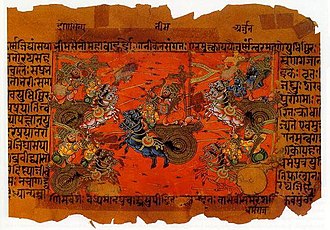
The Mahābhārata
The great epic of India — the war between the Pāṇḍavas and the Kauravas, cousins fighting for a kingdom — and, at about 100,000 couplets, the longest poem ever composed, containing the Bhagavad Gītā and almost the whole of Indian thought on dharma.
The Manusmṛti
The most famous of the Hindu law books — a treatise on dharma covering creation, the four classes, the stages of life, the duties of kings, marriage, inheritance, crime and penance. Revered for two millennia as the code of Hindu society, and condemned in modern times as the charter of caste and of women’s subordination.
Basavaṇṇa (Basava)
The 12th-century Kannada saint, poet and statesman who founded the Vīraśaiva (Liṅgāyat) movement — rejecting caste, temples, priests and the Vedas, preaching that work is worship and that every devotee carries Śiva on his body.
Gitanjali
Tagore’s 1912 collection of devotional prose-poems, translated by himself from Bengali, which won the 1913 Nobel Prize — intimate songs to a God found in nature, in human labour, in love and in death.
Kabīr
The 15th-century weaver-poet of Vārāṇasī who mocked both Hindu and Muslim orthodoxy, taught devotion to a formless God found within, and left the most quoted couplets (dohās) in the Hindi language.
Godān
Premchand’s last and greatest novel (1936) — the life and death of Hori, a poor peasant who longs only to own a cow, crushed by debt, caste, landlords and priests — the epic of the Indian village under colonial rule.