Contents · 7 sections · 16 min
Key Ideas
Arjuna’s despair (viṣāda) — why kill my own kin?
The Self is not slain when the body is slain (2.19–20).
Karma-yoga — your right is to action alone, never to its fruits (2.47).
Svadharma — better one’s own duty imperfectly done than another’s done well (3.35).
The sthitaprajña — the one of steady wisdom.
The universal form (viśvarūpa) — “I am become Time, destroyer of worlds” (11.32).
Surrender — abandon all dharmas and take refuge in me alone (18.66).
The Bhagavad Gītā (“The Song of the Lord”), usually called simply the Gītā, is a dialogue of about 700 Sanskrit verses in eighteen chapters, set on a battlefield at the opening of the great war of the The Mahābhārata. On the eve of the battle, the warrior Arjuna, seeing his teachers, grandfather, cousins and friends drawn up in the opposing army, throws down his bow and refuses to fight. His charioteer, Kṛṣṇa — his friend and cousin, and, as the dialogue reveals, God incarnate — answers his despair with a teaching that ranges over the nature of the self, the meaning of duty, the problem of action, the disciplines of knowledge, meditation and devotion, the structure of the universe, and the nature of God, culminating in a terrifying vision of Kṛṣṇa’s cosmic form and a final call to surrender. Composed probably between the second century BCE and the second century CE, the Gītā is the most widely read, most translated and most commented-upon text of Hinduism. It has been called “the Bible of India”, “the gospel of selfless action”, and the most beautiful philosophical poem in any language. Every major school of Vedānta wrote a commentary on it; Gandhi called it his “spiritual dictionary”; Oppenheimer quoted it after the first atomic explosion; and its central teaching — to act without attachment to the fruits of action — has shaped millions of lives.
Setting
Place in the Mahābhārata
The Gītā occupies chapters 23–40 of the Bhīṣma Parva, the sixth book of the Mahābhārata. The Pāṇḍava brothers, cheated of their kingdom by their cousins the Kauravas in a rigged dice game and sent into thirteen years of exile, have returned to claim their share. All attempts at peace — including Kṛṣṇa’s own embassy asking for only five villages — have failed. The two vast armies face each other on the plain of Kurukṣetra, north of modern Delhi.
The frame of the Gītā is a narration within a narration. The blind king Dhṛtarāṣṭra, father of the Kauravas, sits in his palace while his charioteer Sañjaya, granted divine vision by the sage Vyāsa, describes what is happening on the battlefield. The Gītā opens with the king’s question: “On the field of dharma, on the field of the Kurus (dharmakṣetre kurukṣetre), gathered together, eager to fight, what did my sons and the sons of Pāṇḍu do, Sañjaya?” (1.1). It ends with Sañjaya’s declaration that “where there is Kṛṣṇa, lord of yoga, and where there is Arjuna, the archer, there, I think, are fortune, victory, prosperity and righteousness” (18.78).
Composition
The Gītā is probably later than most of the surrounding epic, and may have been inserted into it; scholars have dated it anywhere from the fifth century BCE to the second century CE, with most favouring a date around the turn of the era. Some see layers within it — an older core on karma-yoga and the self, and later chapters on devotion and the universal form — while others, and the tradition itself, read it as a unified composition. It draws on the Upaniṣads (especially the Kaṭha Upaniṣad, several of whose verses it repeats), on early Sāṃkhya and Yoga (darśana), and on the devotional cult of Vāsudeva-Kṛṣṇa, and it synthesises them into a new whole.
Plot summary
Arjuna’s despair
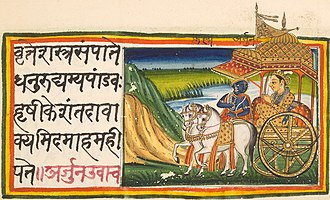
As the armies prepare to fight and the conches blow, Arjuna asks Kṛṣṇa to drive his chariot into the space between the two armies, so that he can see whom he must fight. There he sees “fathers and grandfathers, teachers, uncles, brothers, sons, grandsons, friends” (1.26). He is overwhelmed:
My limbs fail, my mouth is parched, my body trembles, my hair stands on end. My bow Gāṇḍīva slips from my hand, and my skin burns. I cannot stand; my mind is reeling… I do not want victory, Kṛṣṇa, nor kingdom, nor pleasures. What use is kingdom to us, or enjoyment, or even life? (1.29–32)
He argues — with real moral force — that killing one’s kin is a great sin; that it will destroy families, and with them the traditions (dharma) that hold society together; that women will be corrupted and castes mixed; that the ancestors will fall from heaven for lack of offerings. “It would be better for me if the sons of Dhṛtarāṣṭra, weapons in hand, killed me unresisting and unarmed in battle” (1.46). He sinks down in the chariot, his bow and arrows fallen, his mind “overwhelmed by grief” (1.47).
This is the moment the whole Gītā answers. Arjuna’s crisis is not cowardice; it is a genuine conflict between two dharmas — the warrior’s duty to fight a righteous war, and the universal duty not to kill one’s family and teachers. He is, in modern terms, a conscientious objector.
Kṛṣṇa’s first answer: the immortal self
Kṛṣṇa first rebukes him: “Whence has this weakness come upon you at this critical hour? It is unworthy of a noble man… Do not yield to unmanliness. Shake off this petty faintness of heart and arise, scorcher of enemies!” (2.2–3). Arjuna, confused, asks to be taught: “I am your disciple; teach me, who have taken refuge in you” (2.7).
Kṛṣṇa’s teaching begins, smiling, with the immortality of the self:
You grieve for those who should not be grieved for, yet you speak words of wisdom. The wise grieve neither for the living nor for the dead. Never was there a time when I did not exist, nor you, nor these kings; nor will there ever be a time when we cease to be… As the embodied self passes through childhood, youth and old age in this body, so it passes into another body. (2.11–13)
The self “is not born, nor does it ever die… Unborn, eternal, everlasting, ancient, it is not slain when the body is slain” (2.20, from the Kaṭha Upaniṣad). “As a man casts off worn-out clothes and puts on new ones, so the embodied self casts off worn-out bodies and enters new ones. Weapons do not cut it, fire does not burn it, water does not wet it, wind does not dry it” (2.22–23). If the self cannot be killed, Arjuna’s grief is misplaced.
Kṛṣṇa adds a second argument: Arjuna is a Kṣatriya, a warrior, and “there is nothing better for a Kṣatriya than a war of dharma”; if he refuses, he will lose honour and incur sin, and his enemies will mock him as a coward (2.31–37).
Karma-yoga: action without attachment
Then Kṛṣṇa turns to the teaching that is the Gītā’s most distinctive contribution: karma-yoga, the discipline of action. Arjuna’s problem is not just that killing is wrong, but that all action binds — according to the doctrine of Karma, every action produces results that tie the doer to the cycle of rebirth. The ascetic answer, common in Kṛṣṇa’s day, was to renounce action altogether. Kṛṣṇa rejects it. One cannot stop acting: “No one can remain even for a moment without acting; everyone is driven to act, helplessly, by the qualities born of nature” (3.5). What binds is not action but desire for its results:
karmaṇy evādhikāras te mā phaleṣu kadācana mā karma-phala-hetur bhūr mā te saṅgo ‘stv akarmaṇi
Your right is to action alone, never to its fruits. Let not the fruits of action be your motive, nor let your attachment be to inaction. (2.47)
Established in yoga, perform actions, abandoning attachment, Arjuna, the same in success and failure. Evenness of mind is called yoga (samatvaṃ yoga ucyate). (2.48)
Yoga is skill in action (yogaḥ karmasu kauśalam). (2.50)
The ideal is the sthitaprajña, “the person of steady wisdom”, whom Kṛṣṇa describes at the end of the second chapter: one who has abandoned all desires, is content in the self alone, is unshaken by sorrow and undesiring of pleasure, free of passion, fear and anger; who withdraws the senses from their objects “as a tortoise draws in its limbs”; who is like the ocean, which remains unmoved though all the rivers flow into it (2.55–70). Gandhi recited these verses every evening.
Why act at all?
Arjuna is puzzled: if knowledge is superior to action, why urge him to this terrible deed? Kṛṣṇa answers in the third chapter that there are two paths — knowledge for the contemplative, action for the active — but that action is necessary: the body itself cannot be maintained without it; the world itself is sustained by the cycle of sacrifice, in which gods and humans nourish each other; and the wise must act “for the welfare of the world” (loka-saṅgraha), setting an example, as Kṛṣṇa himself acts though he has nothing to gain. “Better one’s own dharma, though imperfect, than another’s well performed; better death in one’s own dharma; another’s dharma is fraught with fear” (3.35). See Dharma.
Arjuna then asks: what drives a person to sin even against his will? Kṛṣṇa answers: desire and anger, born of the quality of passion (rajas), “all-devouring, the great enemy”; as fire is covered by smoke and a mirror by dust, so knowledge is covered by desire (3.36–39).
The avatāra and the sacrifice of knowledge
In the fourth chapter, Kṛṣṇa reveals that he taught this yoga long ago to the sun god, who taught it to Manu, and that it was lost. Arjuna objects: you were born recently, the sun god long ago. Kṛṣṇa answers with the doctrine of the avatāra, the “descent” of God:
Many births of mine have passed, and of yours too, Arjuna. I know them all; you do not… Whenever dharma declines and adharma rises, I send myself forth. To protect the good, to destroy the wicked, and to establish dharma, I come into being age after age. (yadā yadā hi dharmasya glānir bhavati bhārata… sambhavāmi yuge yuge) (4.5–8)
He explains the paradox that the wise see “action in inaction and inaction in action” (4.18): the one who acts without attachment does not really act, and the one who refrains from action out of desire is acting. All action, offered to God, becomes sacrifice; and the highest sacrifice is knowledge, “the sword of knowledge” that cuts doubt (4.33–42).
Renunciation, meditation and the self
The fifth chapter reconciles renunciation (saṃnyāsa) with action: true renunciation is inward — the abandonment of desire, not of work. The one who acts, offering all actions to Brahman, is untouched by sin, “as a lotus leaf by water” (5.10). The sixth chapter describes dhyāna-yoga, meditation: sitting in a clean place, on a seat neither too high nor too low, with body, head and neck erect, gazing at the tip of the nose, the mind fixed on God — “like a lamp in a windless place that does not flicker” (6.11–19). Arjuna objects that the mind is restless, “as hard to control as the wind”; Kṛṣṇa agrees, but says it can be controlled “by practice and dispassion” (6.34–35). And what of the one who fails in yoga? “No one who does good, my friend, ever comes to grief”; he is reborn in a good family and continues the path (6.40–45).
God and the world
Chapters 7 to 12 turn from the discipline of the self to the nature of God and the path of devotion (bhakti). Kṛṣṇa describes his two natures: a lower nature of eight parts — earth, water, fire, air, space, mind, intellect and ego — and a higher nature, the life-principle that sustains the world. “All this is strung on me like pearls on a thread” (7.7). “I am the taste in water, the light in the sun and moon, the Oṃ in all the Vedas, the sound in space, the manhood in men” (7.8). He is the source and dissolution of the world, the goal of all worship: “Whatever form any devotee wishes to worship with faith, I make that faith steady… they obtain their desires, but in truth these are granted by me” (7.21–22).
The eighth chapter teaches about the moment of death: “Whatever state a person remembers at the end, when leaving the body, to that state he goes” (8.6) — so remember God always. The ninth, the “royal secret”, proclaims God’s love for his devotees regardless of birth: “Whoever offers me with devotion a leaf, a flower, a fruit or water, that offering of love I accept” (9.26); “even those of evil birth — women, Vaiśyas and Śūdras — if they take refuge in me, attain the highest goal” (9.32), a verse at once inclusive and revealing of the prejudices of its age. “Fix your mind on me, be devoted to me, sacrifice to me, bow down to me; thus disciplined, with me as your goal, you will come to me” (9.34).
The tenth chapter lists God’s manifestations (vibhūtis): “Among the Ādityas I am Viṣṇu, among lights the radiant sun… among the Vedas I am the Sāma Veda… among mountains I am Meru, among waters the ocean, among trees the sacred fig, among sages Kapila, among horses the one born of nectar… among letters I am A… I am the gambling of cheats… Whatever is glorious, prosperous or mighty, know that it springs from a fragment of my splendour” (10.21–41).
The universal form
In the eleventh chapter, Arjuna asks to see Kṛṣṇa’s divine form. Kṛṣṇa gives him a divine eye, and reveals his universal form (viśvarūpa): a being of countless mouths and eyes, wonderful sights and ornaments and weapons, “as if the light of a thousand suns had risen at once in the sky” (11.12). Arjuna sees the whole universe in Kṛṣṇa’s body — gods, sages, serpents — without beginning, middle or end. Then he sees the warriors of both armies rushing into Kṛṣṇa’s terrible mouths, “some caught between the teeth, their heads crushed to powder” (11.27). Terrified, he asks who this is. Kṛṣṇa answers:
I am Time (kāla), the destroyer of worlds, grown mature, engaged here in destroying the worlds. Even without you, none of the warriors arrayed in the opposing armies will survive. Therefore arise, win glory! Conquer your enemies and enjoy a prosperous kingdom. They have already been slain by me; be merely the instrument, Arjuna. (11.32–33)
J. Robert Oppenheimer, watching the first atomic explosion at Alamogordo in 1945, later said that he remembered this verse — in his translation, “Now I am become Death, the destroyer of worlds” — and also the verse about a thousand suns. Arjuna, shaken, begs Kṛṣṇa to return to his familiar, gentle human form, and Kṛṣṇa does so, telling him that this vision cannot be won by Vedas, austerity, gifts or sacrifice, but only by devotion (11.53–54). See The Universal Form.
Devotion
The twelfth chapter asks which is better: to worship the unmanifest, imperishable Absolute, or the personal God? Kṛṣṇa answers that both reach him, but the path of the unmanifest is harder for embodied beings; the devotee who fixes his mind on God is dearest to him. He describes the true devotee: “He who hates no creature, who is friendly and compassionate, free from ‘mine’ and ‘I’, the same in pain and pleasure, patient… by whom the world is not disturbed and who is not disturbed by the world… the same to friend and foe, in honour and dishonour, cold and heat, praise and blame — that devotee is dear to me” (12.13–19).
The field, the qualities, the tree
The last six chapters return to philosophy. The thirteenth distinguishes the field (kṣetra) — the body and all of nature — from the knower of the field (kṣetrajña), the conscious self; and Kṛṣṇa declares himself the knower in all fields. The fourteenth explains the three guṇas — goodness (sattva), passion (rajas) and darkness (tamas), the strands of nature — and how they bind the self, and how the one who transcends them attains liberation. The fifteenth describes the world as an inverted fig tree with its roots above and branches below, to be cut down with “the strong axe of non-attachment”, and Kṛṣṇa as the “supreme person” (puruṣottama) beyond the perishable and the imperishable. The sixteenth contrasts the divine and demonic natures; the seventeenth classifies faith, food, sacrifice, austerity and gifts by the three guṇas — sattvic food is fresh and nourishing, rajasic food too bitter, sour, salty or hot, tamasic food stale and putrid (17.8–10).
The final teaching
The eighteenth chapter summarises everything: the difference between renunciation and relinquishment; the threefold nature of knowledge, action, agent, intellect, resolve and happiness; the duties of the four classes, each “born of their own nature”; and the perfection achieved by doing one’s own work as worship. Then Kṛṣṇa speaks what tradition calls the final verse (carama-śloka):
sarva-dharmān parityajya mām ekaṃ śaraṇaṃ vraja ahaṃ tvāṃ sarva-pāpebhyo mokṣayiṣyāmi mā śucaḥ
Abandoning all dharmas, take refuge in me alone. I will free you from all sins; do not grieve. (18.66)
Kṛṣṇa asks: “Have you heard this with a concentrated mind, Arjuna? Is your delusion, born of ignorance, destroyed?” Arjuna answers: “My delusion is destroyed, and I have regained my memory through your grace, Acyuta. I stand firm, my doubts are gone. I will do as you say (kariṣye vacanaṃ tava)” (18.73). He picks up his bow. The war begins.
Teachings
Three paths — or one
Later tradition, following the Gītā’s own language, summarised its teaching as three paths (yogas) to liberation: karma-yoga, the path of selfless action; jñāna-yoga, the path of knowledge; and bhakti-yoga, the path of devotion — sometimes with dhyāna-yoga, meditation, as a fourth. The Gītā’s genius is to present these not as rival religions but as aspects of one life: one acts, but without attachment; one acts as an offering to God; and one acts in the knowledge that the self is not the doer, that nature acts through the guṇas, and that God is the source of all. The commentators argued about which path is supreme: Ādi Śaṅkara said knowledge, with action and devotion as preparations; Rāmānuja and later devotional teachers said devotion; Tilak and Gandhi said action.
Synthesis
The Gītā is a synthesis of nearly all the religious currents of its time: the Vedic ideal of sacrifice, reinterpreted as all action offered to God; the Upaniṣadic knowledge of the immortal self; the Sāṃkhya analysis of nature and the guṇas; the Yoga of meditation; the renunciant ideal, interiorised; and the new devotion to a personal God, Vāsudeva-Kṛṣṇa. It is also a synthesis of the two great goods of Indian life — dharma, duty in the world, and mokṣa, liberation from it.
Interpretations
The classical commentators
The Gītā is one of the three foundational texts (prasthāna-traya) of Vedānta, and every school wrote a commentary on it. Śaṅkara’s (8th century), the oldest surviving, reads it as teaching that liberation comes from knowledge alone, and that action is only for those not yet ready for renunciation. Rāmānuja’s (12th century) reads it as teaching devotion and surrender to a personal God as the supreme path. Madhva (13th century) reads it as dualist theism. Abhinavagupta (10th–11th century) read it through Kashmir Śaivism; Jñāneśvar’s Marathi verse commentary, the Jñāneśvarī (1290), made it the heart of devotional religion in Maharashtra.
Modern readings
In the nineteenth and twentieth centuries the Gītā became the central text of modern Hinduism and of Indian nationalism.
- Bal Gangadhar Tilak, in Gītā Rahasya (1915), written in a Mandalay prison, read it as a gospel of energetic action in the world — including political action against colonial rule — rather than renunciation.
- Sri Aurobindo read it as a teaching of integral yoga, the divinisation of life.
- Mahatma Gandhi, who first read it in English (Edwin Arnold’s The Song Celestial) as a law student in London, called it his “mother” and his “spiritual dictionary”: “When disappointment stares me in the face and all alone I see not one ray of light, I go back to the Bhagavad Gītā.” Remarkably, he read it as a teaching of non-violence: the battle was an allegory of the struggle within each person between good and evil, and the essence of the teaching was selfless action, which is incompatible with hatred.
- B. R. Ambedkar read it critically, as a counter-revolutionary text defending the caste order against the egalitarian revolution of Buddhism.
- Vinoba Bhave, Sarvepalli Radhakrishnan, Vivekananda and A. C. Bhaktivedanta Swami (Bhagavad-gītā As It Is, 1968, the basis of the Hare Kṛṣṇa movement) each produced influential readings.
The problem of violence
The Gītā’s most troubling question is the one Arjuna asks: is it right to kill? Kṛṣṇa’s answer — fight, because the self cannot be killed, because it is your duty, because God has already decided the outcome — has disturbed readers for two thousand years. The allegorical reading (Gandhi’s) and the literal reading (the warrior must fight a just war) have both had powerful defenders; so has the critical reading that the text serves to justify violence and caste duty. The Gītā remains one of the great texts on the ethics of war, alongside Augustine and the just-war tradition.
Reception in the world
The Gītā was the first Sanskrit text translated directly into English, by Charles Wilkins in 1785, with a preface by Warren Hastings predicting that it would survive “when the British dominion in India shall long have ceased to exist”. It entered German Romanticism through August Wilhelm Schlegel’s Latin translation (1823); Wilhelm von Humboldt called it “the most beautiful, perhaps the only true philosophical song existing in any known tongue”. In America, Emerson and Thoreau revered it — Thoreau wrote in Walden: “In the morning I bathe my intellect in the stupendous and cosmogonal philosophy of the Bhagavat Geeta.” T. S. Eliot drew on it in Four Quartets (“Not fare well, / But fare forward, voyagers”); Aldous Huxley, Christopher Isherwood, Carl Jung, Hermann Hesse and Simone Weil read it closely. Oppenheimer studied it in Sanskrit. It has been translated into more than seventy-five languages, many hundreds of times.
The Gītā in conversation
Two verses carry the book: “Your right is to action alone, never to its fruits” (2.47) — the ethic of doing one’s best and letting go of outcomes — and “Whenever dharma declines… I come into being age after age” (4.7–8). And when the subject is power and destruction, Oppenheimer’s line is from here: “I am Time, the destroyer of worlds” (11.32).
हिन्दी संस्करण · 3,871 शब्द ·
भगवद्गीता (“भगवान का गीत”), जिसे प्रायः केवल गीता कहा जाता है, लगभग 700 संस्कृत श्लोकों का अठारह अध्यायों में एक संवाद है, जो महाभारत के महायुद्ध के आरंभ में युद्धक्षेत्र पर घटित होता है। युद्ध की पूर्वसंध्या पर योद्धा अर्जुन विरोधी सेना में अपने गुरुओं, पितामह, भाइयों और मित्रों को खड़ा देखकर धनुष रख देता है और लड़ने से इनकार कर देता है। उसका सारथी कृष्ण — उसका मित्र और ममेरा भाई, और जैसा संवाद प्रकट करता है, स्वयं अवतरित ईश्वर — उसकी निराशा का उत्तर एक ऐसी शिक्षा से देता है जो आत्मा के स्वरूप, कर्तव्य के अर्थ, कर्म की समस्या, ज्ञान, ध्यान और भक्ति के मार्गों, विश्व की संरचना और ईश्वर के स्वरूप तक फैली है, और जो कृष्ण के विराट रूप के भयावह दर्शन तथा अंतिम शरणागति के आह्वान में चरम पर पहुँचती है। संभवतः दूसरी शताब्दी ई.पू. से दूसरी शताब्दी ई. के बीच रचित गीता हिंदू धर्म का सबसे अधिक पढ़ा, अनूदित और व्याख्यायित ग्रंथ है। इसे “भारत की बाइबिल”, “निष्काम कर्म का सुसमाचार” और किसी भी भाषा की सबसे सुंदर दार्शनिक कविता कहा गया है। वेदांत के हर प्रमुख संप्रदाय ने इस पर भाष्य लिखा; गांधी ने इसे अपना “आध्यात्मिक शब्दकोश” कहा; ओपेनहाइमर ने पहले परमाणु विस्फोट के बाद इसे उद्धृत किया; और इसकी केंद्रीय शिक्षा — कर्मफल की आसक्ति के बिना कर्म करना — ने करोड़ों जीवनों को आकार दिया है।
पृष्ठभूमि
महाभारत में स्थान
गीता महाभारत के छठे पर्व, भीष्म पर्व, के अध्याय 23 से 40 में स्थित है। पांडव भाई, जिन्हें उनके चचेरे भाइयों कौरवों ने छलपूर्ण द्यूत में उनका राज्य छीनकर तेरह वर्ष के वनवास में भेज दिया था, अपना भाग माँगने लौटे हैं। शांति के सारे प्रयास — कृष्ण का स्वयं दूत बनकर केवल पाँच गाँव माँगना भी — विफल हो चुके हैं। दोनों विशाल सेनाएँ आधुनिक दिल्ली के उत्तर में कुरुक्षेत्र के मैदान में आमने-सामने हैं।
गीता का ढाँचा कथा के भीतर कथा है। अंधे राजा धृतराष्ट्र, कौरवों के पिता, अपने महल में बैठे हैं, जबकि उनका सारथी संजय, ऋषि व्यास द्वारा दी गई दिव्य दृष्टि से, युद्धभूमि का वर्णन करता है। गीता राजा के प्रश्न से आरंभ होती है: “धर्मक्षेत्रे कुरुक्षेत्रे समवेता युयुत्सवः। मामकाः पाण्डवाश्चैव किमकुर्वत सञ्जय॥” — “धर्मक्षेत्र कुरुक्षेत्र में युद्ध की इच्छा से एकत्र मेरे पुत्रों और पांडु के पुत्रों ने क्या किया, संजय?” (1.1)। और संजय की घोषणा पर समाप्त होती है: “जहाँ योगेश्वर कृष्ण हैं और जहाँ धनुर्धारी अर्जुन हैं, वहीं श्री, विजय, विभूति और अटल नीति है — ऐसा मेरा मत है” (18.78)।
रचना
गीता संभवतः आसपास के महाकाव्य से बाद की है और हो सकता है उसमें बाद में जोड़ी गई हो; विद्वानों ने इसका काल पाँचवीं शताब्दी ई.पू. से दूसरी शताब्दी ई. तक माना है, अधिकांश ईसवी सन् के आसपास। कुछ इसमें परतें देखते हैं — कर्मयोग और आत्मा पर एक पुराना केंद्र, और भक्ति तथा विराट रूप पर बाद के अध्याय — जबकि अन्य, और परंपरा स्वयं, इसे एकीकृत रचना मानते हैं। यह उपनिषदों (विशेषकर कठ उपनिषद्, जिसके कई श्लोक यह दोहराती है), आरंभिक सांख्य और योग, तथा वासुदेव-कृष्ण की भक्ति-परंपरा से प्रेरणा लेकर उन्हें एक नए समग्र में गूँथती है।
कथा-सार
अर्जुन का विषाद
जब सेनाएँ तैयार होती हैं और शंख बजते हैं, अर्जुन कृष्ण से रथ को दोनों सेनाओं के बीच ले चलने को कहता है, ताकि देख सके कि उसे किससे लड़ना है। वहाँ वह “पिता, पितामह, आचार्य, मामा, भाई, पुत्र, पौत्र, मित्र” (1.26) देखता है और अभिभूत हो जाता है:
सीदन्ति मम गात्राणि मुखं च परिशुष्यति। वेपथुश्च शरीरे मे रोमहर्षश्च जायते॥ गाण्डीवं स्रंसते हस्तात्त्वक्चैव परिदह्यते…
मेरे अंग शिथिल हो रहे हैं, मुख सूख रहा है, शरीर काँप रहा है, रोमांच हो रहा है। गांडीव हाथ से फिसल रहा है, त्वचा जल रही है… हे कृष्ण, मुझे न विजय चाहिए, न राज्य, न सुख। हमें राज्य से, भोगों से, या जीवन से भी क्या प्रयोजन? (1.29–32)
वह तर्क देता है — सच्ची नैतिक शक्ति के साथ — कि स्वजनों का वध महापाप है; कि इससे कुल नष्ट होंगे, और उनके साथ वे परंपराएँ (धर्म) जो समाज को धारण करती हैं; कि स्त्रियाँ दूषित होंगी और वर्णसंकर होगा; कि पितर पिंड-जल के अभाव में स्वर्ग से गिरेंगे। “यदि शस्त्रधारी धृतराष्ट्र-पुत्र मुझ निःशस्त्र और प्रतिकार न करने वाले को युद्ध में मार डालें, तो वह मेरे लिए अधिक कल्याणकारी होगा” (1.46)। वह धनुष-बाण छोड़कर, “शोक से व्याकुल मन” से, रथ में बैठ जाता है (1.47)।
यही वह क्षण है जिसका उत्तर पूरी गीता देती है। अर्जुन का संकट कायरता नहीं; यह दो धर्मों के बीच वास्तविक संघर्ष है — धर्मयुद्ध लड़ने का क्षत्रिय-कर्तव्य, और अपने परिवार तथा गुरुओं को न मारने का सार्वभौमिक कर्तव्य। आधुनिक शब्दों में, वह अंतरात्मा के आधार पर युद्ध-विरोधी है।
कृष्ण का पहला उत्तर: अमर आत्मा
कृष्ण पहले उसे डाँटते हैं: “कुतस्त्वा कश्मलमिदं विषमे समुपस्थितम्” — “इस संकट की घड़ी में तुम्हें यह मोह कहाँ से आ गया? … क्लैब्यं मा स्म गमः पार्थ — हे पार्थ, नपुंसकता को प्राप्त मत हो; हृदय की इस तुच्छ दुर्बलता को त्यागकर खड़े हो जाओ, परंतप!” (2.2–3)। भ्रमित अर्जुन उपदेश माँगता है: “शिष्यस्तेऽहं शाधि मां त्वां प्रपन्नम्” — “मैं आपका शिष्य हूँ; आपकी शरण में आए मुझे उपदेश दीजिए” (2.7)।
कृष्ण की शिक्षा, मुस्कराते हुए, आत्मा की अमरता से आरंभ होती है:
अशोच्यानन्वशोचस्त्वं प्रज्ञावादांश्च भाषसे। गतासूनगतासूंश्च नानुशोचन्ति पण्डिताः॥ न त्वेवाहं जातु नासं न त्वं नेमे जनाधिपाः। न चैव न भविष्यामः सर्वे वयमतः परम्॥
तुम उनके लिए शोक करते हो जो शोक के योग्य नहीं, और फिर भी ज्ञान की बातें करते हो। ज्ञानी न जीवितों के लिए शोक करते हैं, न मृतों के लिए। ऐसा कभी नहीं था कि मैं न था, या तुम न थे, या ये राजा न थे; और न कभी ऐसा होगा कि हम सब न रहें। (2.11–12)
आत्मा “न जायते म्रियते वा कदाचित्” — “न कभी जन्म लेती है, न मरती है… अजो नित्यः शाश्वतोऽयं पुराणो न हन्यते हन्यमाने शरीरे” — “अजन्मा, नित्य, शाश्वत, पुरातन; शरीर के मारे जाने पर भी यह नहीं मारी जाती” (2.20, कठ उपनिषद् से)। “जैसे मनुष्य पुराने वस्त्र त्यागकर नए धारण करता है, वैसे ही देही जीर्ण शरीरों को त्यागकर नए शरीरों में प्रवेश करता है। नैनं छिन्दन्ति शस्त्राणि नैनं दहति पावकः — इसे शस्त्र नहीं काटते, आग नहीं जलाती, जल नहीं गलाता, वायु नहीं सुखाती” (2.22–23)। यदि आत्मा मारी ही नहीं जा सकती, तो अर्जुन का शोक निरर्थक है।
कृष्ण दूसरा तर्क जोड़ते हैं: अर्जुन क्षत्रिय है, और “धर्म्याद्धि युद्धाच्छ्रेयोऽन्यत्क्षत्रियस्य न विद्यते” — “क्षत्रिय के लिए धर्मयुद्ध से बढ़कर कुछ नहीं”; यदि वह इनकार करेगा, तो कीर्ति खोएगा, पाप का भागी होगा, और शत्रु उसे कायर कहकर हँसेंगे (2.31–37)।
कर्मयोग: आसक्ति-रहित कर्म
फिर कृष्ण उस शिक्षा की ओर मुड़ते हैं जो गीता का सबसे विशिष्ट योगदान है: कर्मयोग। अर्जुन की समस्या केवल यह नहीं कि हत्या गलत है, बल्कि यह कि सभी कर्म बाँधते हैं — कर्म के सिद्धांत के अनुसार हर कर्म ऐसे फल उत्पन्न करता है जो कर्ता को पुनर्जन्म के चक्र से बाँधते हैं। कृष्ण के समय में प्रचलित संन्यासी उत्तर था कर्म का पूर्ण त्याग। कृष्ण इसे अस्वीकार करते हैं। कर्म रोका नहीं जा सकता: “न हि कश्चित्क्षणमपि जातु तिष्ठत्यकर्मकृत्” — “कोई क्षण भर भी बिना कर्म किए नहीं रह सकता; प्रकृति के गुण हर किसी को विवश करके कर्म कराते हैं” (3.5)। जो बाँधता है वह कर्म नहीं, उसके फल की कामना है:
कर्मण्येवाधिकारस्ते मा फलेषु कदाचन। मा कर्मफलहेतुर्भूर्मा ते सङ्गोऽस्त्वकर्मणि॥
तुम्हारा अधिकार केवल कर्म पर है, उसके फलों पर कभी नहीं। कर्मफल तुम्हारा हेतु न हो, और न अकर्म में तुम्हारी आसक्ति हो। (2.47)
योगस्थः कुरु कर्माणि सङ्गं त्यक्त्वा धनञ्जय। सिद्ध्यसिद्ध्योः समो भूत्वा समत्वं योग उच्यते॥ (2.48)
हे धनंजय, योग में स्थित होकर, आसक्ति त्यागकर, सफलता और विफलता में समान रहकर कर्म करो। समता को ही योग कहते हैं।
योगः कर्मसु कौशलम् — कर्मों में कुशलता ही योग है। (2.50)
आदर्श है स्थितप्रज्ञ, “स्थिर बुद्धि वाला”, जिसका वर्णन कृष्ण दूसरे अध्याय के अंत में करते हैं: जिसने सब कामनाएँ त्याग दी हैं, जो आत्मा में ही संतुष्ट है, जो दुःख में उद्विग्न नहीं और सुख की लालसा नहीं रखता, जो राग, भय और क्रोध से मुक्त है; जो इंद्रियों को विषयों से वैसे समेट लेता है “जैसे कछुआ अपने अंग”; जो समुद्र के समान है, जो सारी नदियों के आ मिलने पर भी अविचल रहता है (2.55–70)। गांधी हर संध्या ये श्लोक पढ़ते थे।
कर्म क्यों करें?
अर्जुन उलझन में है: यदि ज्ञान कर्म से श्रेष्ठ है, तो उसे यह भयानक कर्म करने को क्यों कहा जा रहा है? तीसरे अध्याय में कृष्ण उत्तर देते हैं कि दो मार्ग हैं — चिंतनशील के लिए ज्ञान, कर्मशील के लिए कर्म — परंतु कर्म आवश्यक है: शरीर का निर्वाह भी कर्म के बिना नहीं होता; संसार स्वयं यज्ञ-चक्र से चलता है, जिसमें देव और मनुष्य परस्पर पोषण करते हैं; और ज्ञानी को “लोकसंग्रह” — संसार के कल्याण — के लिए कर्म करना चाहिए, उदाहरण प्रस्तुत करते हुए, जैसे स्वयं कृष्ण, जिन्हें कुछ पाना नहीं, फिर भी कर्म करते हैं। “श्रेयान्स्वधर्मो विगुणः परधर्मात्स्वनुष्ठितात्” — “भली-भाँति आचरित पराए धर्म से गुणरहित अपना धर्म श्रेष्ठ है” (3.35)। देखें धर्म।
फिर अर्जुन पूछता है: मनुष्य अपनी इच्छा के विरुद्ध भी पाप की ओर क्यों प्रेरित होता है? कृष्ण उत्तर देते हैं: काम और क्रोध, रजोगुण से उत्पन्न, “महाशनो महापाप्मा” — “सर्वभक्षी, महापापी, महान शत्रु”; जैसे धुएँ से अग्नि और धूल से दर्पण ढक जाता है, वैसे ही कामना से ज्ञान ढक जाता है (3.36–39)।
अवतार और ज्ञान-यज्ञ
चौथे अध्याय में कृष्ण प्रकट करते हैं कि उन्होंने यह योग बहुत पहले सूर्य को सिखाया था, जिसने मनु को सिखाया, और वह लुप्त हो गया। अर्जुन आपत्ति करता है: आप तो अभी जन्मे हैं, सूर्य बहुत पहले। कृष्ण अवतार — ईश्वर के “अवतरण” — के सिद्धांत से उत्तर देते हैं:
बहूनि मे व्यतीतानि जन्मानि तव चार्जुन। तान्यहं वेद सर्वाणि न त्वं वेत्थ परन्तप॥ … यदा यदा हि धर्मस्य ग्लानिर्भवति भारत। अभ्युत्थानमधर्मस्य तदात्मानं सृजाम्यहम्॥ परित्राणाय साधूनां विनाशाय च दुष्कृताम्। धर्मसंस्थापनार्थाय सम्भवामि युगे युगे॥ (4.5–8)
हे अर्जुन, मेरे और तुम्हारे बहुत से जन्म बीत चुके हैं; मैं उन सबको जानता हूँ, तुम नहीं जानते… जब-जब धर्म की हानि होती है और अधर्म बढ़ता है, तब-तब मैं स्वयं को प्रकट करता हूँ। साधुओं की रक्षा, दुष्टों के विनाश और धर्म की स्थापना के लिए मैं युग-युग में प्रकट होता हूँ।
वे यह विरोधाभास समझाते हैं कि ज्ञानी “कर्म में अकर्म और अकर्म में कर्म” देखते हैं (4.18): आसक्ति के बिना कर्म करने वाला वास्तव में कर्म नहीं करता, और कामनावश कर्म से बचने वाला कर्म ही कर रहा है। ईश्वर को अर्पित हर कर्म यज्ञ बन जाता है; और सर्वोच्च यज्ञ ज्ञान है, “ज्ञान की तलवार” जो संशय को काटती है (4.33–42)।
संन्यास, ध्यान और आत्मा
पाँचवाँ अध्याय संन्यास और कर्म का समन्वय करता है: सच्चा संन्यास आंतरिक है — कामना का त्याग, कर्म का नहीं। जो सब कर्म ब्रह्म को अर्पित करके करता है, वह पाप से वैसे अलिप्त रहता है “जैसे कमल का पत्ता जल से” (5.10)। छठा अध्याय ध्यानयोग का वर्णन करता है: शुद्ध स्थान में, न बहुत ऊँचे न बहुत नीचे आसन पर, शरीर, सिर और गर्दन सीधे रखकर, नासिका के अग्र भाग पर दृष्टि टिकाकर, मन ईश्वर में लगाकर — “यथा दीपो निवातस्थो नेङ्गते” — “जैसे निर्वात स्थान में रखा दीपक हिलता नहीं” (6.11–19)। अर्जुन आपत्ति करता है कि मन चंचल है, “वायु के समान नियंत्रित करना कठिन”; कृष्ण सहमत हैं, पर कहते हैं — “अभ्यासेन तु कौन्तेय वैराग्येण च गृह्यते” — “अभ्यास और वैराग्य से वश में होता है” (6.34–35)। और जो योग में असफल हो जाए, उसका क्या? “न हि कल्याणकृत्कश्चिद्दुर्गतिं तात गच्छति” — “हे तात, कल्याणकारी कर्म करने वाला कभी दुर्गति को प्राप्त नहीं होता”; वह अच्छे कुल में जन्म लेकर मार्ग जारी रखता है (6.40–45)।
ईश्वर और संसार
अध्याय 7 से 12 आत्म-अनुशासन से हटकर ईश्वर के स्वरूप और भक्ति के मार्ग की ओर मुड़ते हैं। कृष्ण अपनी दो प्रकृतियों का वर्णन करते हैं: आठ भागों वाली अपरा प्रकृति — पृथ्वी, जल, अग्नि, वायु, आकाश, मन, बुद्धि और अहंकार — और परा प्रकृति, वह जीव-तत्त्व जो संसार को धारण करता है। “मयि सर्वमिदं प्रोतं सूत्रे मणिगणा इव” — “यह सब मुझमें वैसे पिरोया है जैसे धागे में मणियाँ” (7.7)। “रसोऽहमप्सु कौन्तेय प्रभास्मि शशिसूर्ययोः” — “मैं जल में रस हूँ, चंद्र और सूर्य में प्रकाश, सब वेदों में ओंकार, आकाश में शब्द, पुरुषों में पौरुष” (7.8)। वे संसार के उद्गम और लय हैं, सब उपासना के लक्ष्य: “जो भक्त जिस रूप की श्रद्धा से उपासना करना चाहता है, उसकी श्रद्धा को मैं उसी में स्थिर करता हूँ… वे अपनी कामनाएँ पाते हैं, पर वास्तव में वे मेरे द्वारा ही दी जाती हैं” (7.21–22)।
आठवाँ अध्याय मृत्यु के क्षण के बारे में सिखाता है: “यं यं वापि स्मरन्भावं त्यजत्यन्ते कलेवरम्” — “अंत समय में शरीर त्यागते हुए जो जिस भाव का स्मरण करता है, वह उसी को प्राप्त होता है” (8.6) — इसलिए सदा ईश्वर को स्मरण रखो। नौवाँ, “राजविद्या राजगुह्य”, जन्म की परवाह किए बिना भक्तों के प्रति ईश्वर के प्रेम की घोषणा करता है: “पत्रं पुष्पं फलं तोयं यो मे भक्त्या प्रयच्छति। तदहं भक्त्युपहृतमश्नामि प्रयतात्मनः॥” — “जो प्रेम से मुझे पत्ता, फूल, फल या जल अर्पित करता है, वह प्रेम-भेंट मैं स्वीकार करता हूँ” (9.26); “स्त्रियो वैश्यास्तथा शूद्रास्तेऽपि यान्ति परां गतिम्” — “स्त्रियाँ, वैश्य और शूद्र भी, यदि मेरी शरण लें, परम गति पाते हैं” (9.32) — एक पंक्ति जो एक साथ समावेशी भी है और अपने युग के पूर्वाग्रहों को भी प्रकट करती है। “मन्मना भव मद्भक्तो मद्याजी मां नमस्कुरु” — “मुझमें मन लगाओ, मेरे भक्त बनो, मेरी पूजा करो, मुझे नमस्कार करो” (9.34)।
दसवाँ अध्याय ईश्वर की विभूतियाँ गिनाता है: “आदित्यों में मैं विष्णु हूँ, ज्योतियों में सूर्य… वेदों में सामवेद… पर्वतों में मेरु, जलाशयों में सागर, वृक्षों में पीपल, सिद्धों में कपिल… अक्षरों में अकार… छल करने वालों में जुआ… जो कुछ भी विभूतियुक्त, श्रीयुक्त या ऊर्जस्वी है, उसे मेरे तेज के अंश से उत्पन्न जानो” (10.21–41)।
विराट रूप
ग्यारहवें अध्याय में अर्जुन कृष्ण का दिव्य रूप देखना चाहता है। कृष्ण उसे दिव्य दृष्टि देते हैं और अपना विश्वरूप प्रकट करते हैं: असंख्य मुखों और नेत्रों वाला, अद्भुत दृश्यों, आभूषणों और शस्त्रों से युक्त — “दिवि सूर्यसहस्रस्य भवेद्युगपदुत्थिता। यदि भाः सदृशी सा स्याद्भासस्तस्य महात्मनः॥” — “यदि आकाश में एक साथ हज़ार सूर्य उदित हों, तो वह प्रकाश उस महात्मा के प्रकाश के समान हो” (11.12)। अर्जुन कृष्ण के शरीर में सारा ब्रह्मांड देखता है — देवता, ऋषि, नाग — जिसका न आदि है, न मध्य, न अंत। फिर वह दोनों सेनाओं के योद्धाओं को कृष्ण के भयानक मुखों में दौड़ते देखता है, “कुछ दाँतों के बीच फँसे, उनके सिर चूर्ण” (11.27)। भयभीत होकर वह पूछता है कि यह कौन है। कृष्ण उत्तर देते हैं:
कालोऽस्मि लोकक्षयकृत्प्रवृद्धो लोकान्समाहर्तुमिह प्रवृत्तः। ऋतेऽपि त्वां न भविष्यन्ति सर्वे येऽवस्थिताः प्रत्यनीकेषु योधाः॥ … निमित्तमात्रं भव सव्यसाचिन्॥
मैं लोकों का क्षय करने वाला बढ़ा हुआ काल हूँ, यहाँ लोकों का संहार करने में प्रवृत्त। तुम्हारे बिना भी विपक्ष में खड़े ये सब योद्धा नहीं बचेंगे… वे मेरे द्वारा पहले ही मारे जा चुके हैं; हे सव्यसाची, तुम केवल निमित्त बनो। (11.32–33)
जे. रॉबर्ट ओपेनहाइमर ने 1945 में अलामोगोर्डो में पहले परमाणु विस्फोट को देखते हुए, बाद में कहा, यह श्लोक याद किया — अपने अनुवाद में, “अब मैं मृत्यु बन गया हूँ, लोकों का विनाशक” — और हज़ार सूर्यों वाला श्लोक भी। काँपता हुआ अर्जुन कृष्ण से उनके परिचित, सौम्य मानव रूप में लौटने की प्रार्थना करता है, और कृष्ण वैसा करते हुए बताते हैं कि यह दर्शन वेद, तप, दान या यज्ञ से नहीं, केवल भक्ति से संभव है (11.53–54)। देखें विश्वरूप दर्शन।
भक्ति
बारहवाँ अध्याय पूछता है कि कौन श्रेष्ठ है: अव्यक्त, अक्षर ब्रह्म की उपासना या सगुण ईश्वर की? कृष्ण उत्तर देते हैं कि दोनों उन्हें प्राप्त होते हैं, पर देहधारियों के लिए अव्यक्त का मार्ग कठिन है; जो भक्त ईश्वर में मन लगाता है वह उन्हें सबसे प्रिय है। वे सच्चे भक्त का वर्णन करते हैं: “अद्वेष्टा सर्वभूतानां मैत्रः करुण एव च। निर्ममो निरहङ्कारः समदुःखसुखः क्षमी॥” — “जो किसी प्राणी से द्वेष नहीं करता, मैत्रीपूर्ण और करुणावान है, ममता और अहंकार से रहित, दुःख-सुख में समान, क्षमाशील… जिससे लोक उद्विग्न नहीं होता और जो लोक से उद्विग्न नहीं होता… जो मित्र और शत्रु में, मान और अपमान में, शीत और उष्ण में, स्तुति और निंदा में समान है — वह भक्त मुझे प्रिय है” (12.13–19)।
क्षेत्र, गुण और वृक्ष
अंतिम छह अध्याय दर्शन की ओर लौटते हैं। तेरहवाँ क्षेत्र — शरीर और समस्त प्रकृति — और क्षेत्रज्ञ — चेतन आत्मा — में भेद करता है; और कृष्ण स्वयं को सब क्षेत्रों का क्षेत्रज्ञ घोषित करते हैं। चौदहवाँ तीन गुणों — सत्त्व, रज और तम — को समझाता है, कि वे आत्मा को कैसे बाँधते हैं, और जो उनसे परे हो जाता है वह कैसे मुक्त होता है। पंद्रहवाँ संसार का वर्णन उलटे पीपल के रूप में करता है — “ऊर्ध्वमूलमधःशाखम्” — जिसकी जड़ें ऊपर और शाखाएँ नीचे हैं, जिसे “असंगशस्त्रेण दृढेन छित्त्वा” — “वैराग्य की दृढ़ कुल्हाड़ी” से काटना है — और कृष्ण को क्षर और अक्षर से परे पुरुषोत्तम बताता है। सोलहवाँ दैवी और आसुरी संपदा की तुलना करता है; सत्रहवाँ श्रद्धा, आहार, यज्ञ, तप और दान को तीन गुणों के अनुसार वर्गीकृत करता है — सात्त्विक आहार ताज़ा और पौष्टिक, राजसिक अति कड़वा, खट्टा, नमकीन या तीखा, तामसिक बासी और सड़ा हुआ (17.8–10)।
अंतिम उपदेश
अठारहवाँ अध्याय सब कुछ समेटता है: संन्यास और त्याग का भेद; ज्ञान, कर्म, कर्ता, बुद्धि, धृति और सुख का त्रिविध स्वरूप; चार वर्णों के “स्वभावज” कर्म; और अपने कर्म को पूजा के रूप में करके प्राप्त सिद्धि। फिर कृष्ण वह कहते हैं जिसे परंपरा चरम श्लोक कहती है:
सर्वधर्मान्परित्यज्य मामेकं शरणं व्रज। अहं त्वा सर्वपापेभ्यो मोक्षयिष्यामि मा शुचः॥
सब धर्मों को छोड़कर केवल मेरी शरण में आ जाओ। मैं तुम्हें सब पापों से मुक्त कर दूँगा; शोक मत करो। (18.66)
कृष्ण पूछते हैं: “क्या तुमने एकाग्र मन से यह सुना, अर्जुन? क्या अज्ञान से उत्पन्न तुम्हारा मोह नष्ट हुआ?” अर्जुन उत्तर देता है: “नष्टो मोहः स्मृतिर्लब्धा त्वत्प्रसादान्मयाच्युत। स्थितोऽस्मि गतसन्देहः करिष्ये वचनं तव॥” — “हे अच्युत, आपकी कृपा से मेरा मोह नष्ट हो गया और मुझे स्मृति प्राप्त हो गई। मैं संदेहरहित होकर स्थित हूँ; आपकी आज्ञा का पालन करूँगा” (18.73)। वह धनुष उठाता है। युद्ध आरंभ होता है।
शिक्षाएँ
तीन मार्ग — या एक
बाद की परंपरा ने, गीता की ही भाषा के अनुसार, इसकी शिक्षा को मुक्ति के तीन मार्गों (योगों) में संक्षेपित किया: कर्मयोग, निष्काम कर्म का मार्ग; ज्ञानयोग, ज्ञान का मार्ग; और भक्तियोग, भक्ति का मार्ग — कभी-कभी चौथे के रूप में ध्यानयोग के साथ। गीता की प्रतिभा यह है कि वह इन्हें प्रतिद्वंद्वी धर्मों के रूप में नहीं, एक ही जीवन के पहलुओं के रूप में प्रस्तुत करती है: व्यक्ति कर्म करता है, पर आसक्ति के बिना; ईश्वर को अर्पण के रूप में कर्म करता है; और इस ज्ञान में कर्म करता है कि आत्मा कर्ता नहीं, प्रकृति गुणों द्वारा कर्म करती है, और ईश्वर सबका स्रोत है। भाष्यकारों ने इस पर बहस की कि कौन-सा मार्ग सर्वोच्च है: शंकराचार्य ने ज्ञान कहा, कर्म और भक्ति को तैयारी के रूप में; रामानुज और बाद के भक्ति-आचार्यों ने भक्ति; तिलक और गांधी ने कर्म।
समन्वय
गीता अपने युग की लगभग सभी धार्मिक धाराओं का समन्वय है: यज्ञ का वैदिक आदर्श, जिसे ईश्वर को अर्पित हर कर्म के रूप में नई व्याख्या दी गई; अमर आत्मा का औपनिषदिक ज्ञान; प्रकृति और गुणों का सांख्य-विश्लेषण; ध्यान का योग; संन्यास का आदर्श, आंतरिक बनाकर; और सगुण ईश्वर, वासुदेव-कृष्ण, के प्रति नई भक्ति। यह भारतीय जीवन के दो महान लक्ष्यों — संसार में कर्तव्य, धर्म, और उससे मुक्ति, मोक्ष — का भी समन्वय है।
व्याख्याएँ
शास्त्रीय भाष्यकार
गीता वेदांत के तीन आधार-ग्रंथों (प्रस्थानत्रयी) में से एक है, और हर संप्रदाय ने इस पर भाष्य लिखा। शंकराचार्य का (आठवीं शताब्दी), सबसे पुराना उपलब्ध, इसे केवल ज्ञान से मुक्ति की शिक्षा के रूप में पढ़ता है, और कर्म को उनके लिए जो अभी संन्यास के योग्य नहीं। रामानुज का (बारहवीं शताब्दी) इसे सगुण ईश्वर के प्रति भक्ति और शरणागति की सर्वोच्च शिक्षा के रूप में पढ़ता है। मध्वाचार्य (तेरहवीं शताब्दी) इसे द्वैतवादी ईश्वरवाद के रूप में। अभिनवगुप्त (दसवीं-ग्यारहवीं शताब्दी) ने इसे कश्मीर शैव दर्शन से पढ़ा; ज्ञानेश्वर की मराठी पद्य-टीका, ज्ञानेश्वरी (1290), ने इसे महाराष्ट्र के भक्ति-धर्म का हृदय बना दिया।
आधुनिक पाठ
उन्नीसवीं और बीसवीं शताब्दियों में गीता आधुनिक हिंदू धर्म और भारतीय राष्ट्रवाद का केंद्रीय ग्रंथ बन गई।
- बाल गंगाधर तिलक ने मांडले जेल में लिखे गीता रहस्य (1915) में इसे संन्यास के बजाय संसार में ऊर्जस्वी कर्म — औपनिवेशिक शासन के विरुद्ध राजनीतिक कर्म सहित — के सुसमाचार के रूप में पढ़ा।
- श्री अरविंद ने इसे पूर्ण योग, जीवन के दिव्यीकरण, की शिक्षा के रूप में पढ़ा।
- महात्मा गांधी, जिन्होंने इसे पहली बार लंदन में कानून के छात्र के रूप में अंग्रेज़ी में (एडविन आर्नल्ड का द सॉन्ग सेलेस्टियल) पढ़ा, इसे अपनी “माँ” और अपना “आध्यात्मिक शब्दकोश” कहते थे: “जब निराशा मेरे सामने खड़ी होती है और मुझे प्रकाश की एक किरण नहीं दिखती, तो मैं भगवद्गीता की ओर लौटता हूँ।” उल्लेखनीय रूप से, उन्होंने इसे अहिंसा की शिक्षा के रूप में पढ़ा: युद्ध हर व्यक्ति के भीतर अच्छाई और बुराई के संघर्ष का रूपक है, और शिक्षा का सार निष्काम कर्म है, जो घृणा के साथ असंगत है।
- बी. आर. आंबेडकर ने इसे आलोचनात्मक दृष्टि से पढ़ा — बौद्ध धर्म की समतावादी क्रांति के विरुद्ध जाति-व्यवस्था की रक्षा करने वाले प्रतिक्रांतिकारी ग्रंथ के रूप में।
- विनोबा भावे, सर्वपल्ली राधाकृष्णन, विवेकानंद और ए. सी. भक्तिवेदांत स्वामी (भगवद्गीता यथारूप, 1968, हरे कृष्ण आंदोलन का आधार) ने प्रभावशाली व्याख्याएँ दीं।
हिंसा की समस्या
गीता का सबसे बेचैन करने वाला प्रश्न वही है जो अर्जुन पूछता है: क्या मारना उचित है? कृष्ण का उत्तर — लड़ो, क्योंकि आत्मा मारी नहीं जा सकती, क्योंकि यह तुम्हारा कर्तव्य है, क्योंकि परिणाम ईश्वर पहले ही तय कर चुके हैं — दो हज़ार वर्षों से पाठकों को विचलित करता रहा है। रूपक-पाठ (गांधी का) और शाब्दिक पाठ (योद्धा को धर्मयुद्ध लड़ना चाहिए) — दोनों के शक्तिशाली समर्थक रहे हैं; और उस आलोचनात्मक पाठ के भी जो कहता है कि यह ग्रंथ हिंसा और जाति-कर्तव्य को उचित ठहराता है। गीता युद्ध की नैतिकता पर संसार के महान ग्रंथों में से एक बनी हुई है।
संसार में ग्रहण
गीता सीधे अंग्रेज़ी में अनूदित पहला संस्कृत ग्रंथ था — चार्ल्स विल्किंस द्वारा 1785 में, वॉरेन हेस्टिंग्स की भूमिका के साथ, जिसने भविष्यवाणी की कि यह “तब भी जीवित रहेगी जब भारत में ब्रिटिश शासन कब का समाप्त हो चुका होगा।” जर्मन रोमांटिकवाद में यह ऑगस्ट विल्हेम श्लेगल के लैटिन अनुवाद (1823) से पहुँची; विल्हेम फ़ॉन हम्बोल्ट ने इसे “किसी भी ज्ञात भाषा में विद्यमान सबसे सुंदर, शायद एकमात्र सच्चा दार्शनिक गीत” कहा। अमेरिका में एमर्सन और थोरो ने इसका आदर किया — थोरो ने वॉल्डन में लिखा: “सुबह मैं अपनी बुद्धि को भगवद्गीता के विराट और ब्रह्मांडीय दर्शन में स्नान कराता हूँ।” टी. एस. इलियट ने फ़ोर क्वार्टेट्स में इससे प्रेरणा ली; एल्डस हक्सले, कार्ल युंग, हरमन हेस और सिमोन वेल ने इसे गहराई से पढ़ा। ओपेनहाइमर ने इसे संस्कृत में पढ़ा। इसका पचहत्तर से अधिक भाषाओं में सैकड़ों बार अनुवाद हुआ है।
बातचीत में गीता
दो श्लोक पूरी पुस्तक वहन करते हैं: “कर्मण्येवाधिकारस्ते मा फलेषु कदाचन” (2.47) — अपना सर्वश्रेष्ठ करो और परिणामों को छोड़ दो — और “यदा यदा हि धर्मस्य ग्लानिर्भवति… सम्भवामि युगे युगे” (4.7–8)। और जब विषय शक्ति और विनाश हो, तो ओपेनहाइमर की पंक्ति यहीं से है: “कालोऽस्मि लोकक्षयकृत्” — “मैं लोकों का क्षय करने वाला काल हूँ” (11.32)।
The Bhagavad Gītā in two minutes
Do your duty without attachment to its fruits, know the Self that cannot be slain, and surrender to the Lord.
The “Song of the Lord” — Kṛṣṇa’s teaching to the despairing warrior Arjuna on the battlefield of Kurukṣetra, on duty, action without attachment, knowledge and devotion.
- Arjuna’s despair (viṣāda) — why kill my own kin?
- The Self is not slain when the body is slain (2.19–20).
- Karma-yoga — your right is to action alone, never to its fruits (2.47).
- Svadharma — better one’s own duty imperfectly done than another’s done well (3.35).
- The sthitaprajña — the one of steady wisdom.
- The universal form (viśvarūpa) — “I am become Time, destroyer of worlds” (11.32).
- Surrender — abandon all dharmas and take refuge in me alone (18.66).
“Your right is to action alone, never to its fruits. Let not the fruits of action be your motive, nor let your attachment be to inaction.” — Bhagavad Gītā 2.47
Characters
1Great Scenes
1Lines to Remember
5 quotationsYour right is to action alone, never to its fruits. Let not the fruits of action be your motive, nor let your attachment be to inaction.
कर्मण्येवाधिकारस्ते मा फलेषु कदाचन। मा कर्मफलहेतुर्भूर्मा ते सङ्गोऽस्त्वकर्मणि॥
Context & when to use it
The most quoted verse of the Gītā — for duty without attachment, process over outcome, Stoic-like equanimity.
Weapons do not cut it, fire does not burn it, water does not wet it, wind does not dry it.
नैनं छिन्दन्ति शस्त्राणि नैनं दहति पावकः। न चैनं क्लेदयन्त्यापो न शोषयति मारुतः॥
Context & when to use it
On the indestructible Self — why Arjuna should not grieve.
For the eternal self, consolation in grief.
As a man casts off worn-out garments and puts on others that are new, so the embodied Self casts off worn-out bodies and enters into others that are new.
Context & when to use it
For reincarnation; death as transition.
Better is one’s own duty, though imperfectly done, than the duty of another well performed.
श्रेयान्स्वधर्मो विगुणः परधर्मात्स्वनुष्ठितात्
Context & when to use it
For authenticity and vocation — your own path over imitation.
I am Time, the mighty destroyer of worlds, come forth to annihilate the peoples.
कालोऽस्मि लोकक्षयकृत्प्रवृद्धो लोकान्समाहर्तुमिह प्रवृत्तः
Context & when to use it
From the theophany of the universal form.
For the sublime terror of time and death. Oppenheimer’s paraphrase — “Now I am become Death, the destroyer of worlds.”
Sententiae
phrases in the originalKarmaṇy evādhikāras te
Origin. Bhagavad Gītā 2.47. — The Bhagavad Gītā
For acting well without anxiety about outcomes.
Explore Next
related by shared connectionsBrahma Sūtras
Bādarāyaṇa’s 555 terse aphorisms systematizing the Upanishads — so condensed they are unreadable without the commentaries that founded the schools of Vedānta.
Sūrdās
The 16th-century blind poet of Braj whose songs of Kṛṣṇa’s childhood mischief and the gopīs’ longing — the Sūrsāgar, “Ocean of Sūr” — are the heart of Kṛṣṇa devotion in Hindi.
What Is the Self? — The Indian Argument
Three thousand years of Indian argument about the “I” — from the Upaniṣads’ Self that is Brahman, through the Buddha’s no-self, the Jain soul, the Nyāya substance, Sāṃkhya’s witness, to Ramana’s “Who am I?” and Ambedkar’s social self.
Basavaṇṇa (Basava)
The 12th-century Kannada saint, poet and statesman who founded the Vīraśaiva (Liṅgāyat) movement — rejecting caste, temples, priests and the Vedas, preaching that work is worship and that every devotee carries Śiva on his body.
Caitanya Mahāprabhu
The 15th–16th century Bengali saint who led an ecstatic movement of singing the names of Kṛṣṇa, regarded by his followers as Kṛṣṇa and Rādhā in one body — founder of Gauḍīya Vaiṣṇavism and ancestor of the Hare Kṛṣṇa movement.
Rāmānanda
The 14th–15th century Vaiṣṇava teacher of Vārāṇasī who, by tradition, opened devotion to Rāma to all castes and both sexes, and whose disciples included Kabīr, Ravidās and Pīpā — the bridge between South Indian theology and North Indian bhakti.