- 1
 c. 800–700 BCE · Indian
Yājñavalkya
The Self is the unseen seer — you cannot see the seer of seeing. It can only be described as “not this, not this” (neti neti).
Read the full argument → - 2 UĀc. 800–700 BCE · Indian
Uddālaka Āruṇi
The finest essence of everything — invisible as salt in water — is the Self, and “that thou art”.
Read the full argument → - 3
 c. 500 BCE · Indian
Kaṭha Upaniṣad
The Self is not born and does not die; it is not slain when the body is slain. The body is its chariot.
Read the full argument → - 4
 c. 563–483 BCE · Indian
Gautama Buddha
Search the five aggregates — body, feeling, perception, formations, consciousness — and you find no permanent self. “This is not mine, this I am not, this is not my self.”
Read the full argument → - 5 Mc. 540–468 BCE · Indian
Mahāvīra
Every living thing has a soul (jīva) — infinite in knowledge and bliss by nature, weighed down by the matter of karma.
Read the full argument → - 6 Cc. 600 BCE – c. 1400 · Indian
Cārvāka (Lokāyata)
The self is the living body; consciousness arises from matter as intoxication from fermented grain. When the body is ash, nothing returns.
Read the full argument → - 7 Sc. 500 BCE – c. 1700 · Indian
Sāṃkhya
The self is pure consciousness (puruṣa), a witness that never acts. Thinking, feeling and the ego belong to matter.
Read the full argument → - 8 Qoc. 100 BCE – c. 200 · Indian
The Questions of King Milinda
“Nāgasena” is a name like “chariot” — a convenient designation for parts. There is no person to be found beyond them.
Read the full argument → - 9 Nc. 200 BCE – c. 1900 · Indian
Nyāya
Memory and recognition prove an enduring self — one person cannot remember what another has seen.
Read the full argument → - 10
 c. 150 – c. 250 · Indian
Nāgārjuna
The self is neither the aggregates nor other than them. It is empty — like everything else, including emptiness.
Read the full argument → - 11
 c. 700 – c. 750 · Indian
Ādi Śaṅkara
There is only one Self, identical with Brahman. The individual “I” is a superimposition, as a snake is superimposed on a rope.
Read the full argument → - 12 Ac. 950 – c. 1016 · Indian
Abhinavagupta
The Self is Śiva — consciousness that is not a passive witness but free, self-aware and creative. Liberation is recognition.
Read the full argument → - 13
 1017 – 1137 · Indian
Rāmānuja
Selves are many, real and eternal — the body of God, distinct from him yet inseparable, as a body from its soul.
Read the full argument → - 14 Kc. 1440 – c. 1518 · Indian
Kabīr
“The musk is in the deer’s own navel” — what you seek in temples and mosques is within you.
Read the full argument → - 15 RM1879 – 1950 · Indian
Ramana Maharshi
Ask “Who am I?” — trace the I-thought to its source, and it dissolves into pure awareness.
Read the full argument → - 16 BR1891 – 1956 · Indian
B. R. Ambedkar
The self that matters is the human being denied dignity by caste. Religion is for man, not man for religion.
Read the full argument →
The Indian traditions asked “What am I?” more persistently than any other, and gave every possible answer: one Self for all, countless souls, no self at all, the body alone. Each step of this ladder is an answer to the step before.
Explore Next
related by shared connectionsŚaṅkara vs. Rāmānuja
The great Vedāntic debate — is the self identical with Brahman, and the world an illusion? Or are souls and world real, the body of a personal God?
Gauḍapāda
The earliest systematic teacher of Advaita Vedānta, whose verses on the Māṇḍūkya Upaniṣad taught that nothing has ever really been born — the waking world is like a dream, and the one consciousness only seems to become many.
What Is the Self?
From ātman to anattā, from the cogito to the bundle, from Kierkegaard’s task of becoming oneself to Sartre’s nothingness.
Advaita Vedānta
Non-dualist Vedānta — Brahman alone is real, the world is appearance (māyā), and the self is identical with Brahman.
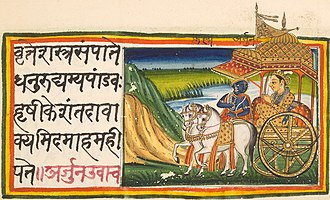
The Bhagavad Gītā
The “Song of the Lord” — Kṛṣṇa’s teaching to the despairing warrior Arjuna on the battlefield of Kurukṣetra, on duty, action without attachment, knowledge and devotion.
Brahma Sūtras
Bādarāyaṇa’s 555 terse aphorisms systematizing the Upanishads — so condensed they are unreadable without the commentaries that founded the schools of Vedānta.