Parmenides says only what-is is, and change is illusion; Heraclitus says everything flows. Aristotle makes “being qua being” the subject of first philosophy. Martin Heidegger accuses the whole Western tradition of forgetting the question of Being. In Advaita Vedānta, Brahman is sat — pure being — and the world of change is māyā.
Thinkers & Authors
23Uddālaka Āruṇi
Upanishadic teacher who instructed his son Śvetaketu with salt in water and the seed of a banyan, ending each lesson — “tat tvam asi”, that thou art.

Yājñavalkya
The boldest sage of the Upanishads, who taught that the Self (ātman) is the unseen seer, describable only as “neti neti” — not this, not this.
Gārgī Vācaknavī
The woman philosopher who challenged Yājñavalkya at King Janaka’s court with questions about what the universe is “woven on” — pressing him until he warned that her head would fall off, then returning with two questions “like arrows”. One of the earliest named women philosophers in history.
Kapila
The legendary founder of Sāṃkhya, revered as the “first knower” (ādividvān) and, in later Hinduism, as an incarnation of Viṣṇu — a sage known almost entirely through myth, to whom India credits the first systematic philosophy of consciousness and nature.

Laozi
The legendary “Old Master” credited with the Tao Te Ching — the short, paradoxical classic of the Way that cannot be named, of yielding water and effortless action.

Heraclitus
The obscure philosopher of Ephesus for whom everything flows, strife is the father of all things, and a hidden logos governs the endless change.

Parmenides
The stern pre-Socratic of Elea who argued that only what-is can be thought, that nothing comes from nothing, and that change and plurality are illusions.

Aristotle
Plato’s greatest student and tutor of Alexander the Great, who founded logic, systematized biology, ethics and politics, and brought the Forms down to earth.
Kaṇāda
The founder of Vaiśeṣika and traditional author of the Vaiśeṣika Sūtras — the sage remembered as India’s first atomist, who taught that everything perceptible is built from eternal, indivisible particles.
Bādarāyaṇa
The author, by tradition, of the Brahma Sūtras — the systematisation of the Upaniṣads that became the root text of every school of Vedānta. Often identified with Vyāsa, compiler of the Vedas and author of the Mahābhārata.

Nāgārjuna
Founder of the Madhyamaka (“Middle Way”) school of Buddhism, who argued that all things are empty (śūnya) of independent existence — including emptiness itself.
Vasubandhu
The 4th–5th century Buddhist philosopher who wrote the definitive summary of Abhidharma — and then, converted by his brother Asaṅga, became co-founder of Yogācāra, arguing that the world we experience is “representation only”.
Bhartṛhari
The 5th-century philosopher of language who taught that ultimate reality is the Word (śabda-brahman), that meaning flashes forth as a whole (sphoṭa), and that all knowledge is shot through with language — and, by tradition, the poet of the Three Centuries on love, worldly wisdom and renunciation.
Gauḍapāda
The earliest systematic teacher of Advaita Vedānta, whose verses on the Māṇḍūkya Upaniṣad taught that nothing has ever really been born — the waking world is like a dream, and the one consciousness only seems to become many.

Ādi Śaṅkara
The great systematizer of Advaita (non-dual) Vedānta — Brahman alone is real, the world is māyā, and the individual self is none other than Brahman.
Abhinavagupta
The towering Kashmiri polymath (c. 950–1016) — the great systematiser of non-dual Kashmir Śaivism and the greatest theorist of Indian aesthetics, who taught that in the experience of art (rasa) the self tastes its own blissful consciousness.

Avicenna (Ibn Sīnā)
Persian polymath — physician, metaphysician, logician — whose Canon of Medicine was taught in Europe for 500 years and whose distinction between essence and existence reshaped philosophy in Islam and the Latin West.

Rāmānuja
Founder of Viśiṣṭādvaita — “qualified non-dualism” — who argued against Śaṅkara that the world and souls are real, forming the body of a personal God.

Thomas Aquinas
Dominican friar and the greatest of the scholastics, who wove Aristotle’s philosophy and Christian theology into a single vast system — the Summa Theologiae — with five ways to prove God.
Madhva
The 13th-century philosopher from Udupi who founded Dvaita Vedānta — the uncompromising teaching that God, souls and matter are eternally distinct, and that Viṣṇu alone is independent.

Georg Wilhelm Friedrich Hegel
The philosopher of Spirit and dialectic, for whom reality is a rational process working itself out through contradiction in history — “the real is the rational”.
Sri Aurobindo
The revolutionary nationalist turned yogi and philosopher of Pondicherry, whose The Life Divine and Integral Yoga teach that evolution is spirit’s ascent through matter, life and mind toward a “supermind” that will divinise earthly life.

Martin Heidegger
The philosopher of Being, who argued that the West had forgotten the question of what it means to be, and analysed human existence (Dasein) as thrown, anxious, being-toward-death.
Works
11The Ṛg Veda
The oldest text of India and one of the oldest in any Indo-European language — 1,028 hymns to the gods of fire, storm, sky and order, composed c. 1500–1000 BCE and preserved orally, syllable for syllable, for over three thousand years. Its final book already asks how the universe began, and whether even its creator knows.
The Upaniṣads
The philosophical dialogues that close the Vedas (c. 800–200 BCE) — forest teachings in which kings, priests, women and a boy at Death’s door ask what the Self is, what Brahman is, and how to be free. The source of Vedānta, and of almost every later Indian idea about the self.

Bṛhadāraṇyaka Upaniṣad
The “Great Forest” Upanishad, oldest and longest, home of Yājñavalkya’s debates, the teaching to Maitreyī, and “neti neti”.

Chāndogya Upaniṣad
One of the oldest Upanishads, famed for Uddālaka’s teaching to Śvetaketu — tat tvam asi — and Satyakāma’s honest answer about his birth.
Taittirīya Upaniṣad
The Upaniṣad of the five sheaths and the graduation address — it defines Brahman as “truth, knowledge, infinity”, peels away the layers of the self from food to bliss, measures the bliss of Brahman, and tells departing students “Treat your mother as a god.”

Tao Te Ching
The 81 short chapters of the “Classic of the Way and its Power” — the foundational text of Daoism and one of the most translated books ever written.
Brahma Sūtras
Bādarāyaṇa’s 555 terse aphorisms systematizing the Upanishads — so condensed they are unreadable without the commentaries that founded the schools of Vedānta.
Māṇḍūkya Upaniṣad
The shortest Upaniṣad — twelve verses on the syllable Oṃ and the four states of consciousness, waking, dreaming, deep sleep and the “fourth” (turīya), the pure Self. Said to be enough, by itself, for liberation.
Mūlamadhyamakakārikā
Nāgārjuna’s 450 verses in 27 chapters — the founding text of Madhyamaka, which examines causation, motion, the self, time and nirvāṇa, and shows that nothing has intrinsic existence; everything is empty because everything is dependent.
The Heart Sūtra
The shortest and most famous Mahāyāna scripture — a single page in which the bodhisattva Avalokiteśvara declares that “form is emptiness, emptiness is form”, negates every Buddhist category, and ends with a mantra: “gone, gone, gone beyond, gone altogether beyond — awakening, hail!”
Sāṃkhya Kārikā
Īśvarakṛṣṇa’s 72-verse poem that is the classical statement of Sāṃkhya philosophy — from the threefold suffering of life, through the evolution of nature in twenty-five principles, to the liberating vision in which nature, “seen”, stops dancing.
Ideas
9Ātman is Brahman
The central Upanishadic insight — the innermost Self of each being is identical with the ultimate reality of the universe.
Anekāntavāda
The Jain doctrine that reality is many-sided — that every thing has infinite aspects and every statement captures only one, so that truth requires holding many viewpoints together. Expressed in the parable of the blind men and the elephant and formalised in the sevenfold logic of syādvāda.
Nothing from Nothing
The ancient principle that nothing comes from nothing — the foundation of Greek physics and the target of the Christian doctrine of creation from nothing.
Pratītyasamutpāda (Dependent Origination)
The Buddha’s central insight — “when this exists, that comes to be; when this ceases, that ceases.” Nothing exists independently; everything arises from conditions. Applied to suffering, it becomes the twelve-linked chain from ignorance to death.
The Forms
Plato’s eternal, perfect, unchanging realities — Beauty itself, Justice itself, the Good — of which the things we see are imperfect copies.
Śūnyatā (Emptiness)
Emptiness — the Mahāyāna teaching that all things lack intrinsic, independent existence (svabhāva), because they arise in dependence on causes, parts and concepts. Not nothingness, but the openness that makes change and freedom possible.
Māyā
The power of appearance — in Advaita, the cosmic illusion by which the one Brahman appears as a world of many things.
The Thing-in-Itself
Reality as it is independently of how it appears to us — for Kant, thinkable but never knowable.
Dasein
Heidegger’s term for the human being — “being-there” — the entity whose own being is an issue for it.
Schools & Movements
13Vedānta
“The end of the Veda” — the schools that interpret the Upanishads, Bhagavad Gītā and Brahma Sūtras to understand Brahman, the Self, and liberation.
The Pre-Socratics
The first Greek philosophers — from Thales to Democritus — who asked what everything is made of and replaced myth with argument.
Sāṃkhya
The oldest of the classical Indian systems — a radical dualism of pure, inactive consciousness (puruṣa) and active, unconscious nature (prakṛti) with its three strands, the guṇas. Liberation is seeing that consciousness was never really entangled in nature.
Daoism
The Chinese tradition of the Dao — the nameless Way of nature — teaching spontaneity, simplicity, effortless action and harmony with the flow of things.
Platonism
The tradition descending from Plato — eternal Forms, an immortal soul, and a reality higher than the senses — from the Academy through Neoplatonism to Christian theology.
Vaiśeṣika
India’s school of natural philosophy and atomism — reality analysed into six (later seven) categories, the world built from eternal, indivisible atoms of earth, water, fire and air, combined by an unseen moral force. Merged with Nyāya, it gave Indian realism its map of what exists.
Madhyamaka
Nāgārjuna’s school of emptiness — nothing has intrinsic existence (svabhāva), all things are empty because they arise in dependence, and even emptiness is empty. Its dialectic dismantles every view, and it became the summit of Tibetan Buddhist philosophy.
Yogācāra
The “mind-only” school of Mahāyāna Buddhism, founded by Asaṅga and Vasubandhu — the world we experience is a construction of consciousness, carried by a “storehouse” of karmic seeds; awakening is the transformation of the basis of consciousness itself.
Advaita Vedānta
Non-dualist Vedānta — Brahman alone is real, the world is appearance (māyā), and the self is identical with Brahman.
Kashmir Śaivism
The non-dual Śaiva philosophy of medieval Kashmir — reality is the free, self-aware consciousness of Śiva, who playfully contracts himself into the many selves and the world, and liberation is the recognition that you are Śiva. The world is not illusion but God’s self-expression.
Dvaita Vedānta
Madhva’s realist, theistic Vedānta — God (Viṣṇu) alone is independent; souls and matter are real, eternally distinct from God and from each other, and wholly dependent on him. The most uncompromising rejection of Advaita in Indian thought.
German Idealism
The extraordinary philosophical movement after Kant — Fichte, Schelling, Hegel — that tried to complete his revolution by showing reality itself to be the work of mind or Spirit.
Phenomenology
Husserl’s method of describing experience exactly as it appears — “to the things themselves!” — which Heidegger and Sartre turned toward existence.
Debates
2Being vs. Becoming
The first great quarrel in Western philosophy — is reality one and changeless (Parmenides) or everlasting flux (Heraclitus)?
Śaṅkara vs. Rāmānuja
The great Vedāntic debate — is the self identical with Brahman, and the world an illusion? Or are souls and world real, the body of a personal God?
Great Scenes
2The Allegory of the Cave
Prisoners chained since birth see only shadows on a cave wall; one is freed, dragged into the sunlight, and returns to tell the others — who would kill him if they could.
Tat Tvam Asi — Salt in Water
Uddālaka tells his son Śvetaketu to dissolve salt in water and taste it — invisible, yet everywhere — “that is the Self; that thou art.”
Great Questions
3How Is the Mind Related to the Body?
Witness-consciousness and matter, the soul as form, two substances, one substance, Dasein — the mind–body problem across civilizations.
What Is Time?
Flux and permanence, the moving image of eternity, Augustine’s puzzle, Kant’s form of intuition, eternal recurrence, Heidegger’s temporality.
What Is the Self? — The Indian Argument
Three thousand years of Indian argument about the “I” — from the Upaniṣads’ Self that is Brahman, through the Buddha’s no-self, the Jain soul, the Nyāya substance, Sāṃkhya’s witness, to Ramana’s “Who am I?” and Ambedkar’s social self.
Lines to Remember
11 quotationsYou cannot step twice into the same river; for other waters are ever flowing on to you.
Context & when to use it
The famous “river fragment”, known in several ancient versions.
For change, impermanence, the self in flux.
War is the father of all and king of all.
πόλεμος πάντων μὲν πατήρ ἐστι, πάντων δὲ βασιλεύς
Context & when to use it
For conflict as creative force; Hegel’s dialectic; Nietzsche’s agon.
For it is the same thing to think and to be.
τὸ γὰρ αὐτὸ νοεῖν ἐστίν τε καὶ εἶναι
Context & when to use it
For idealism, the unity of thought and reality, the limits of what can be thought.
Nothing can ever be created by divine power out of nothing.
nullam rem e nilo gigni divinitus umquam
Context & when to use it
For naturalism and conservation laws; the root of “ex nihilo nihil fit”.
What then is time? If no one asks me, I know; if I wish to explain it to one who asks, I know not.
Quid est ergo tempus? Si nemo ex me quaerat, scio; si quaerenti explicare velim, nescio.
Context & when to use it
For any concept we use easily but cannot define.
Language is the house of Being. In its home man dwells.
Context & when to use it
For the philosophy of language and poetry.
That which is the finest essence — this whole world has that as its Self. That is the Truth. That is the Self. That thou art, Śvetaketu.
स य एषोऽणिमैतदात्म्यमिदं सर्वं तत्सत्यं स आत्मा तत्त्वमसि श्वेतकेतो
Context & when to use it
The refrain of Uddālaka’s teaching, repeated nine times.
For non-duality, compassion grounded in identity, the unity of self and world.
Whatever is dependently arisen, that is explained to be emptiness. That, being a dependent designation, is itself the middle way.
Context & when to use it
For emptiness as relationality, not nothingness.
Brahman is real, the world is illusory; the individual self is none other than Brahman.
ब्रह्म सत्यं जगन्मिथ्या जीवो ब्रह्मैव नापरः
Context & when to use it
The half-verse summary of Advaita Vedānta.
⚠ The formula is traditionally attributed to Śaṅkara; its exact textual source is debated.
Nothing will come of nothing. Speak again.
Context & when to use it
Cordelia refuses to flatter, saying “Nothing, my lord.” Lear warns her that she will inherit nothing.
Ex nihilo nihil fit, in Shakespeare’s mouth. For causation, for silence, for refusing flattery.
We are such stuff As dreams are made on, and our little life Is rounded with a sleep.
Context & when to use it
Prospero ends the masque — the “cloud-capp’d towers” and “the great globe itself” shall dissolve.
For māyā, the dreamlike unreality of the world, and the brevity of life. Perfect beside Śaṅkara or Zhuangzi’s butterfly.
⚠ “Made on”, not “made of”.
Sententiae
phrases in the originalPanta rhei
Origin. The summary of Heraclitus’ doctrine — but the phrase itself appears first in later writers (Simplicius); it is not among his fragments. — Heraclitus
⚠ A slogan about Heraclitus, not by him.
For impermanence and change.
Ex nihilo nihil fit
Origin. The principle goes back to Parmenides (c. 500 BCE), who argued that what-is cannot come from what-is-not. Lucretius put it in Latin verse — “nil posse creari de nilo”, nothing can be created out of nothing (De Rerum Natura I.155–156). The compact form “ex nihilo nihil fit” is a later scholastic formula. — Parmenides
⚠ Christian theology answered with “creatio ex nihilo” — God creates out of nothing, precisely because God is not bound by the rule. Shakespeare’s Lear throws the maxim at Cordelia — “Nothing will come of nothing: speak again.”
Against any argument that pulls something from nowhere — a free lunch, a cause without a cause, a conclusion without premises.
Deus sive Natura
Origin. Spinoza, Ethics IV, preface and prop. 4 — God and Nature are one and the same infinite substance. — Baruch Spinoza
⚠ “Sive” means “or, in other words” — an identity, not an alternative. That identity got Spinoza called an atheist and a pantheist at once.
For pantheism, naturalism, the sacredness of nature.
Das Ding an sich
Origin. Kant, Critique of Pure Reason — reality as it is independent of how it appears to us. — Immanuel Kant
For what lies beyond appearances and models.
Tat tvam asi
Origin. Chāndogya Upaniṣad 6.8.7, repeated nine times by Uddālaka to his son Śvetaketu. — Uddālaka Āruṇi, Chāndogya Upaniṣad
⚠ Some scholars (Joel Brereton) argue the grammar may mean “you are that (finest essence)” — the reading of identity with Brahman comes from the Vedāntic tradition.
For non-duality, the unity of self and cosmos, compassion grounded in identity (Schopenhauer).
Ahaṃ brahmāsmi
Origin. Bṛhadāraṇyaka Upaniṣad 1.4.10 — one of the four mahāvākyas. — Bṛhadāraṇyaka Upaniṣad
For the realization of identity with the absolute — not ego-inflation but ego-dissolution.
Brahma satyaṃ jagan mithyā
Origin. Traditional summary of Advaita, attributed to Śaṅkara. — Ādi Śaṅkara
⚠ “Mithyā” does not mean non-existent like a hare’s horn, but dependent and ultimately unreal — like the snake seen in a rope.
For Advaita in one line.
Explore Next
related by shared connections
Plato
Socrates’ student and Aristotle’s teacher, author of the dialogues, founder of the Academy, and the philosopher of the Forms — of whom Whitehead said all Western philosophy is a series of footnotes.
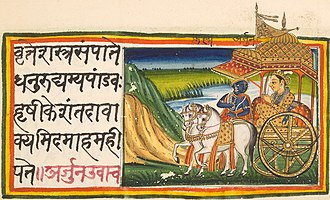
The Bhagavad Gītā
The “Song of the Lord” — Kṛṣṇa’s teaching to the despairing warrior Arjuna on the battlefield of Kurukṣetra, on duty, action without attachment, knowledge and devotion.
What Are the Limits of the Human Mind?
Can reason know everything — or are there things the mind can never reach? From the Upanishads’ unknowable knower to Kant’s boundary and Wittgenstein’s silence.

Gautama Buddha
The prince who left his palace to seek an end to suffering, awoke under the Bodhi tree, and taught the Four Noble Truths, the Middle Way and no-self (anattā).

Simone de Beauvoir
French existentialist philosopher and novelist whose The Second Sex (1949) — “One is not born, but rather becomes, a woman” — founded modern feminist philosophy, and whose ethics of ambiguity argued that my freedom requires the freedom of others.
Ramana Maharshi
The silent sage of Arunachala (1879–1950), who at sixteen experienced his own death and the deathless Self, and taught one practice above all — self-inquiry, “Who am I?” — the simplest and most direct path of Advaita.