Seeing teachers, grandsires, cousins and friends in both armies, Arjuna’s limbs fail, his mouth dries, the bow Gāṇḍīva slips from his hand. “I do not wish to kill them, though they kill me.” Like Hamlet, a warrior paralysed by conscience before a duty of killing — but where Hamlet’s world gives him no answer, Kṛṣṇa gives Arjuna eighteen chapters of one.
Explore Next
related by shared connectionsThe Universal Form
Arjuna asks to see Kṛṣṇa’s true form — and beholds the whole universe, all beings, all gods, and all the warriors rushing into Time’s blazing mouths.
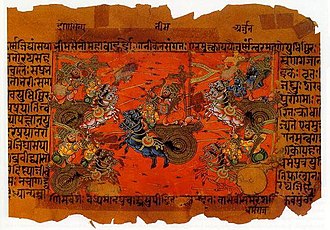
The Mahābhārata
The great epic of India — the war between the Pāṇḍavas and the Kauravas, cousins fighting for a kingdom — and, at about 100,000 couplets, the longest poem ever composed, containing the Bhagavad Gītā and almost the whole of Indian thought on dharma.

Meditations
The private notebook of the Stoic emperor Marcus Aurelius, written on campaign — the most intimate and enduring work of ancient practical philosophy.

The Odyssey
Homer’s epic of Odysseus’s ten-year journey home from Troy — monsters, witches, the underworld and a household besieged — the archetype of every adventure, every homecoming and every clever hero.
The Bhāgavata Purāṇa
The most beloved of the Purāṇas (c. 9th–10th century) — twelve books of devotion to Viṣṇu, culminating in the tenth book’s life of Kṛṣṇa: the butter-thief child, the cowherd, the lover of the gopīs, the god who dances with every devotee at once.
Are We Free?
Fate, karma, determinism, compatibilism, radical freedom — the long argument over whether we choose what we do.