- 1 ṚVc. 1500–1000 BCE · Indian
The Ṛg Veda
Right action is right ritual — the sacrifice that keeps the cosmic order (ṛta) turning.
Read the full argument → - 2 Kc. 700 BCE · Indian
Karma
“As a man acts, so he becomes.” Every act leaves a trace that ripens — the chain that binds us to rebirth.
Read the full argument → - 3
 c. 563–483 BCE · Indian
Gautama Buddha
Karma is intention. Act without greed, hatred and delusion — the Middle Way between indulgence and austerity.
Read the full argument → - 4 Mc. 540–468 BCE · Indian
Mahāvīra
All beings love life. Harm none — in thought, word or deed — even the insect underfoot.
Read the full argument → - 5
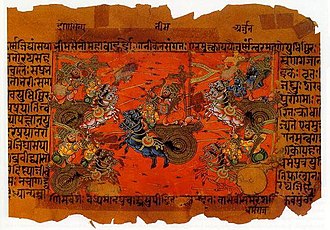 c. 400 BCE – c. 400 · Indian
The Mahābhārata
Dharma is subtle; its truth is hidden in a cave. The best people break rules; the worst keep them.
Read the full argument → - 6
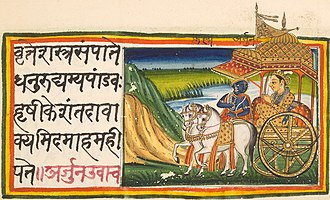 c. 200 BCE · Indian
The Bhagavad Gītā
Act, but without attachment to the fruits. “Your right is to action alone, never to its fruits.”
Read the full argument → - 7 Kc. 375–283 BCE · Indian
Kauṭilya (Cāṇakya)
The king must use whatever works — conciliation, gifts, division, force — for the welfare of his people.
Read the full argument → - 8 Tc. 400 – c. 500 · Indian
The Tirukkuṟaḷ
Return good for evil; non-killing is the highest virtue; agriculture is the axle of the world.
Read the full argument → - 9 Bc. 1131 – c. 1167 · Indian
Basavaṇṇa (Basava)
Work is worship. The labourer’s body is a temple more lasting than stone.
Read the full argument → - 10 MG1869 – 1948 · Indian
Mahatma Gandhi
Truth is God and non-violence the means. Suffer, don’t inflict — and remember the face of the poorest.
Read the full argument → - 11 BR1891 – 1956 · Indian
B. R. Ambedkar
Political democracy without social democracy is a contradiction. Educate, agitate, organise.
Read the full argument →
India’s long argument about action is about one problem: action binds, yet no one can stop acting. Each answer here is a different way out.
Explore Next
related by shared connectionsGandhi vs. Ambedkar
The great argument of modern India — can caste be reformed from within Hinduism, as Gandhi believed, or must it be annihilated, with the scriptures that sanctify it, as Ambedkar argued?
Annihilation of Caste
Ambedkar’s 1936 undelivered speech — the most powerful critique of caste ever written — arguing that caste is a division of labourers, not of labour, that it rests on the authority of the Hindu scriptures, and that it cannot be reformed but only destroyed.
The Arthaśāstra
Kauṭilya’s treatise on statecraft — 15 books on kingship, administration, economy, law, espionage, diplomacy and war. Lost for centuries and rediscovered in 1905, it is the most comprehensive ancient manual of government in any civilisation.
Hind Swaraj
Gandhi’s 1909 manifesto, written in ten days on a ship — a dialogue in which the “Editor” tells an impatient “Reader” that true home rule is rule over oneself, that modern civilisation is a disease, and that India must win freedom by non-violence and the spinning wheel.
Tiruvaḷḷuvar
The Tamil poet-sage who wrote the Tirukkuṟaḷ — 1,330 couplets on virtue, wealth and love that form the most revered ethical work in Tamil, translated into more languages than almost any other Indian text.
What Is the Self? — The Indian Argument
Three thousand years of Indian argument about the “I” — from the Upaniṣads’ Self that is Brahman, through the Buddha’s no-self, the Jain soul, the Nyāya substance, Sāṃkhya’s witness, to Ramana’s “Who am I?” and Ambedkar’s social self.