Vālmīki in One Ideas
the essentialsŚoka becomes śloka
Grief at a hunter’s killing of a crane became the first verse — poetry born of compassion.
Vālmīki is the sage-poet to whom tradition attributes the The Rāmāyaṇa, the older of India’s two great Sanskrit epics, and who is therefore honoured as the ādikavi, “the first poet”. Nothing historical is known of him. The Rāmāyaṇa itself makes him a character: in its first book, he witnesses a hunter kill one of a pair of mating cranes, and his grief (śoka) bursts out as a curse in a new metre — the first śloka — after which the god Brahmā commands him to tell the story of Rāma in that metre. In its last book, he shelters the banished Sītā in his hermitage and teaches the poem to her twin sons, Lava and Kuśa, who sing it before Rāma.
A later legend, popular across India, makes Vālmīki a former highway robber named Ratnākara. When he tried to rob the divine sage Nārada, Nārada asked him whether his family, for whom he robbed, would share the sin of his crimes. Ratnākara went home to ask; they refused. Shaken, he returned to Nārada, who taught him to repeat the name of Rāma — but the robber could only say “marā, marā” (“dead, dead”), which, repeated, becomes “Rāma, Rāma”. He meditated so long that an anthill (valmīka) grew over him, from which he emerged as Vālmīki. The story became a favourite parable of redemption.
Curiosities
did you know?- Legend: as the robber Ratnākara, he was told by the sage Nārada to ask his family whether they would share the sin of his crimes; they refused. Repenting, he meditated so long that an anthill (valmīka) grew over him — hence his name.
- He appears in the Rāmāyaṇa’s last book as the sage who shelters the banished Sītā and teaches the epic to her sons.
- The Vālmīki community, many of them Dalits, honour him as their ancestor; Vālmīki Jayantī is celebrated across North India.
Questions to Argue About
debate club →- Can a criminal become a saint — and a poet?
Explore Next
related by shared connectionsRāmcaritmānas
Tulsīdās’s 16th-century retelling of the Rāmāyaṇa in Avadhī Hindi — 12,800 lines of devotional epic that made Rāma the God of North India, recited daily, staged every year as Rāmlīlā, and loved more than any other book in Hindi.
Tulsīdās
The 16th-century poet of Vārāṇasī who retold the Rāmāyaṇa in Avadhī as the Rāmcaritmānas — the most widely read and recited book in North India — and wrote the Hanumān Chālīsā, sung daily by millions.
The Mahābhārata
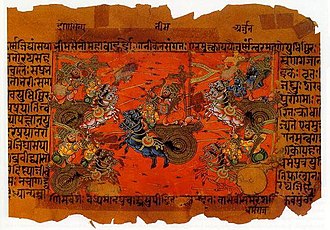
The great epic of India — the war between the Pāṇḍavas and the Kauravas, cousins fighting for a kingdom — and, at about 100,000 couplets, the longest poem ever composed, containing the Bhagavad Gītā and almost the whole of Indian thought on dharma.
The Jātakas
547 stories of the Buddha’s previous lives — as a hare, a monkey king, a merchant, a prince — told to illustrate the virtues that lead to awakening. India’s great treasury of folk tales, carved on stūpas and painted in caves.
Cordelia
Lear’s youngest daughter, who will not flatter, is disinherited, returns to rescue him, forgives him with “No cause, no cause” — and is hanged.
Lear Wakes: "No Cause, No Cause"
Lear wakes from madness to find Cordelia beside him, thinks he is in hell, begs her forgiveness — and she answers with two words that undo the whole tragedy.