

Contents · 3 sections · 2 min
Cervantes in Four Ideas
the essentialsThe first modern novel
Don Quixote turns fiction on itself — a book about the effects of reading books, full of characters who have read Part One.
Idealism and reality
The knight sees giants where there are windmills; the squire sees windmills. The novel holds both visions in tension without choosing.
Irony and compassion
Cervantes mocks his hero mercilessly and loves him completely — the birth of humane irony.
Perspectivism
Is it a barber’s basin or Mambrino’s helmet? “A basin-helmet” — reality depends on who looks.
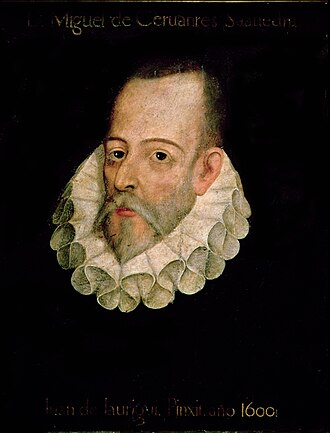
Miguel de Cervantes Saavedra lived a life more adventurous than most novels — soldier, wounded hero, slave, tax collector, prisoner — and in his late fifties published the book that is often called the first modern novel and the greatest ever written: Don Quixote.
Life
Cervantes was born in 1547 in Alcalá de Henares, near Madrid, the fourth of seven children of an itinerant barber-surgeon who was often in debt. He had little formal education. In 1569, after wounding a man in a duel, he fled to Italy, served in the household of a cardinal, and joined the Spanish infantry. On 7 October 1571 he fought aboard the galley Marquesa at the Battle of Lepanto, the great naval victory of the Holy League over the Ottoman fleet. Though feverish, he insisted on fighting; he was shot twice in the chest and once in the left hand, which was maimed for life. He was proud of it: “I lost the movement of my left hand for the greater glory of the right.”
In 1575, sailing home to Spain, his ship was captured by Barbary pirates, and he spent five years as a captive in Algiers. He organized four escape attempts; each failed, and each time he took full responsibility, yet his captors spared him, perhaps because they hoped for a large ransom. In 1580 Trinitarian friars ransomed him.
Back in Spain he married, wrote plays and a pastoral romance (La Galatea, 1585) that brought little money, and worked as a commissary requisitioning grain for the Spanish Armada and then as a tax collector — work that landed him twice in prison for irregular accounts. Tradition says he conceived Don Quixote in prison in Seville.
Don Quixote Part One appeared in 1605 and was an immediate success, translated into English (by Thomas Shelton, 1612) and French within a few years. But Cervantes had sold the rights and earned little. A spurious sequel by an unknown “Alonso Fernández de Avellaneda” appeared in 1614; Cervantes, furious, finished his own Part Two (1615), mocking the impostor within the text. He also published the Exemplary Novels (1613), short stories of extraordinary range, and The Travails of Persiles and Sigismunda (1617), a romance he thought his best work. He died in Madrid on 22 April 1616.
Cervantes and the novel
Cervantes did not invent prose fiction — there were Greek romances, Spanish picaresque tales like Lazarillo de Tormes, and the chivalric romances he parodied. What he invented was a fiction aware of itself: a book about reading, about the gap between books and life, about how people make their realities out of stories. Its narrator claims to be translating an Arabic manuscript by “Cide Hamete Benengeli”; in Part Two, characters have read Part One and recognize Don Quixote from it. Michel Foucault, in The Order of Things, called Don Quixote “the first modern work of literature” — the moment when words and things come apart.
Legacy
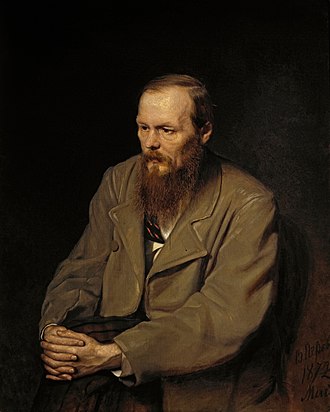
Every later novelist is in his debt: Fielding, Sterne, Flaubert (Madame Bovary is a female Quixote ruined by romances), Fyodor Dostoevsky (who called Don Quixote “the saddest book ever written” and modelled Prince Myshkin partly on him), Melville, Twain, Kafka (a parable in which Sancho invents Don Quixote), Borges (“Pierre Menard, Author of the Quixote”), Nabokov (who lectured on its cruelty), Milan Kundera, Salman Rushdie (Quichotte). The Spanish language itself is called “the language of Cervantes”.
Curiosities
did you know?- He lost the use of his left hand at the battle of Lepanto (1571) — ‘to the greater glory of the right’.
- He spent five years as a captive in Algiers, attempting four escapes.
- He died on 22 April 1616 (buried on the 23rd), almost the same date as Shakespeare — but England still used the Julian calendar, so they died ten days apart.
- His bones were rediscovered in a Madrid convent in 2015.
Questions to Argue About
debate club →- Is Don Quixote mad, or is the world mad?
- Is it better to live by an impossible ideal or by the facts?
In Their Own Words
2 quotationsLook, your worship, those things over there aren’t giants, they’re windmills, and what seem to be their arms are the sails.
Context & when to use it
For the realist’s reply to the idealist — and for tilting at windmills.
Freedom, Sancho, is one of the most precious gifts heaven has bestowed upon men; no treasure the earth holds or the sea conceals can compare with it.
Context & when to use it
For liberty — written by a man who spent five years as a slave.
Explore Next
related by shared connections
Anton Chekhov
Russian doctor, short-story writer and playwright who revolutionised both forms — stories without neat plots or morals, plays where the drama happens beneath ordinary talk — and became the great artist of wasted lives, quiet longing and compassion.
The Copernican Revolution
Kant’s reversal — instead of the mind conforming to objects, objects must conform to the mind’s forms of knowing.

Nikolai Chernyshevsky
Radical critic and author of What Is to Be Done? — the utopian novel of “rational egoism” that inspired Lenin and provoked Dostoevsky’s Underground Man.
Hume's Fork
Every meaningful claim is either a relation of ideas (certain but empty) or a matter of fact (informative but uncertain) — metaphysics is neither.

John Locke
Father of British empiricism and of liberalism — the mind begins as a blank slate, and government rests on the consent of the governed.

William Shakespeare
The playwright and poet of Stratford whose 37-odd plays and 154 sonnets gave English its richest store of quotation and gave philosophy Hamlet, Lear and Macbeth.