


Turgenev in Three Ideas
the essentialsThe nihilist
Through Bazarov — “a man who does not bow down before any authority, who does not accept any principle on faith” — Turgenev named the radical youth of the 1860s.
Fathers and sons
The generational quarrel between liberal idealists of the 1840s and materialist radicals of the 1860s.
Nature outlasts ideas
The novel ends at Bazarov’s grave — flowers speak of “eternal reconciliation and of life which is endless.”
Turgenev was attacked from both sides: radicals thought Bazarov a slander, conservatives thought him a glorification. Dostoevsky caricatured Turgenev as the vain writer Karmazinov in Demons. He lived most of his later life abroad, close to the singer Pauline Viardot, and friend of Flaubert.
Curiosities
did you know?- Dostoevsky caricatured him as the vain writer Karmazinov in Demons.
Questions to Argue About
debate club →- Is rejecting all authority a form of freedom or of emptiness?
In Their Own Words
1 quotationsA nihilist is a man who does not bow down before any authority, who does not accept any principle on faith, however much that principle may be revered.
Context & when to use it
Arkady explains his friend Bazarov to his father and uncle.
The definition of Russian nihilism — use it when someone calls themselves a free thinker.
Through Their Characters
2A decent chemist is twenty times more useful than any poet.
Context & when to use it
Bazarov’s utilitarian contempt for art.
For science versus the humanities; utility versus beauty.
Nature is not a temple, but a workshop, and man’s the workman in it.
Context & when to use it
Against Romantic reverence for nature.
For instrumental reason, the technological attitude (Heidegger’s “standing-reserve”).
Explore Next
related by shared connectionsYevgeny Bazarov
Turgenev’s young doctor-nihilist who rejects art, love and every authority — and dies of a cut finger, having loved and lost.
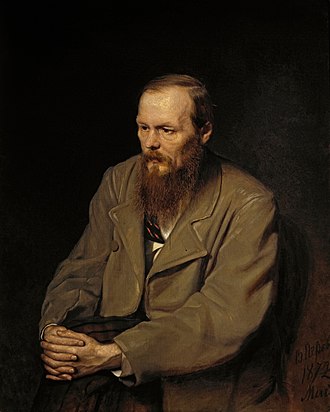
Fyodor Dostoevsky
The Russian novelist of the abyss — crime, faith, freedom, suffering — whose characters argue philosophy with their lives. Nietzsche called him the only psychologist he had anything to learn from.

Homer
The legendary blind poet of Greece to whom the Iliad and the Odyssey are attributed — the founding works of Western literature, and for the Greeks the “educator of Hellas”.

Demons
Dostoevsky’s prophetic political novel — a provincial town possessed by revolutionary nihilists, the murder of one of their own, and the hollow charisma of Stavrogin.

Hamlet
Shakespeare’s longest play — a prince ordered by his father’s ghost to avenge a murder thinks, doubts, delays, feigns madness, and dies in the act.

Leo Tolstoy
The Russian giant of War and Peace and Anna Karenina, who in mid-life fell into a crisis of meaning and reinvented himself as a prophet of non-violence and simple Christian love.