- 1
 1564 – 1616 · British & Irish
William Shakespeare
Macbeth — life signifies nothing; Hamlet — “there is nothing either good or bad, but thinking makes it so.”
Read the full argument → - 2
 1743 – 1819 · German-language
Friedrich Heinrich Jacobi
1799 — coins Nihilismus. Idealism dissolves reality into the self, and so into nothing.
Read the full argument → - 3
 1818 – 1883 · Russian
Ivan Turgenev
1862 — Bazarov, the nihilist who bows to no authority. A generation takes the name.
Read the full argument → - 4
 1828 – 1889 · Russian
Nikolai Chernyshevsky
1863 — rational egoism and the Crystal Palace; the positive programme of the radicals.
Read the full argument → - 5
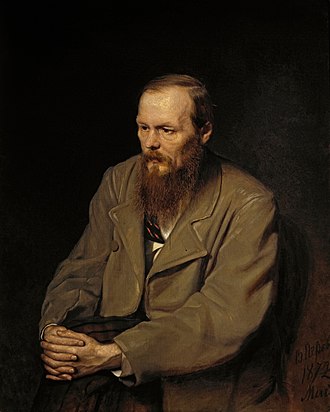 1821 – 1881 · Russian
Fyodor Dostoevsky
1864–1880 — the Underground Man, Raskolnikov, Kirillov, Ivan Karamazov. What happens when the idea is lived?
Read the full argument → - 6
 1844 – 1900 · German-language
Friedrich Nietzsche
1882–1888 — God is dead; nihilism is the uncanniest guest; overcome it by creating values.
Read the full argument → - 7
 1889 – 1976 · German-language
Martin Heidegger
Nihilism is the history of Western metaphysics forgetting Being.
Read the full argument → - 8
 1913 – 1960 · French
Albert Camus
1942–1951 — the absurd is not nihilism. Neither suicide nor the leap — revolt, with limits.
Read the full argument →
See the theme hub Nihilism.
Explore Next
related by shared connectionsRussian Nihilism
The 1860s movement of young Russian radicals who rejected tradition, religion, art and authority in the name of science, utility and the people.

Anton Chekhov
Russian doctor, short-story writer and playwright who revolutionised both forms — stories without neat plots or morals, plays where the drama happens beneath ordinary talk — and became the great artist of wasted lives, quiet longing and compassion.

Jean-Paul Sartre
The face of French existentialism — existence precedes essence, we are condemned to be free, and hell is other people.

Søren Kierkegaard
The melancholy Dane, father of existentialism, who set the passionate individual against Hegel’s System and faith against reason — “truth is subjectivity”.
The Rebel
Camus’s history of revolt — metaphysical and political — arguing that rebellion that kills for history betrays its own origin. It ended his friendship with Sartre.

Demons
Dostoevsky’s prophetic political novel — a provincial town possessed by revolutionary nihilists, the murder of one of their own, and the hollow charisma of Stavrogin.