Muni in One Ideas
the essentialsRasa
Art’s purpose is to give the audience rasa — emotion savoured, not merely felt.
Bharata Muni (“the sage Bharata”) is the figure to whom Indian tradition attributes the The Nāṭyaśāstra, the encyclopaedic treatise on theatre, dance and music composed between about the second century BCE and the second century CE. Nothing is known of him as a historical person; the treatise itself presents him as a sage who received the “fifth Veda” of theatre from Brahmā and staged the first play with his hundred sons. Some scholars think the work was compiled by several hands over centuries; others that “bharata”, which also came to mean “actor”, is a title. Whatever his reality, Bharata’s name stands at the head of Indian aesthetics: his theory of Rasa and his detailed codification of gesture, movement and music underlie every classical Indian performing art.
Curiosities
did you know?- Some scholars think ‘Bharata’ is not a person’s name but a title — ‘bharata’ also meant ‘actor’ — or an acronym of bhāva, rāga and tāla (emotion, melody and rhythm).
Questions to Argue About
debate club →- Is a treatise attributed to a legendary sage the work of one mind or many?
Explore Next
related by shared connectionsRasa
The Indian theory of aesthetic experience — the “flavour” or “relish” that art evokes in the audience. Bharata named eight rasas; Abhinavagupta added peace and explained rasa as the self tasting its own consciousness through universalised emotion.
Kashmir Śaivism
The non-dual Śaiva philosophy of medieval Kashmir — reality is the free, self-aware consciousness of Śiva, who playfully contracts himself into the many selves and the world, and liberation is the recognition that you are Śiva. The world is not illusion but God’s self-expression.
Advaita Vedānta
Non-dualist Vedānta — Brahman alone is real, the world is appearance (māyā), and the self is identical with Brahman.
What Is the Self? — The Indian Argument
Three thousand years of Indian argument about the “I” — from the Upaniṣads’ Self that is Brahman, through the Buddha’s no-self, the Jain soul, the Nyāya substance, Sāṃkhya’s witness, to Ramana’s “Who am I?” and Ambedkar’s social self.
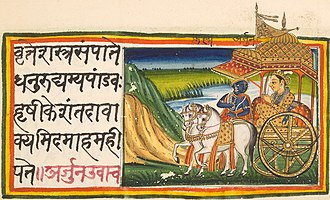
The Bhagavad Gītā
The “Song of the Lord” — Kṛṣṇa’s teaching to the despairing warrior Arjuna on the battlefield of Kurukṣetra, on duty, action without attachment, knowledge and devotion.
The Kāmasūtra
Vātsyāyana’s treatise on kāma — pleasure, love and desire — as one of the three legitimate aims of life. Far more than a sex manual, it is a handbook of urban culture, courtship, marriage, friendship and the arts of living well.