Key Ideas
Being-in-itself (en-soi) is massive, opaque, without reason.
Being-for-itself (pour-soi) is consciousness — a nothingness that makes there be a world.
Existence precedes essence.
Bad faith is lying to oneself about one’s freedom.
The Look of the other makes me an object — “hell is other people”.
Freedom is absolute; one is “condemned to be free”.
Human beings are a “useless passion” to be God.
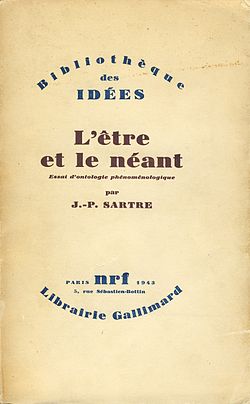
Being and Nothingness (L’Être et le Néant, 1943), subtitled “An Essay on Phenomenological Ontology”, is Jean-Paul Sartre‘s philosophical masterpiece, written during the German Occupation of Paris, partly in the cafés of Saint-Germain-des-Prés, and published in the middle of the war. It is a book of some eight hundred pages that makes a single, stark argument: there are two radically different kinds of being, the full, inert, self-identical being of things (l’être-en-soi, being-in-itself) and the being of consciousness (l’être-pour-soi, being-for-itself), which is not a thing but a lack, a questioning, a nothingness that makes a world appear. From this contrast Sartre derives a philosophy of absolute freedom and responsibility, in which human beings, without any given essence, nature or God, must constantly make themselves; and then describes the ways we flee from this freedom — in bad faith, in the roles we play, in our relations with others, in love, desire and conflict. It became the founding text of French existentialism and one of the most widely read philosophical works of the twentieth century.
The book begins with the phenomenological claim, following Husserl, that consciousness is always consciousness of something: it has no content of its own, and is wholly directed toward the world. Sartre draws from this an anti-Cartesian conclusion. Consciousness is not a thing inside the head; it is a translucent “nothing”, a pure intentionality; the ego, the “I”, is not an inhabitant of consciousness but an object in the world, constituted by reflection (the argument of his early essay The Transcendence of the Ego). All consciousness is at the same time pre-reflectively aware of itself, but in a non-positional way: when I count cigarettes, I am conscious of the cigarettes and of counting, without taking myself as an object. Yet the question that interests Sartre is: how can there be a being whose nature is to be consciousness of something other than itself? His answer is that consciousness is the way in which nothingness enters the world.
Nothingness is first revealed in negation. When I look for Pierre in a café and do not find him, his absence is a real feature of the situation: the café is full of people, but Pierre is not there. Absence, question, possibility, distance, destruction — all presuppose a being capable of negating. Where does nothingness come from? Not from being-in-itself, which is full, plenum, simply what it is; therefore from a being that is not in itself and so “has to be” what it is, a being that is its own nothingness. This is the for-itself. The for-itself is “what it is not and is not what it is”: it is not identical with its past or with its present form; it is a constant projection toward what it is not yet; it separates itself from the in-itself by a “nihilating” gap. Consciousness is thus a lack and a desire: a desire to be, to coincide with itself, to achieve the solid being of a thing. Sartre’s most famous formula follows: “Existence precedes essence.” A paper-knife has an essence (the idea in the artisan’s mind) before it exists; but a human being first exists, finds himself in the world, and defines himself afterward by what he makes of himself. There is no human nature, no God to give a design: “man is nothing else but what he makes of himself.”
If consciousness is nothingness, then it is free, not as one of its properties, but as its very structure: “Freedom is not a quality added to the being of man; it is the very stuff of his being.” Nothing determines my action: no motive, character or past can compel me, since I give them their weight in the act of choosing. Even when I am in chains, I am free to interpret my situation; even refusing to choose is a choice. Hence Sartre’s startling conclusion: “man is condemned to be free” — condemned, because he did not create himself, and yet free, because once cast into the world, he is responsible for everything he does. This freedom is experienced as anguish: the dizziness we feel at the edge of a precipice, not from fear that we may fall, but from the realisation that nothing prevents us from throwing ourselves over. Anguish is the discovery that I am the foundation of my own values, and that nothing outside me guarantees them. Most of us, most of the time, flee it.
The flight from anguish is bad faith (mauvaise foi), the central notion of the book’s psychology: a form of self-deception, in which I lie to myself about my own freedom, and treat myself either as a thing (a determined object, whose nature explains what I do) or as pure transcendence (an ideal self not yet realised). Sartre’s examples have become classic. The woman on a first date lets her hand rest in her companion’s without noticing it, treating it as a thing detached from her, to avoid deciding whether to accept his advances; she is both aware and unaware of his intentions. The café waiter moves with a little too much precision, too quickly and stiffly, playing at being a waiter, like an actor, to escape the fact that he is a free person who is in no way identical with his role. The homosexual who denies that he is a homosexual, because he has not always acted as one, and the champion of sincerity who insists he is a homosexual in the manner of a stone is a stone, are both in bad faith: the first denies facticity (the past he is), the second denies transcendence (the freedom he is). The structure is paradoxical, since the liar and the deceived are the same consciousness; Sartre rejects the Freudian unconscious as an explanation, since the censor would have to know what it hid. Bad faith is possible because consciousness is “what it is not and is not what it is”.
In Part Three, “Being-for-Others”, Sartre turns to the problem of the other. How do I know that there are other consciousnesses? Not by analogy or inference, but in the experience of the Look (le regard). Suppose I am peeping through a keyhole, absorbed in the scene, wholly an unselfconscious “for-itself” — and I hear footsteps behind me. Suddenly I feel myself seen: I experience shame; I am no longer a free subject, but an object — “a peeping Tom” — in someone else’s world. “Shame is shame of self before the Other.” The other’s look steals my world, turns me into an object with a nature (cowardly, ridiculous, guilty) that I did not choose, and that I cannot fully control. Hence conflict is the original meaning of being-for-others: each consciousness tries to reduce the other to an object and to preserve its own subjectivity. Sartre’s treatment of love, language, masochism, indifference, desire, sadism and hate shows that all our relations are variations on this conflict. In love, I want the other to love me freely and also to be wholly in my power — an impossibility. The play No Exit (1944) puts it in the line, “Hell is other people” (L’enfer, c’est les autres): in Hell, three dead people in a room are each other’s torturers by their gaze.
The last part, “Having, Doing and Being”, develops the implications of freedom for action, situation and responsibility. My situation is made of facticity (my body, past, environment, others) and the meaning I give it by projecting myself toward goals; a rock that is an obstacle to a climber is an aid to a painter. I am entirely responsible for my situation, even for the war I am drafted into: “there are no innocent victims” in the sense that I have chosen to live. This responsibility is “overwhelming”. Each of us has a “fundamental project”, an original choice of ourselves, which gives sense to our individual acts, and which can be revealed by existential psychoanalysis, the interpretation of a life through its basic choice, rather than through unconscious drives. The human being’s fundamental desire is to be God — that is, to be the in-itself-for-itself, a being that is self-founded, perfectly solid and fully conscious. This project is contradictory: consciousness cannot coincide with itself without ceasing to be consciousness; hence “man is a useless passion”. The book ends with a promise of an ethics, which Sartre never wrote, though notebooks published posthumously (Notebooks for an Ethics) attempt it.
The reception was immense. The book established Sartre as the most visible philosopher in post-war France and shaped the thought of Beauvoir, Merleau-Ponty (who criticised its dualism), Camus, Fanon and Laing. It also drew criticism: from Heidegger (in the Letter on Humanism, 1947), who rejected the anthropocentrism of “existentialism”; from Marxists, who found its freedom unreal in the face of material conditions (Sartre’s own Critique of Dialectical Reason of 1960 answers this); from feminists, who noted its masculinist assumptions (while Beauvoir took its categories to analyse woman as Other); and from analytic philosophers, who found it obscure. The lectures Existentialism Is a Humanism (1946) were Sartre’s popular summary.
In conversation
- The waiter, the date — bad faith in everyday roles.
- The keyhole — the Look that makes me an object.
- “A useless passion” — the human desire to be God.
Being and Nothingness in two minutes
Consciousness is a nothingness that is not what it is and is what it is not; because it is nothing, it is free — and flees its freedom in bad faith.
Sartre’s 1943 phenomenological ontology: being-in-itself is full and opaque, being-for-itself is consciousness as a nothingness that must make itself; from this come freedom, anguish, bad faith, and the look of the other — “man is condemned to be free.”
- Being-in-itself (en-soi) is massive, opaque, without reason.
- Being-for-itself (pour-soi) is consciousness — a nothingness that makes there be a world.
- Existence precedes essence.
- Bad faith is lying to oneself about one’s freedom.
- The Look of the other makes me an object — “hell is other people”.
- Freedom is absolute; one is “condemned to be free”.
- Human beings are a “useless passion” to be God.
Explore Next
related by shared connections
Simone de Beauvoir
French existentialist philosopher and novelist whose The Second Sex (1949) — “One is not born, but rather becomes, a woman” — founded modern feminist philosophy, and whose ethics of ambiguity argued that my freedom requires the freedom of others.

Maurice Merleau-Ponty
The French phenomenologist of the body, whose Phenomenology of Perception (1945) argued that we do not have a body but are one — that perception, motor skill, space, time, other people and freedom are all understood from the “lived body” — and who spent his last years exploring the “flesh” of the world.

Emmanuel Levinas
The Lithuanian-French Jewish philosopher who, after surviving captivity and losing his family in the Holocaust, argued that ethics, not ontology, is first philosophy: the face of the other person makes an infinite demand that precedes all knowledge, freedom and being — “responsibility for the other”.

Martin Heidegger
The philosopher of Being, who argued that the West had forgotten the question of what it means to be, and analysed human existence (Dasein) as thrown, anxious, being-toward-death.

Notes from Underground
A spiteful, hyper-conscious ex-official rants from his “mousehole” against reason, progress and the Crystal Palace — often called the first existentialist novel.

Bad Faith
Self-deception about one’s own freedom — pretending to be a thing, determined by role or nature, to escape the anguish of choice.