Key Ideas
Existence is contingent: nothing explains why things are; they are simply “de trop”, superfluous.
Nausea is the experience of the sheer facticity of existence.
The self-taught Humanist and the portraits in the museum are bad faith.
Adventures do not exist; one tells a life by living it forwards, but understands it backwards.
Art — the jazz song “Some of These Days” — offers a form that is not subject to contingency.
Nausea (La Nausée, 1938) is Jean-Paul Sartre‘s first novel, and the book in which he made philosophy into literature. It takes the form of the diary of Antoine Roquentin, a thirty-year-old historian who has settled in Bouville (“Mudville”), a provincial port on the French coast, to finish a biography of the eighteenth-century adventurer and diplomat the Marquis de Rollebon. A solitary man with a small private income, he has travelled in Africa, Central Europe and the Far East; he lives in a hotel room near the station, eats in a railway café, works in the municipal library and meets almost no one. The novel opens with a note from an unnamed “editor” saying that the papers were found, undated, and published without changes, and with Roquentin’s own first page, in which he writes that “something has happened to me; I can’t doubt it any more”. Since the beginning of the year, objects have started to affect him strangely: a pebble on the beach that he was about to throw into the sea, the handle of a door, a beer glass, his own hand, turning in his fingers like a crab. He feels, at first obscurely, then with increasing force, a sickness — the Nausea — that overtakes him at moments, and that seems to come not from within but from things.
The story is told in a series of diary entries, from late January to mid-February 1932, some precise in date, some loosely marked “Tuesday”, “Friday”, “Sunday”, with notes of what he did and saw: a stroll along the streets of Bouville; his meetings with the Autodidact, a naïve, gentle clerk who is working through the library alphabetically (he has reached the letter L, and is currently reading Lavergne, Lastex and Lavoisier), and who has dreams of a universal humanism; his visits to the café “Les Rendez-vous des Cheminots”, where the proprietress, Madeleine, serves him; his lunch on Sundays in the Brasserie Vézelize with the other regulars, bourgeois families in their best clothes; his strolls past the portraits of the leading citizens in the museum, with their self-assured expressions and their titles; and his relationship with Anny, a former lover, an actress, whom he has not seen for four years and who has written him to ask to see him in Paris. Alongside them are scenes of the work on Rollebon, which becomes impossible: Roquentin realises that he cannot “resurrect” the dead man, that all history is a fabrication that gives an illusion of necessity to what was only a contingent series of events, and that he is only writing “to keep Rollebon alive” for his own company.
What the Nausea reveals is stated on the afternoon in the municipal park, in the famous scene of the chestnut root. Sitting on a bench, Roquentin looks at the root of a chestnut tree under his feet, and suddenly the word “root” vanishes; all the names, categories, explanations, uses that make a thing familiar drop away; and there is just the black, knotty, hard thing itself, in its enormous, obscene, naked presence. “I understood that I had found the key to Existence… The Nausea is not inside me: I feel it out there in the wall, in the suspenders, everywhere around me. It is one with the café, I am the one who is within it.” Existence is not a quality or a category; it is the sheer fact that things are, without reason, without necessity, without explanation, in excess: “de trop”, superfluous. “The essential thing is contingency. I mean that, by definition, existence is not necessity. To exist is simply to be there; what exists appears, lets itself be encountered, but you can never deduce it.” Everything that exists is born without reason, prolongs itself through weakness and dies by chance; Roquentin himself is also de trop, “I, too, was de trop”, and the thought of his own gratuitous body fills him with horror. Everything that seems to impose order on the world — mathematics, history, the ideas of humanism — is a comforting fiction thrown over this raw fact.
It follows that the bourgeois citizens of Bouville, the self-satisfied “salauds” (“bastards”), who live as if their lives were necessary — who wear the proud solemnity of their status, family, property, rights, duties, who look at the Sunday crowds in the Rue Tournebride with the confidence of those who have a place in the world — are living in bad faith, deceiving themselves about the contingency of their lives. Roquentin looks at their portraits in the museum with ironic admiration for the artists’ skill in giving the impression of necessity; but he sees through them. The Autodidact’s humanism, with its love for all men, is another consolation: when the Autodidact is caught making advances to a boy in the library, and is beaten and expelled, Roquentin cannot help him; the philosophy of “Man” cannot withstand the brutal fact of life. Adventures, he decides, do not exist: “I wanted the moments of my life to follow one another in an orderly fashion like those of a life remembered. You might as well try to catch time by the tail.” One lives the day forwards and tells it backwards; the narrative form is a lie.
The last chapters turn toward a modest hope. Roquentin goes to see Anny in Paris and finds that she has changed: she no longer believes in “perfect moments”, the ideal of intense, privileged experiences with which they had once played; she, too, has come to see the contingent nature of existence, and has no consolation. They part. On his last evening in Bouville he sits in the railway café, waiting for his train to Paris, listening to the record that Madeleine has played several times: a jazz song, “Some of These Days”, sung by a Black woman and composed by a Jewish man. The melody, with its precise, necessary progression of notes, belongs to another order than existence: “The Negress sings. So one can justify one’s existence? A little? … It does not exist, since it is beyond — behind — something… I hear the Negress’s voice, she is sad, and she is saved.” The author of the song and its singer are “washed clean of the sin of existing” — not completely, but a little — by creating a work of art that has a necessary form. Roquentin decides that he too might write a book — not a history, which is a fiction, but a novel, “something beautiful and hard as steel, that would make people ashamed of their existence”. The final line: “Tomorrow it will rain on Bouville.”
Nausea, begun in 1932 under the title Melancholia and rewritten several times, owes its existence to Sartre’s study of phenomenology in Berlin (1933–34), and to Husserl’s lesson that things can be perceived in their raw givenness. It was accepted by Gaston Gallimard on the recommendation of Brice Parain, and published with the title suggested by him in April 1938; it was a success of esteem, though overshadowed by the war. It contains in narrative form themes that Sartre would develop in Being and Nothingness: contingency; the “for-itself” and “in-itself”; bad faith; the look of the other; the possibility of redemption by creation. Critics have noted the debt to Proust, Céline’s Journey to the End of Night, Rilke’s Notebooks of Malte Laurids Brigge and Dostoevsky’s Notes from Underground. It is also, in its physical language, a work of great poetic force: the descriptions of the sea, the sky, the scraps of newspaper, the vegetal swarm of the park and the beer glass in the light, among the most vivid in modern French prose. The novel was Sartre’s own favourite, and it remains the best way into existentialist philosophy.
In conversation
- The chestnut root — when the word dissolves and the thing remains.
- “Some of These Days” — the song that escapes existence.
- The salauds — the bourgeois portraits in the Bouville museum.
Nausea in two minutes
Existence is not necessary but superfluous, de trop — and once seen, it cannot be unseen.
Sartre’s 1938 novel in the form of a diary by Antoine Roquentin, a historian in the port town of Bouville, who is overcome by a sickness that reveals the raw, contingent, gratuitous existence of things — the chestnut root, the pebble, himself — and who finds a thread of redemption in a jazz song and the thought of writing a book.
- Existence is contingent: nothing explains why things are; they are simply “de trop”, superfluous.
- Nausea is the experience of the sheer facticity of existence.
- The self-taught Humanist and the portraits in the museum are bad faith.
- Adventures do not exist; one tells a life by living it forwards, but understands it backwards.
- Art — the jazz song “Some of These Days” — offers a form that is not subject to contingency.
Explore Next
related by shared connections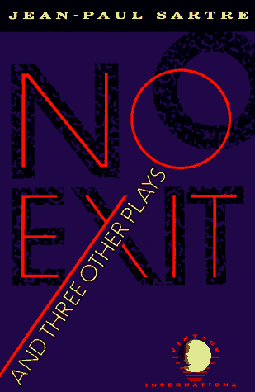
No Exit
Sartre’s one-act play of 1944: three dead people — a coward, a lesbian postal clerk and an infanticide — are locked together in a drawing-room that is Hell, with no torturers or fire, and discover that “Hell is other people”: each is the others’ mirror, judge and torment.

Being and Time
Heidegger’s 1927 masterwork, which asks the forgotten question of the meaning of Being by analysing the one being who asks it — Dasein, the human being as being-in-the-world — through care, moods, anxiety, being-towards-death, conscience and temporality.

Edmund Husserl
The Moravian-German mathematician turned philosopher who founded phenomenology — “to the things themselves!” — the rigorous description of experience as it is lived, through intentionality, the epoché and the lifeworld; teacher of Heidegger and inspiration of Sartre, Merleau-Ponty and Levinas.

Existentialism Is a Humanism
Sartre’s 1945 public lecture — the most popular statement of existentialism — existence precedes essence, man is condemned to be free.

Bad Faith
Self-deception about one’s own freedom — pretending to be a thing, determined by role or nature, to escape the anguish of choice.

Josef K.
A bank officer arrested on his thirtieth birthday for an unnamed crime, who spends a year failing to reach the court that has already judged him.