




Contents · 9 sections · 5 min
Husserl in Six Ideas
the essentialsTo the things themselves
Philosophy must begin not from theories but from careful description of what is given in experience.
Intentionality
Consciousness is always consciousness of something — every perceiving, judging, loving or fearing is directed at an object.
The epoché
Bracket — suspend belief in — the existence of the world, to study how the world is given to consciousness.
Noesis and noema
Every act of consciousness (noesis) has its intended object-as-meant (noema).
Time-consciousness
The living present has a “thickness” — retention of the just-past and protention of the about-to-come, as in hearing a melody.
The lifeworld
The sciences forget the pre-scientific world of lived experience (Lebenswelt) from which all their meaning comes.
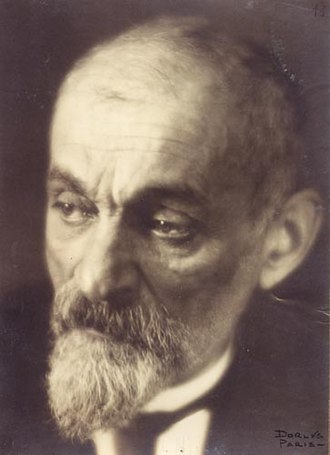
Edmund Gustav Albrecht Husserl was the founder of phenomenology (Phenomenology), one of the most important philosophical movements of the twentieth century. Trained as a mathematician, he sought to establish philosophy as a “rigorous science” by turning “to the things themselves” (zu den Sachen selbst) — describing, without prejudice or speculative theory, exactly how things show themselves in conscious experience. His central discovery was intentionality: consciousness is always consciousness of something. His method, the phenomenological reduction or epoché, suspends our natural belief in the existence of the world so that we can study how the world is given and constituted in consciousness. His later idea of the lifeworld (Lebenswelt) diagnosed a “crisis” of the European sciences. His students and readers — Heidegger, Edith Stein, Roman Ingarden, Sartre, Merleau-Ponty, Levinas, Beauvoir, Derrida — made phenomenology the foundation of continental philosophy.
Life
Husserl was born on 8 April 1859 in Prossnitz (Prostějov), Moravia, then part of the Austrian Empire, into a Jewish family of cloth merchants. He studied mathematics, physics and astronomy at Leipzig, Berlin — under Weierstrass and Kronecker — and Vienna, where he completed a doctorate on the calculus of variations (1883). In Vienna he attended the lectures of the philosopher-psychologist Franz Brentano, who convinced him that philosophy could be a rigorous science and introduced him to the concept of intentionality. In 1886 he converted to Lutheran Christianity; he married Malvine Steinschneider, also a Jewish convert, in 1887.
He taught at Halle (1887–1901), where he wrote Philosophy of Arithmetic (1891), which tried to ground arithmetic in psychological acts of counting; Frege‘s sharp review of it (1894) helped turn him against psychologism. His breakthrough, the Logical Investigations (1900–01), made his name. At Göttingen (1901–16) he gathered a circle of students and published Ideas I (1913), which announced transcendental phenomenology. In 1916 he succeeded Heinrich Rickert at Freiburg, where his assistants included Edith Stein and Martin Heidegger; his younger son Wolfgang was killed at Verdun the same year. He retired in 1928 and Heidegger succeeded him.
After the Nazis came to power in 1933, Husserl, as a man of Jewish descent, was stripped of his privileges at the university; Heidegger, now rector and a Nazi party member, did not intervene, and their relationship had already broken over philosophical differences. Isolated, forbidden to publish in Germany, Husserl lectured in Vienna and Prague in 1935 on “the crisis of European humanity” and worked on The Crisis of European Sciences, published in part in Belgrade in 1936. He died in Freiburg on 27 April 1938. Months later, a young Franciscan, Herman Leo Van Breda, smuggled his 40,000 pages of shorthand manuscripts and his library out of Germany to Leuven in Belgium, where the Husserl Archives still publish them as the Husserliana.
Against psychologism
The first volume of the Logical Investigations (the “Prolegomena to Pure Logic”) is a devastating critique of psychologism, the view that the laws of logic are psychological laws describing how people actually think. If logic were psychology, Husserl argued, its laws would be vague, probable and empirical, like the laws of psychology; but the laws of logic are exact, necessary and known a priori. Psychologism leads to relativism: if the law of non-contradiction depended on human psychology, it might be different for other beings. Logic concerns ideal meanings and their relations, not mental events. This argument, close to Frege’s, convinced many of his contemporaries.
Intentionality and description
The second volume turned to the acts of consciousness in which we grasp meanings. Following Brentano, Husserl held that the distinctive feature of mental acts is intentionality: every act is directed toward an object — one perceives a tree, remembers a friend, fears an exam, judges that 2 + 2 = 4. The object may not exist (one can imagine a centaur), but the act is still of something. Phenomenology describes the structures of such acts: how a perceived object is given in “adumbrations” (Abschattungen), profiles from one side at a time, while we intend the whole object; how meaning-intentions are “fulfilled” by intuition, as when I expect a friend and then see him; how categorial intuition grasps states of affairs.
The epoché and transcendental phenomenology
In Ideas I (1913) Husserl introduced the method of the phenomenological reduction. In the “natural attitude” of everyday life and science, we take the world simply to exist “out there”. The phenomenologist performs the epoché (Greek, “suspension”): without denying the world’s existence, he “brackets” it, refraining from all judgments about it, and turns attention to the world as it is given in experience — the world as phenomenon. What remains after the reduction is transcendental consciousness, the field of pure experience in which the world is constituted, meaningfully, for a subject.
Every act has two correlated aspects: the noesis, the act of meaning (perceiving, remembering, judging), and the noema, the object as meant — “this tree, as seen from here, in this light”. Phenomenology studies the essential structures of these correlations by eidetic variation: imagining an object varied in every possible way to discover which features are invariant, its essence (eidos).
This turn to transcendental subjectivity, which seemed to many a return to idealism, divided Husserl’s followers. In the Cartesian Meditations (1931), lectures given in Paris, he presented phenomenology as a radicalisation of Descartes‘s project of beginning from the ego cogito, and tried to show how other subjects are given to me through “empathy” (Einfühlung) — the problem of intersubjectivity.
Time and the body
In lectures on internal time-consciousness (1905, published 1928 by Heidegger), Husserl analysed how we experience temporal objects, like a melody. When I hear a note, the previous notes are not simply gone, nor are they merely remembered; they are retained in the living present as just-past, while I protend, or anticipate, what is about to come. The present is not a knife-edge point but has a “thickness” — a structure of retention, primal impression and protention — which makes the experience of duration, and of the self’s continuity, possible.
He also analysed the lived body (Leib), as distinct from the body as physical object (Körper): the body as the zero-point of orientation, the organ of perception and movement, experienced from within — an analysis taken up by Merleau-Ponty and Beauvoir.
The crisis and the lifeworld
In his last work, The Crisis of European Sciences and Transcendental Phenomenology (1936), written as Europe moved toward catastrophe, Husserl argued that the sciences, since Galileo’s “mathematisation of nature”, had lost touch with the lifeworld (Lebenswelt) — the pre-scientific world of everyday lived experience, of colours, tools, persons and purposes, from which all scientific concepts draw their meaning. Treating the mathematical model as the true reality, science had become unable to address questions of meaning and value, leaving modern humanity in a “crisis” of rationality. Philosophy’s task was to recover the lifeworld and the responsibility of reason.
Legacy
Husserl’s students carried phenomenology in many directions he disliked: Heidegger toward the question of Being and existence (Being and Time, 1927, dedicated to him); Sartre, who read him in Berlin in 1933–34, toward existentialism; Merleau-Ponty toward the phenomenology of perception and the body; Levinas toward ethics; Derrida toward deconstruction, which began with a critique of Husserl’s theory of signs. Analytic philosophers too have found in him a theory of intentionality and meaning comparable with Frege’s, and cognitive science has taken up his descriptions of time and embodiment.
In conversation
- “To the things themselves!” — the phenomenological motto.
- Bracketing the world — the epoché.
- The melody — retention, protention and the living present.
Edmund Husserl in two minutes
The Moravian-German mathematician turned philosopher who founded phenomenology — “to the things themselves!” — the rigorous description of experience as it is lived, through intentionality, the epoché and the lifeworld; teacher of Heidegger and inspiration of Sartre, Merleau-Ponty and Levinas.
- To the things themselves. Philosophy must begin not from theories but from careful description of what is given in experience.
- Intentionality. Consciousness is always consciousness of something — every perceiving, judging, loving or fearing is directed at an object.
- The epoché. Bracket — suspend belief in — the existence of the world, to study how the world is given to consciousness.
- Noesis and noema. Every act of consciousness (noesis) has its intended object-as-meant (noema).
- Time-consciousness. The living present has a “thickness” — retention of the just-past and protention of the about-to-come, as in hearing a melody.
- The lifeworld. The sciences forget the pre-scientific world of lived experience (Lebenswelt) from which all their meaning comes.
Answering: René Descartes, Immanuel Kant, Wilhelm Dilthey, Gottlob Frege · Answered by: Lev Shestov, Martin Heidegger, Theodor W. Adorno, Jean-Paul Sartre, Emmanuel Levinas, Simone de Beauvoir, Maurice Merleau-Ponty
Curiosities
did you know?- He was born Jewish, converted to Lutheranism at twenty-seven, and under Nazi law was barred from the University of Freiburg in 1933.
- Heidegger dedicated Being and Time (1927) to him, but removed the dedication from the 1941 edition.
- He wrote in Gabelsberger shorthand: some 40,000 pages of manuscripts, smuggled out of Nazi Germany to Leuven in 1938 by the Franciscan Herman Van Breda.
- His assistant Edith Stein, a Jewish convert who became a Carmelite nun, was murdered at Auschwitz and later canonised.
Questions to Argue About
debate club →- What is given in experience before any theory?
- Can consciousness ever be empty — conscious of nothing?
Explore Next
related by shared connections
Gabriel Marcel
The French Catholic playwright and philosopher of “concrete philosophy” and “Christian existentialism”, who distinguished problem from mystery, having from being, the objective “it” from the participating “thou”, and described hope, fidelity and availability as ways of encountering being.

Existentialism
The philosophy of the existing individual — freedom, anxiety, authenticity, the absurd — running from Kierkegaard and Dostoevsky through Nietzsche and Heidegger to Sartre and Camus.

Hans-Georg Gadamer
The Heidelberg philosopher whose Truth and Method (1960) made hermeneutics a universal philosophy: understanding is not a method but the way we exist; we are always already shaped by tradition (“prejudices”), and understanding occurs as a fusion of horizons in dialogue — a conversation that is also play.

Georg Wilhelm Friedrich Hegel
The philosopher of Spirit and dialectic, for whom reality is a rational process working itself out through contradiction in history — “the real is the rational”.

Cogito, ergo sum
I think, therefore I am — the one certainty Descartes found after doubting everything else.

Karl Jaspers
The German psychiatrist turned philosopher of Existenz, who described “limit situations” (death, suffering, struggle, guilt), “the Encompassing” and “philosophical faith”, introduced the Axial Age, and in The Question of German Guilt (1946) distinguished criminal, political, moral and metaphysical guilt.