
Contents · 7 sections · 7 min
Core Theses
Writers modelled themselves on the Rome of Augustus — Virgil, Horace, Ovid — and prized order, clarity, balance and correctness.
Satire is the age’s characteristic weapon, aimed at folly, corruption and pride.
The heroic couplet, perfected by Dryden and Pope, is its signature verse form.
The novel was invented in these decades — a new form for a new middle-class reading public.
Between the restoration of King Charles II in 1660 and the first stirrings of Romanticism in the 1780s, English literature became urbane, public, rational and satirical. Its writers called their age Augustan, comparing it with the reign of the emperor Augustus in Rome, when Virgil, Horace and Ovid wrote; they sought the classical virtues of order, clarity, decorum and “correctness”. It was the age of the coffee-house and the periodical, of political parties (Whig and Tory) and the first newspapers, of Newton’s physics and Locke’s philosophy, of the commercial and imperial expansion of Britain after the union of England and Scotland in 1707. It produced the greatest English satirists — John Dryden, Jonathan Swift, Alexander Pope — the great moralist Samuel Johnson, and, most consequentially, a new literary form: the novel.
The Restoration
When Charles II returned from exile in France in 1660, the Puritan republic’s closure of the theatres ended. The new theatres were indoor, lit by candles, with painted scenery, and for the first time women acted on the English stage — Nell Gwyn, the king’s mistress, among them. The characteristic genre was the Restoration comedy of manners: witty, cynical, sexually frank plays about the intrigues of fashionable London — rakes and fops, cuckolds and coquettes, marriage as a commercial transaction. William Wycherley’s The Country Wife (1675), George Etherege’s The Man of Mode (1676) and, at the end of the century, William Congreve’s The Way of the World (1700), with its brilliant bargaining scene between the lovers Mirabell and Millamant, are the peaks. Aphra Behn (1640–89), dramatist, novelist (Oroonoko, 1688) and spy, was the first Englishwoman to earn her living by writing; Virginia Woolf said all women writers should “let flowers fall upon the tomb of Aphra Behn”.
John Dryden (1631–1700) dominated the age: poet laureate, playwright, translator of Virgil, and the founder of modern English criticism (An Essay of Dramatic Poesy, 1668). He perfected the heroic couplet — pairs of rhymed iambic pentameter lines, each pair often a complete, balanced, quotable statement — and used it for verse satire. Absalom and Achitophel (1681) disguises a political crisis as a biblical story; Mac Flecknoe crowns a rival poet as the monarch of dullness.
The Restoration also saw the publication of two great Puritan works by men on the losing side: John Milton‘s Paradise Lost (1667) and John Bunyan’s The Pilgrim’s Progress (1678), written in Bedford gaol by a tinker-preacher imprisoned for preaching without a licence. Bunyan’s allegory of Christian’s journey from the City of Destruction to the Celestial City, through the Slough of Despond, Vanity Fair and the Valley of the Shadow of Death, was for two centuries the most widely read book in English after the Bible.
The age of satire
The early eighteenth century was dominated by a group of Tory wits, friends and members of the Scriblerus Club. Jonathan Swift (1667–1745), Anglo-Irish clergyman and Dean of St Patrick’s in Dublin, wrote the most savage satire in English: A Tale of a Tub (1704), on religious corruption; Gulliver’s Travels (1726), in which a ship’s surgeon visits the tiny Lilliputians, the giant Brobdingnagians, the mad scientists of Laputa and the rational horses (Houyhnhnms) who rule over the bestial human Yahoos; and A Modest Proposal (1729), which suggests, with a perfectly straight face, that the poverty of the Irish be relieved by selling their babies as food for the rich. His epitaph speaks of the place “where savage indignation can no longer lacerate his heart”.
Alexander Pope (1688–1744), a Catholic barred from university and public office, crippled by tuberculosis of the spine, became the greatest poet of the age and the first to make a fortune from his pen (by translating Homer). He brought the heroic couplet to perfection. An Essay on Criticism (1711) gives us “To err is human, to forgive divine”, “A little learning is a dangerous thing” and “Fools rush in where angels fear to tread”. The Rape of the Lock (1714) is a mock-epic in which the theft of a lock of a society beauty’s hair is treated with the grandeur of the Trojan War. An Essay on Man (1733–34) offers a philosophical justification of the universe — “Whatever is, is right” — and the injunction “Know then thyself, presume not God to scan; / The proper study of mankind is man”. The Dunciad (1728–43) is a dark, hilarious epic of the triumph of Dullness over culture.
The new journalism was led by Joseph Addison and Richard Steele, whose daily papers The Tatler (1709) and The Spectator (1711–12) set out to bring “philosophy out of closets and libraries… to dwell in clubs and assemblies, at tea-tables and in coffee-houses”. Their polite, lucid essays shaped middle-class manners and English prose style.
The rise of the novel
The most important literary development of the century was the emergence of the novel — a long prose fiction about ordinary people in the recognisable contemporary world, told with circumstantial realism. It answered a new reading public: a growing middle class, many of them women, with leisure, literacy, circulating libraries and an appetite for stories about lives like their own. Its roots lay in Bunyan’s allegory, in spiritual autobiographies, in journalism and travel writing, in the French romance and in Don Quixote.
Daniel Defoe (c. 1660–1731), merchant, journalist, government agent and bankrupt, wrote at nearly sixty Robinson Crusoe (1719), the story of a sailor shipwrecked for twenty-eight years on a desert island who, through labour, ingenuity and Providence, rebuilds civilisation and acquires a servant, Friday. Presented as a true memoir, it became a myth of economic man and colonial mastery. Moll Flanders (1722) is the life of a London thief and prostitute told in her own voice.
Samuel Richardson (1689–1761), a printer, developed the epistolary novel, told in letters. Pamela (1740) tells of a fifteen-year-old maidservant whose master tries to seduce her, and whose virtue is “rewarded” by marriage to him; it was a sensation. Clarissa (1747–48), at about a million words perhaps the longest novel in English, is a tragedy of a young woman abducted and raped by the rake Lovelace, who dies rather than marry him — a profound study of psychology and moral will.
Henry Fielding (1707–54), playwright turned magistrate, thought Pamela hypocritical and parodied it (Shamela), then wrote Tom Jones (1749), a “comic epic poem in prose”: the adventures of a warm-hearted, impulsive foundling, told by a witty, intrusive narrator who addresses the reader in essays opening each book. Its plot — every coincidence resolved — was admired by Coleridge as one of the three most perfect in literature.
Laurence Sterne (1713–68), a Yorkshire parson, then exploded the new form before it had settled. Tristram Shandy (1759–67) is the “life and opinions” of a narrator who does not get himself born until volume three, digresses endlessly, includes a black page mourning the death of Parson Yorick, a marbled page, a blank page for the reader to draw the widow Wadman, and diagrams of the plot’s wiggles. Based on Locke’s theory of the association of ideas, it is a comedy about the impossibility of telling a life — and it anticipated the modernist novel by 150 years. Tobias Smollett, Oliver Goldsmith (The Vicar of Wakefield) and Frances Burney (Evelina, 1778) continued the tradition that leads to Jane Austen.
Johnson and the later century
The literary dictator of the second half of the century was Samuel Johnson (1709–84), poet, essayist, critic, editor of Shakespeare, conversationalist and moralist. Poor, ugly, scarred by scrofula, afflicted with tics and depression, he single-handedly compiled A Dictionary of the English Language (1755) in nine years — 42,773 entries illustrated with 114,000 quotations — with famous definitions (“Lexicographer: a writer of dictionaries; a harmless drudge”; “Oats: a grain, which in England is generally given to horses, but in Scotland supports the people”). He wrote the philosophical tale Rasselas (1759), the essays of The Rambler, the Lives of the Poets (1779–81) and the great Preface to Shakespeare. He lives above all in James Boswell’s Life of Samuel Johnson (1791), the greatest biography in English, which preserves his talk: “When a man is tired of London, he is tired of life”; “Patriotism is the last refuge of a scoundrel”; “No man but a blockhead ever wrote except for money.”
Around Johnson’s club gathered Edmund Burke, Oliver Goldsmith, the painter Joshua Reynolds and the actor David Garrick. Edward Gibbon’s Decline and Fall of the Roman Empire (1776–88) and the philosophy of David Hume and Adam Smith (the Scottish Enlightenment) belong to the same world. Richard Brinsley Sheridan’s comedies The Rivals (1775) — with Mrs Malaprop — and The School for Scandal (1777) revived the comedy of manners.
Toward Romanticism
From mid-century a new sensibility appeared: the graveyard poets (Thomas Gray’s Elegy Written in a Country Churchyard, 1751: “The paths of glory lead but to the grave”), the cult of feeling in Sterne and the “novel of sensibility”, the Gothic novel (Horace Walpole’s The Castle of Otranto, 1764), the forged ancient Celtic epics of “Ossian” and the poems of Thomas Chatterton, the love of wild landscape and the sublime. Robert Burns (1759–96) wrote Scots songs of the heart (“Auld Lang Syne”, “A Red, Red Rose”). William Blake’s Songs of Innocence appeared in 1789, the year of the French Revolution — and with it the Romantic age.
In conversation
- “A harmless drudge” — Johnson’s self-mocking definition of a lexicographer; used for anyone doing patient, unglamorous work.
- A modest proposal — after Swift, any outrageous suggestion delivered with deadpan seriousness to expose an injustice.
- Shandean — digressive, playful, self-conscious storytelling, after Tristram Shandy.
Restoration and the Eighteenth Century in two minutes
English literature from the Restoration of 1660 to the 1780s — Dryden, the Restoration comedy of manners, Swift’s and Pope’s great satires, Johnson’s Dictionary, and the rise of the novel with Defoe, Richardson, Fielding and Sterne.
- Writers modelled themselves on the Rome of Augustus — Virgil, Horace, Ovid — and prized order, clarity, balance and correctness.
- Satire is the age’s characteristic weapon, aimed at folly, corruption and pride.
- The heroic couplet, perfected by Dryden and Pope, is its signature verse form.
- The novel was invented in these decades — a new form for a new middle-class reading public.
Members
3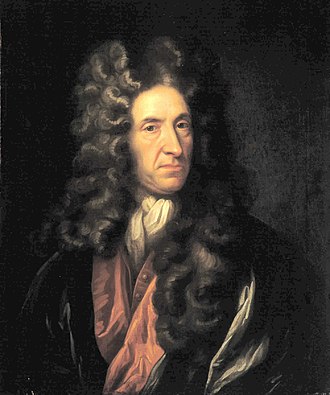
Daniel Defoe
Merchant, bankrupt, spy, pamphleteer and pilloried dissenter who, at nearly sixty, wrote Robinson Crusoe (1719) and then Moll Flanders and A Journal of the Plague Year — inventing the realistic English novel out of journalism, spiritual autobiography and the voices of ordinary people.

Jonathan Swift
The Anglo-Irish clergyman and Dean of St Patrick’s, Dublin, who became the greatest satirist in English — author of Gulliver’s Travels, A Tale of a Tub and A Modest Proposal — whose “savage indignation” at human pride, folly and cruelty still burns.

Samuel Johnson
The great moralist, critic, poet and lexicographer of the eighteenth century — author of the Dictionary of the English Language, Rasselas, The Rambler, the Lives of the Poets and the Preface to Shakespeare — whose talk, preserved by Boswell, made him the most quoted Englishman after Shakespeare.
Explore Next
related by shared connections
Gulliver's Travels
Swift’s satire (1726): a ship’s surgeon is shipwrecked among the six-inch Lilliputians, the giant Brobdingnagians, the absent-minded scientists of Laputa and the rational horses who rule the bestial human Yahoos — and comes home unable to bear the sight of his own kind.

Shrilal Shukla
The civil servant who became Hindi’s greatest satirist — author of Rāg Darbārī (1968), the merciless, hilarious novel of corruption in a north Indian village after independence — and of Makān, Bisrāmpur kā Sant and many satirical essays.

Robinson Crusoe
Defoe’s novel (1719): a restless young Englishman defies his father, goes to sea, is enslaved, becomes a Brazilian planter, and is shipwrecked alone on a Caribbean island for twenty-eight years — where by labour, ingenuity and Providence he rebuilds civilisation and takes a servant he names Friday.

George Orwell
Eric Blair — Old Etonian, imperial policeman in Burma, tramp, Spanish Civil War militiaman and democratic socialist — who as George Orwell wrote Down and Out in Paris and London, Homage to Catalonia, Animal Farm and Nineteen Eighty-Four, and essays that made plain, honest prose a weapon against tyranny and lies.

Dayānanda Sarasvatī
The Gujarati ascetic (1824–1883) who founded the Ārya Samāj with the cry “Back to the Vedas!” — rejecting idol-worship, caste by birth, and the Purāṇas, and calling for a rational Vedic religion, education for women and the reconversion of those who had left Hinduism.
Rāg Darbārī
Shrilal Shukla’s satirical novel (1968): a city-educated young man spends some months in the village of Shivpalganj, where his uncle Vaidyaji, a tonic-selling Ayurvedic doctor, controls the college, the cooperative and the village council — a hilarious and merciless portrait of power, corruption and the hollowing of democracy in independent India.