
Contents · 6 sections · 7 min
Swift in Five Ideas
the essentialsSavage indignation
Satire as a moral weapon — “the chief end I propose to myself in all my labours is to vex the world rather than divert it.”
The animal capable of reason
“I have ever hated all nations, professions, and communities, and all my love is towards individuals… I hate and detest that animal called man.”
Deadpan irony
His masks — the earnest projector, the gullible traveller — speak monstrous things with a straight face, and the reader must see through them.
Ireland's champion
In the Drapier’s Letters and A Modest Proposal he attacked English exploitation of Ireland, becoming an Irish national hero.
Against abstraction
He mocked theorists, projectors and system-builders who forget common sense and common humanity.
Jonathan Swift was the foremost prose satirist in the English language — a clergyman of the Church of Ireland, Dean of St Patrick’s Cathedral in Dublin, political pamphleteer, poet, and the author of Gulliver's Travels (1726), a book that children read as a fairy tale of tiny people and giants and adults read as one of the most ferocious indictments of human nature ever written. His A Tale of a Tub (1704) mocked religious corruption and modern learning; his A Modest Proposal (1729) suggested, in the calm voice of an economic planner, that the poverty of Ireland be relieved by fattening the babies of the poor as food for the rich. His own epitaph, in Latin, speaks of a place “where savage indignation can no longer lacerate his heart” — ubi saeva indignatio ulterius cor lacerare nequit.
Life
An Anglo-Irish youth
Swift was born in Dublin on 30 November 1667, seven months after the death of his father, an English lawyer who had settled in Ireland. His mother returned to England, and the boy was brought up by his uncle; a nurse took him to England for three years as an infant, a story he told himself. He went to Kilkenny Grammar School and Trinity College, Dublin, where he received his degree only by “special grace”, having neglected the scholastic curriculum.
When the Glorious Revolution of 1688 brought war to Ireland, he went to England and became secretary to Sir William Temple, a retired diplomat and essayist, at Moor Park in Surrey, on and off for ten years. There he read enormously, began to write, and met Esther Johnson, the eight-year-old daughter of a household servant, whom he taught and who became the most important person in his life — the “Stella” of his letters and poems. He suffered the first attacks of the vertigo, nausea and deafness (probably Ménière’s disease) that tormented him all his life. He was ordained in the Church of Ireland in 1694 and given a poor parish at Kilroot, near Belfast, then returned to Temple.
Satirist and politician
In 1704 he published, anonymously, A Tale of a Tub, a wildly inventive satire on “corruptions in religion and learning”, centred on the allegory of three brothers — Peter (the Catholic Church), Martin (the Church of England) and Jack (the Dissenters) — who inherit three coats from their father with instructions never to alter them, and do; it is interrupted by digressions mocking modern hack writers and critics, including a “Digression on Madness”. Its irreverence probably cost him a bishopric: Queen Anne is said never to have forgiven it. The Battle of the Books, published with it, describes a mock-epic battle in a library between the Ancient and Modern authors, with the fable of the spider (modern self-spun learning) and the bee (ancient learning, bringing “sweetness and light”).
From 1707 Swift spent long periods in London, at first as a Whig, then, from 1710, as the chief propagandist of the Tory government of Robert Harley and Henry St John, editing their paper The Examiner and writing The Conduct of the Allies (1711), which helped end the War of the Spanish Succession. He was at the centre of politics and literary London, a member with Alexander Pope, John Gay, John Arbuthnot and others of the Scriblerus Club, which planned satires on false learning (the seeds of Gulliver, Pope’s Dunciad and Gay’s Beggar’s Opera). His letters home to Stella and her companion, published as the Journal to Stella, give an intimate day-by-day account of these years, in baby talk and nicknames. He also became entangled with a young woman, Esther Vanhomrigh (“Vanessa”), who fell passionately in love with him; his poem Cadenus and Vanessa recounts their relationship.
In 1713 he was made Dean of St Patrick’s Cathedral, Dublin — not the English bishopric he wanted. When Queen Anne died in 1714 and the Tories fell, he returned to Ireland, which he regarded as exile.
Champion of Ireland
In Dublin he became the most effective defender of Irish interests against English exploitation. Ireland was then governed for the benefit of England and its Protestant Ascendancy; its trade was restricted, its Catholic majority dispossessed, its poor starving. In The Drapier’s Letters (1724–25), written as a Dublin draper, he attacked a patent given to an English ironmaster, William Wood, to mint copper coins for Ireland, arguing that the debased coinage would ruin the country, and declaring that “government without the consent of the governed is the very definition of slavery.” The campaign forced the government to withdraw the patent; a reward offered for the author’s identity went unclaimed, though everyone knew who he was. He became a hero to the Dublin crowd.
Gulliver’s Travels was published in London in October 1726, anonymously, as the travels of Lemuel Gulliver, and was an instant success. “It is universally read,” wrote Gay, “from the cabinet council to the nursery.”
A Modest Proposal for Preventing the Children of Poor People in Ireland from Being a Burden to Their Parents or Country, and for Making Them Beneficial to the Public (1729) is the most famous satirical essay in English. In the reasonable tone of an economic “projector”, the speaker observes the crowds of starving beggar women and children in Ireland and proposes:
I have been assured by a very knowing American of my acquaintance in London, that a young healthy child well nursed is at a year old a most delicious, nourishing, and wholesome food, whether stewed, roasted, baked, or boiled; and I make no doubt that it will equally serve in a fricassee, or a ragout.
He calculates numbers, prices and benefits — the landlords, “who, as they have already devoured most of the parents, seem to have the best title to the children” — and dismisses other remedies (taxing absentee landlords, buying Irish goods, “teaching landlords to have at least one degree of mercy towards their tenants”), which are, of course, Swift’s real proposals. The irony turns the language of economic calculation, which treated the Irish poor as livestock, back on itself.
Last years
Stella died in 1728; Swift, unable to attend her funeral because of illness, wrote a tribute to her that night. He wrote some of his best poetry in these years, including the ironic self-elegy Verses on the Death of Dr Swift (1731), imagining his friends’ indifferent reactions (“The Dean is dead (and what’s the trump?)”). In his last years his illness worsened, and in 1742 he was declared of unsound mind and placed under guardianship. He died on 19 October 1745 and was buried in St Patrick’s beside Stella. He left his fortune to found St Patrick’s Hospital for the mentally ill.
Satire and irony
Swift’s characteristic method is irony through a persona. He rarely speaks in his own voice. Instead he invents a narrator — the hack writer of A Tale of a Tub, the economist of A Modest Proposal, the naive, literal-minded Gulliver — whose earnest, reasonable manner contrasts with the monstrousness of what he says or sees. The reader must constantly judge what the narrator cannot. The effect is unsettling: Swift’s irony shifts its targets without warning, so that the reader who laughs at others may suddenly find himself the target. “Satire is a sort of glass,” he wrote in the preface to The Battle of the Books, “wherein beholders do generally discover everybody’s face but their own.”
His style is famously plain: “Proper words in proper places, make the true definition of a style.” He distrusted ornament, abstraction and enthusiasm.
Ideas
Human nature. Swift wrote to Pope in 1725, while finishing Gulliver: “I have ever hated all nations, professions, and communities, and all my love is towards individuals… But principally I hate and detest that animal called man, although I heartily love John, Peter, Thomas, and so forth.” He wished to refute the definition of man as animal rationale (a rational animal) and prove him only rationis capax — capable of reason. This is not pure misanthropy but a moralist’s insistence on human pride and folly, and a Christian’s sense of fallen nature.
Against “projectors” and abstraction. Swift mocked the new science of the Royal Society, speculative philosophers, economic planners and system-builders who lose touch with common sense and human reality — the Academy of Lagado in Gulliver extracts sunbeams from cucumbers.
Politics and religion. He was a High Churchman who defended the established Church against both Catholics and Dissenters, a Tory in politics who nevertheless defended liberty and attacked tyranny, and an Irish patriot who despised the Irish Catholic peasantry’s oppressors.
Legacy
Swift was admired and feared in his lifetime. Later readers have argued over him: Samuel Johnson found Gulliver’s fourth part disgusting; Thackeray called Swift a monster; Orwell, in “Politics vs. Literature” (1946), saw him as a reactionary who nevertheless had a “terrible intensity of vision”. Joyce, Beckett and the Irish tradition claimed him. His words “Lilliputian” and “Yahoo” entered the language. His satire — the deadpan “modest proposal” — remains a model for satirists from Voltaire to Jonathan Swift’s modern heirs on television.
In conversation
- A modest proposal — an outrageous suggestion made with a straight face to expose an injustice.
- Lilliputian — tiny, petty; a Yahoo — a crude, brutish person.
- “Savage indignation” — the anger that drives satire.
Jonathan Swift in two minutes
The Anglo-Irish clergyman and Dean of St Patrick’s, Dublin, who became the greatest satirist in English — author of Gulliver’s Travels, A Tale of a Tub and A Modest Proposal — whose “savage indignation” at human pride, folly and cruelty still burns.
- Savage indignation. Satire as a moral weapon — “the chief end I propose to myself in all my labours is to vex the world rather than divert it.”
- The animal capable of reason. “I have ever hated all nations, professions, and communities, and all my love is towards individuals… I hate and detest that animal called man.”
- Deadpan irony. His masks — the earnest projector, the gullible traveller — speak monstrous things with a straight face, and the reader must see through them.
- Ireland's champion. In the Drapier’s Letters and A Modest Proposal he attacked English exploitation of Ireland, becoming an Irish national hero.
- Against abstraction. He mocked theorists, projectors and system-builders who forget common sense and common humanity.
Curiosities
did you know?- He left most of his fortune to found St Patrick’s Hospital in Dublin, one of the first psychiatric hospitals in the world — ‘to show by one satiric touch / No nation wanted it so much.’
- He played an elaborate April Fool on the astrologer John Partridge, publishing a prediction of his death and then an account of it, so that Partridge spent years trying to prove he was alive.
- His intimate friendships with two women, ‘Stella’ (Esther Johnson) and ‘Vanessa’ (Esther Vanhomrigh), remain mysterious; he may have secretly married Stella.
- He coined the word ‘Lilliputian’ and gave ‘yahoo’ to the language.
Questions to Argue About
debate club →- Is Gulliver’s final contempt for humanity Swift’s own — or another target of satire?
- Can satire change anything?
- Was Swift a misanthrope, or a disappointed lover of humanity?
Explore Next
related by shared connections
Rāg Darbārī
Shrilal Shukla’s satirical novel (1968): a city-educated young man spends some months in the village of Shivpalganj, where his uncle Vaidyaji, a tonic-selling Ayurvedic doctor, controls the college, the cooperative and the village council — a hilarious and merciless portrait of power, corruption and the hollowing of democracy in independent India.

Samuel Johnson
The great moralist, critic, poet and lexicographer of the eighteenth century — author of the Dictionary of the English Language, Rasselas, The Rambler, the Lives of the Poets and the Preface to Shakespeare — whose talk, preserved by Boswell, made him the most quoted Englishman after Shakespeare.

Charles Dickens
The great Victorian novelist — a boy who worked in a blacking factory while his father sat in a debtors’ prison, and became the most popular writer in the world, creating Oliver Twist, Scrooge, Micawber and Miss Havisham, and using comedy and melodrama to expose the cruelties of industrial England.

Nineteen Eighty-Four
Orwell’s dystopia (1949): in Airstrip One, a province of the superstate Oceania ruled by the Party and its leader Big Brother, Winston Smith rewrites history at the Ministry of Truth, falls in love with Julia, joins what he believes is a resistance — and is broken in the Ministry of Love until he loves Big Brother.
Master and Slave Morality
Nietzsche’s genealogy — “good/bad” was the self-affirmation of nobles; “good/evil” was invented by the resentful weak to revenge themselves on the strong.
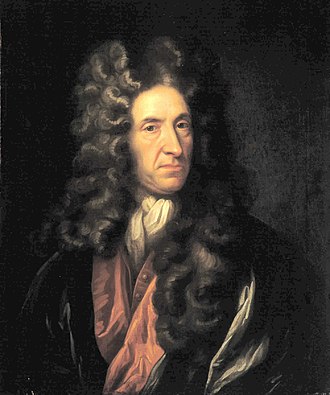
Daniel Defoe
Merchant, bankrupt, spy, pamphleteer and pilloried dissenter who, at nearly sixty, wrote Robinson Crusoe (1719) and then Moll Flanders and A Journal of the Plague Year — inventing the realistic English novel out of journalism, spiritual autobiography and the voices of ordinary people.