Every literature examines how people live together, but the English tradition made society its central subject. Geoffrey Chaucer‘s The Canterbury Tales presents the whole of medieval England on horseback — knight, monk, miller, merchant, wife — each revealed by the story they choose. The Restoration comedy of manners and the satires of Swift and Pope mocked a society of fashion, greed and pride.
The novel, born with the eighteenth-century middle class, became the great instrument for studying society: its classes and incomes, its manners and hypocrisies. Jane Austen examined “three or four families in a country village” with a precision that exposed the economics of marriage (Pride and Prejudice). Charles Dickens turned the novel into a weapon against the workhouse, the debtors’ prison and the Court of Chancery, and asked in Great Expectations what a gentleman really is.
Philosophers have argued the same question. Jean-Jacques Rousseau claimed that “man is born free, and everywhere he is in chains” — that society corrupts natural goodness, the argument the creature makes in Frankenstein. Thomas Hobbes answered that without society life would be “nasty, brutish, and short”. Karl Marx saw society as the history of class struggle.
Thinkers & Authors
18
Geoffrey Chaucer
The father of English poetry — a London wine merchant’s son, courtier, diplomat and customs officer whose Canterbury Tales and Troilus and Criseyde made English a language for great literature and filled it with the first gallery of living characters.
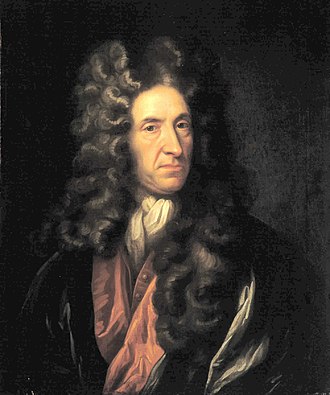
Daniel Defoe
Merchant, bankrupt, spy, pamphleteer and pilloried dissenter who, at nearly sixty, wrote Robinson Crusoe (1719) and then Moll Flanders and A Journal of the Plague Year — inventing the realistic English novel out of journalism, spiritual autobiography and the voices of ordinary people.

Jonathan Swift
The Anglo-Irish clergyman and Dean of St Patrick’s, Dublin, who became the greatest satirist in English — author of Gulliver’s Travels, A Tale of a Tub and A Modest Proposal — whose “savage indignation” at human pride, folly and cruelty still burns.

Jane Austen
The novelist of “three or four families in a country village” — a clergyman’s daughter whose six comedies of courtship, money and moral growth (Pride and Prejudice, Emma, Persuasion) perfected the English novel with irony, free indirect style and an unerring eye for self-deception.

Charles Dickens
The great Victorian novelist — a boy who worked in a blacking factory while his father sat in a debtors’ prison, and became the most popular writer in the world, creating Oliver Twist, Scrooge, Micawber and Miss Havisham, and using comedy and melodrama to expose the cruelties of industrial England.

Charlotte Brontë
The eldest Brontë sister to survive childhood, a Yorkshire parson’s daughter who, as “Currer Bell”, published Jane Eyre (1847) — the passionate first-person story of a plain, poor governess who demands to be loved as an equal — and then Shirley and Villette.

George Eliot
Mary Ann Evans — translator of German theology, editor, scandalous partner of a married man, and the most intellectual of the great Victorian novelists — whose Adam Bede, The Mill on the Floss, Silas Marner and Middlemarch made the novel an instrument of moral sympathy and philosophical depth.

Oscar Wilde
The Irish wit, aesthete and dramatist of 1890s London — author of The Picture of Dorian Gray, The Importance of Being Earnest and the fairy tales — who made paradox a philosophy and art its own end, until his trial and imprisonment for “gross indecency” destroyed him, and gave us De Profundis and The Ballad of Reading Gaol.

Sumitranandan Pant
The poet of nature among the four pillars of Chhāyāvād — a child of the Kumaon Himalaya whose Pallav and Guñjan sang of clouds, mountains and beauty — who later turned to Marxist, then Aurobindonian visions of a new humanity, and was the first Hindi poet to win the Jnanpith Award.

George Orwell
Eric Blair — Old Etonian, imperial policeman in Burma, tramp, Spanish Civil War militiaman and democratic socialist — who as George Orwell wrote Down and Out in Paris and London, Homage to Catalonia, Animal Farm and Nineteen Eighty-Four, and essays that made plain, honest prose a weapon against tyranny and lies.

Saadat Hasan Manto
The fearless master of the Urdu short story — chronicler of Partition’s madness in “Toba Tek Singh”, “Khol Do” and “Ṭhanḍā Gosht”, of prostitutes, pimps and the city’s outcasts in Bombay — tried six times for obscenity, dead of drink at forty-two, now hailed as the greatest story-writer of South Asia.

Bhisham Sahni
The Hindi writer of Partition and of the middle class — author of Tamas (“Darkness”, 1974), the great novel of the communal riots of 1947, and of the story “Chīf kī Dāvat”, the plays Kabirā Khaṛā Bāzār Mẽ and Hānūś, and the memoir of his brother, the actor Balraj Sahni.
Ismat Chughtai
The boldest woman of Urdu fiction — author of “Liḥāf” (The Quilt), tried for obscenity in 1944, of the novel Ṭeṛhī Lakīr and of stories of women’s desire, the zenana and middle-class Muslim households, told in a racy, colloquial voice that changed Urdu prose.

Phanishwar Nath "Renu"
The Hindi novelist of Bihar’s Purnea countryside who created the “regional novel” (āñcalik upanyās) with Mailā Āñcal (1954) — a whole village of Maryganj told in its own dialects, songs and rumours — and wrote “Mare Gaye Gulfām”, filmed as Teesri Kasam.
Sahir Ludhianvi
The Urdu poet of protest and heartbreak who became the greatest lyricist of Hindi cinema — author of Talkhiyā̃ (“Bitterness”) and of film songs like “Ye mahlõ ye takhtõ”, “Kabhī kabhī mere dil mẽ” and “Allah tero nām” — who brought progressive poetry to hundreds of millions.

Mohan Rakesh
The playwright who created modern Hindi theatre — Āṣāṛh kā Ek Din, Laharõ ke Rājhaṁs, Ādhe Adhūre — and a leader of the Nayī Kahānī, writing of artists, lovers and families broken between ambition and longing.

Shrilal Shukla
The civil servant who became Hindi’s greatest satirist — author of Rāg Darbārī (1968), the merciless, hilarious novel of corruption in a north Indian village after independence — and of Makān, Bisrāmpur kā Sant and many satirical essays.

Qurratulain Hyder
“Ainee Apa”, the grande dame of Urdu fiction — novelist of time, history and the Indo-Muslim civilisation, whose Āg kā Daryā (River of Fire, 1959) follows four souls across 2,500 years of Indian history, from the age of the Buddha to Partition.
Works
9
The Canterbury Tales
Chaucer’s unfinished masterpiece (c. 1387–1400): thirty pilgrims of every rank ride from Southwark to Canterbury and compete by telling stories — knightly romance, bawdy farce, saints’ lives, sermons, beast fables — each tale a mirror of its teller.

Robinson Crusoe
Defoe’s novel (1719): a restless young Englishman defies his father, goes to sea, is enslaved, becomes a Brazilian planter, and is shipwrecked alone on a Caribbean island for twenty-eight years — where by labour, ingenuity and Providence he rebuilds civilisation and takes a servant he names Friday.

Gulliver's Travels
Swift’s satire (1726): a ship’s surgeon is shipwrecked among the six-inch Lilliputians, the giant Brobdingnagians, the absent-minded scientists of Laputa and the rational horses who rule the bestial human Yahoos — and comes home unable to bear the sight of his own kind.

Pride and Prejudice
Jane Austen’s most famous novel (1813): witty Elizabeth Bennet, one of five daughters with no fortune, misjudges the proud and wealthy Mr Darcy — and he her — until a letter, a visit to Pemberley and a family scandal teach them both to see clearly.

Bleak House
Dickens’s most ambitious novel (1852–53): fog-bound London, the endless Chancery lawsuit of Jarndyce and Jarndyce, the orphan Esther Summerson, the cold Lady Dedlock and her secret, the crossing-sweeper Jo, and the first detective in English fiction — a whole society entangled in a system that ruins everyone it touches.

Great Expectations
Dickens’s darkest and most perfectly made novel (1860–61): the orphan Pip, raised by his sister and the blacksmith Joe, is given money by a mysterious benefactor to become a gentleman — and learns that his fortune, his love for the cold Estella and his snobbery all rest on illusions.

Middlemarch
George Eliot’s masterpiece (1871–72): in a Midlands town on the eve of the 1832 Reform Act, the idealistic Dorothea Brooke marries a dry old scholar and the ambitious doctor Tertius Lydgate marries a pretty, selfish wife — and a whole community of lives, marriages, debts and secrets is woven into “one of the few English novels written for grown-up people”.

Āg kā Daryā
Qurratulain Hyder’s epic Urdu novel (1959): four characters — Gautam, Champa, Kamal and Cyril — reappear in different forms across 2,500 years of Indian history, from the age of the Buddha through the Mughals and the British to Partition, in a meditation on time, civilisation and loss.
Rāg Darbārī
Shrilal Shukla’s satirical novel (1968): a city-educated young man spends some months in the village of Shivpalganj, where his uncle Vaidyaji, a tonic-selling Ayurvedic doctor, controls the college, the cooperative and the village council — a hilarious and merciless portrait of power, corruption and the hollowing of democracy in independent India.
Schools & Movements
4
Restoration and the Eighteenth Century
English literature from the Restoration of 1660 to the 1780s — Dryden, the Restoration comedy of manners, Swift’s and Pope’s great satires, Johnson’s Dictionary, and the rise of the novel with Defoe, Richardson, Fielding and Sterne.

Victorian Literature
English literature in the reign of Queen Victoria (1837–1901) — the great age of the novel (Dickens, the Brontës, Thackeray, George Eliot, Trollope, Hardy), of Tennyson and Browning, of the sage-writers Carlyle, Ruskin and Mill, and of a society wrestling with industry, empire, class, faith and doubt.
Progressive Writers' Movement
The movement of Urdu, Hindi and other Indian writers founded in 1936 (presided over at its first meeting by Premchand) which demanded a literature of social realism against colonialism, feudalism, poverty and religious obscurantism — and produced Faiz, Manto, Ismat Chughtai, Krishan Chander, Sahir and Kaifi Azmi.
Nayī Kahānī
The “New Story” movement in Hindi fiction of the 1950s and 1960s — Mohan Rakesh, Kamleshwar, Rajendra Yadav, Nirmal Verma, Mannu Bhandari, Bhisham Sahni, Krishna Sobti — which turned from Premchand’s village and idealism to the lonely, uprooted urban middle class of independent India and its broken relationships.
Explore Next
related by shared connectionsVirginia Woolf
Novelist, essayist, publisher and the presiding genius of the Bloomsbury Group, whose Mrs Dalloway, To the Lighthouse, Orlando and The Waves remade the novel around consciousness and time, and whose A Room of One’s Own became a founding text of feminist criticism.

Faiz Ahmad Faiz
The greatest Urdu poet of the twentieth century — a Marxist and lover whose ghazals and nazms fused the classical language of love with revolution, prison and protest; jailed in Pakistan, exiled in Beirut, sung across the subcontinent: >- “Mujh se pahlī sī mohabbat”, “Bol”, “Ham dekhẽge”.
Premchand
The greatest writer of modern Hindi and Urdu fiction — novelist of the Indian village, of peasants crushed by debt, caste and colonial rule — whose Godān and stories like “The Shroud” founded social realism in Indian literature.

Dante Alighieri
The Florentine poet of the Divine Comedy — the journey through Hell, Purgatory and Paradise that summed up medieval thought and created the Italian language.

Jane Eyre
Charlotte Brontë’s novel (1847): an orphan girl survives a cruel aunt and a harsh charity school, becomes governess at Thornfield Hall, falls in love with its brooding master Mr Rochester, discovers on her wedding day that he already has a wife — locked in the attic — and flees, to return at last as his equal: “Reader, I married him.”

Nineteen Eighty-Four
Orwell’s dystopia (1949): in Airstrip One, a province of the superstate Oceania ruled by the Party and its leader Big Brother, Winston Smith rewrites history at the Ministry of Truth, falls in love with Julia, joins what he believes is a resistance — and is broken in the Ministry of Love until he loves Big Brother.