
Contents · 6 sections · 10 min
Key Ideas
The hypocrisy of imperialism — “the merry dance of death and trade” behind talk of civilisation.
The darkness within — civilisation’s restraints removed, a man discovers he can do anything.
Kurtz — eloquence without moral substance, “hollow at the core.”
Truth and lies — Marlow hates lies, yet tells one at the end.
Africa as setting — the novella’s denial of African voices, as Achebe argued.
Heart of Darkness is a short novel by Joseph Conrad, first published in three instalments in Blackwood’s Magazine in 1899 and in book form in 1902. It is told by Charles Marlow, an English seaman, to four friends on a yacht anchored in the Thames estuary as night falls. Marlow recounts how, as a young man, he took a job as captain of a river steamer for a Belgian trading company in the Congo, and travelled up the great river into the interior to find Mr Kurtz, the company’s most successful ivory agent, rumoured to be a man of genius — and found him, dying, having become a god to the local people, presiding over rituals and surrounded by heads on stakes. Kurtz’s last words — “The horror! The horror!” — and Marlow’s lie to Kurtz’s fiancée in Brussels close a story that has become one of the most read, taught and argued-over works in English.
It is a story of a journey into a continent and into the self; a devastating exposure of European colonialism’s greed and hypocrisy; a founding text of modernism; and, since Chinua Achebe’s 1975 lecture, a focus of debate over racism in literature.
At a glance
| Published | Blackwood’s Magazine, February–April 1899; book form in Youth: A Narrative, and Two Other Stories (1902) |
| Setting | London, Brussels (“the sepulchral city”), and the Congo Free State, c. 1890 |
| Basis | Conrad’s own voyage up the Congo as a steamer captain in 1890 |
| Narration | An anonymous frame narrator; Marlow’s spoken story within |
The story
The Nellie, a cruising yawl, lies at anchor in the Thames at sunset, waiting for the tide. On board are five men, old friends from the sea: the Director of Companies, the Lawyer, the Accountant, the anonymous narrator and Marlow, who sits “cross-legged right aft… with sunken cheeks, a yellow complexion, a straight back, an ascetic aspect”, like an idol or a Buddha. The narrator reflects on the glorious history of the river, from which the great explorers and conquerors sailed. Marlow suddenly says: “And this also has been one of the dark places of the earth.” He imagines a Roman commander arriving in Britain nineteen hundred years ago, facing marshes, forests and savages — “the fascination of the abomination”. “The conquest of the earth, which mostly means the taking it away from those who have a different complexion or slightly flatter noses than ourselves, is not a pretty thing when you look into it too much. What redeems it is the idea only.”
He begins his story. As a boy he loved maps, and the blank spaces on them; the biggest, “the most blank”, had by his manhood become “a place of darkness” — Africa, with its mighty river like an immense snake. Needing work, he got his aunt, who had connections, to find him a post with a Continental trading company as captain of a river steamboat, replacing a captain killed in a quarrel over two black hens.
In Brussels, a city like “a whited sepulchre”, he visits the Company’s offices, where two women knit black wool at the door, like Fates guarding the door of darkness, and signs a contract. A doctor measures his skull, asking whether there is madness in his family — scientifically interested in “the mental changes of individuals, on the spot”. His aunt speaks of “weaning those ignorant millions from their horrid ways”.
He sails on a French steamer down the African coast, past a French warship “firing into a continent”, shelling invisible “enemies” in the bush. At the Company’s Outer Station, he sees the reality of colonial trade: a railway being built by blasting a cliff for no purpose; a boiler lying in the grass; a chain gang of emaciated black men with iron collars, “criminals” under the new laws, guarded by a black man in uniform; and in a grove of trees, the “grove of death”, where sick and starving workers, used up and discarded, have crawled away to die — “black shapes crouched, lay, sat between the trees… in all the attitudes of pain, abandonment, and despair.” Then he meets the Company’s chief accountant, immaculate in a starched white collar and varnished boots, keeping perfect books amid the chaos and dying men, who first speaks of Mr Kurtz: “a first-class agent… a very remarkable person,” who sends in as much ivory as all the others together.
Marlow walks two hundred miles with a caravan of porters to the Central Station, a scene of moral and physical decay, run by a manager — a common trader with no gift but an ability to stay healthy, “he inspired uneasiness” — and staffed by “pilgrims”, white agents with long staves who stroll about intriguing for promotion and hoping for ivory. Marlow’s steamer has been sunk; he spends months repairing it, waiting for rivets that never come. He hears more of Kurtz: “an emissary of pity, and science, and progress”; “a universal genius”; destined for promotion. The manager and his uncle, leader of the “Eldorado Exploring Expedition” (a band of looters), hope Kurtz will die of the climate. Marlow becomes fascinated by Kurtz, who represents, he thinks, something more than greed.
At last the steamer sets off upriver, with Marlow, the manager, a few pilgrims and a crew of African “cannibals” who never eat their captors, though starving — a restraint Marlow marvels at. “Going up that river was like travelling back to the earliest beginnings of the world, when vegetation rioted on the earth and the big trees were kings.” The jungle is silent, inscrutable, immense; on the banks they glimpse “a burst of yells, a whirl of black limbs, a mass of hands clapping, of feet stamping, of bodies swaying” — and Marlow feels a “remote kinship with this wild and passionate uproar”. Fifty miles below Kurtz’s station, they find a hut with firewood and a note, “Hurry up. Approach cautiously”, and a battered book on seamanship annotated in what seems to be cipher (it is Russian).
In fog near the Inner Station they are attacked from the bush with arrows; Marlow’s African helmsman is killed by a spear, his blood filling Marlow’s shoes. Marlow blows the steam whistle and the attackers flee. He realises that he has been longing to hear Kurtz talk — “the gift of expression, the bewildering, the illuminating, the most exalted and the most contemptible, the pulsating stream of light, or the deceitful flow from the heart of an impenetrable darkness.” He anticipates his story: Kurtz had written, for the International Society for the Suppression of Savage Customs, a seventeen-page report of burning eloquence on civilising Africa, at the end of which was scrawled, “in an unsteady hand… Exterminate all the brutes!”
At the Inner Station they are greeted by a young Russian, dressed in motley patches like a harlequin, who has been living with Kurtz and worships him: “This man has enlarged my mind.” Through binoculars Marlow sees that the posts around Kurtz’s house are topped with human heads, facing inward — “Mr. Kurtz lacked restraint in the gratification of his various lusts… there was something wanting in him.” Kurtz, the Russian says, has raided the country for ivory with the help of the local people, who adore him and whose chiefs crawl to him; he has taken part in “unspeakable rites”; he has been ill, and they would not let him go.
Kurtz is carried out on a stretcher — emaciated, his head like an ivory ball, opening his mouth “as if it had wanted to swallow all the air, all the earth, all the men before him.” A magnificent African woman, adorned with ornaments, appears on the bank, “savage and superb”, and raises her arms to the sky as he is taken aboard. The manager complains that Kurtz’s “unsound method” has ruined the district. Marlow, disgusted by the manager, finds himself loyal to Kurtz, “a choice of nightmares”.
That night Kurtz crawls away towards the drums and fires of his worshippers. Marlow follows him through the grass and confronts him; Kurtz, “his soul mad”, says he had “immense plans”; Marlow persuades him back. “I had to deal with a being to whom I could not appeal in the name of anything high or low.”
The steamer goes downstream; the people gather on the bank, and the woman cries out; Marlow sounds the whistle to frighten them away; the pilgrims fire into the crowd. Kurtz, dying, talks endlessly of his intended, his station, his career, his ideas, and gives Marlow a packet of papers and a photograph. The steamer breaks down. One evening Marlow brings a candle to his cabin and sees on Kurtz’s face “an expression of sombre pride, of ruthless power, of craven terror — of an intense and hopeless despair. Did he live his life again in every detail of desire, temptation, and surrender during that supreme moment of complete knowledge? He cried in a whisper at some image, at some vision — he cried out twice, a cry that was no more than a breath: ‘The horror! The horror!’” The manager’s boy puts his insolent black head in the doorway: “Mistah Kurtz — he dead.” Marlow, who falls gravely ill himself and nearly dies, comes to believe that Kurtz’s cry was “an affirmation, a moral victory” — that he had judged himself, seen the truth, and “had something to say”.
Back in Brussels, Marlow, contemptuous of the comfortable citizens around him, gives Kurtz’s report (minus the postscript) to a Company man, receives visits from a cousin and a journalist claiming Kurtz, and finally, a year later, visits Kurtz’s Intended, a pale young woman in black, still mourning him, in a drawing room with a grand piano “like a sombre and polished sarcophagus”. She speaks of Kurtz’s greatness and goodness; Marlow, in the dusk, hears the whisper “The horror!” around him. She begs to know his last words: “I want — I want — something — something — to — to live with.” Marlow cannot tell her the truth: “The last word he pronounced was — your name.” She cries out in triumph and grief. “It seemed to me that the house would collapse before I could escape, that the heavens would fall upon my head. But nothing happened. The heavens do not fall for such a trifle… It would have been too dark — too dark altogether.”
Marlow falls silent. On the Nellie, the narrator looks up: the tide has turned, and “the tranquil waterway leading to the uttermost ends of the earth flowed sombre under an overcast sky — seemed to lead into the heart of an immense darkness.”
Themes
Imperialism. The novella exposes the reality of King Leopold’s Congo Free State — where perhaps ten million people died from violence, famine and disease under a regime of forced labour for rubber and ivory — behind the rhetoric of civilisation, progress and philanthropy. The chain gang, the grove of death, the warship shelling a continent, the pilgrims’ greed, Kurtz’s “Exterminate all the brutes!” — all lay bare “the merry dance of death and trade”. Conrad’s own Congo Diary records the reality. Yet Marlow also distinguishes the efficient British empire (red on the map, “good to see… because one knows that some real work is done in there”) from the Belgian, and the story’s frame ties London to the darkness.
The darkness within. Kurtz, the cultivated European of genius — “all Europe contributed to the making of Kurtz” — once freed from the restraints of society (“the butcher and the policeman”), becomes a monster of appetite and power. The “darkness” is not Africa but what lies in every man; London too has been “one of the dark places of the earth”. Marlow himself is drawn to Kurtz and to the “fascination of the abomination”.
Truth and lies. Marlow says he hates a lie — “there is a taint of death, a flavour of mortality in lies” — yet ends by lying to the Intended, to protect her illusions and the “great and saving illusion” of European civilisation itself.
Language and meaning. The novella is famous for its vagueness: “inscrutable”, “unspeakable”, “impenetrable”. F. R. Leavis complained of Conrad’s “adjectival insistence upon inexpressible and incomprehensible mystery”. Others see this as the point: the experience cannot be fully told, and Kurtz, “a voice”, is eloquence without substance, “hollow at the core”.
Race and Achebe’s critique. In 1975 Chinua Achebe, author of Things Fall Apart, argued in “An Image of Africa: Racism in Conrad’s Heart of Darkness” that the novella depicts Africa as “the other world”, “the antithesis of Europe and therefore of civilization”, its people a “whirl of black limbs” without language or individuality — “Africa as setting and backdrop which eliminates the African as human factor” — and that Conrad was “a thoroughgoing racist”. Defenders reply that the novella’s target is imperialism, that its racist language belongs to Marlow and his time, and that Conrad was more critical than nearly any contemporary. The debate has become a classic of postcolonial criticism; most readers now hold both the book’s power and its limits in view.
Afterlife
T. S. Eliot used “Mistah Kurtz — he dead” as the epigraph to “The Hollow Men” (1925) and originally intended Kurtz’s death scene as the epigraph to The Waste Land. Orson Welles planned it as his first film. Francis Ford Coppola’s Apocalypse Now (1979) moved it to Vietnam, with Marlon Brando as Colonel Kurtz. Ngũgĩ wa Thiong’o, V. S. Naipaul (A Bend in the River), Tayeb Salih (Season of Migration to the North) and Barbara Kingsolver (The Poisonwood Bible) wrote novels in dialogue with it. Adam Hochschild’s history King Leopold’s Ghost (1998) documents the reality behind it.
In conversation
- “The horror! The horror!” — the recognition of unspeakable evil or despair.
- A Kurtz — a gifted man corrupted by unchecked power far from accountability.
- “Exterminate all the brutes!” — the genocidal truth beneath humanitarian rhetoric.
Heart of Darkness in two minutes
A journey up an African river into the darkness at the heart of European civilisation — and of the self.
Conrad’s novella (1899): on a yacht in the Thames at dusk, Marlow tells of his journey up the Congo River to find Kurtz, a brilliant ivory agent who has made himself a god among the people and whose dying words are “The horror! The horror!” — the founding text of modernism and of the argument about empire.
- The hypocrisy of imperialism — “the merry dance of death and trade” behind talk of civilisation.
- The darkness within — civilisation’s restraints removed, a man discovers he can do anything.
- Kurtz — eloquence without moral substance, “hollow at the core.”
- Truth and lies — Marlow hates lies, yet tells one at the end.
- Africa as setting — the novella’s denial of African voices, as Achebe argued.
Explore Next
related by shared connections
Othello
Shakespeare’s tragedy of jealousy (c. 1603–04): Othello, a Black general in the service of Venice, secretly marries the young Desdemona; his ensign Iago, out of hatred he never fully explains, persuades him that she is unfaithful, and Othello kills her — then learns the truth.

Modernism in English Literature
The radical experiment in English-language writing from about 1900 to 1940 — Conrad, Joyce, Woolf, Eliot, Pound, Yeats, Lawrence, Forster — which broke with Victorian forms to render consciousness, fragmentation and the shock of the modern world, with stream of consciousness, free verse, myth and collage.

Macbeth
Shakespeare’s shortest and darkest tragedy (c. 1606): a brave Scottish general, prompted by three witches and his ambitious wife, murders his king and wades so deep in blood that life becomes “a tale told by an idiot, full of sound and fury, signifying nothing”.
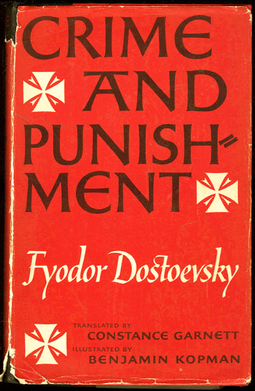
Rodion Raskolnikov
Impoverished ex-student who murders a pawnbroker to prove he is an “extraordinary man” beyond morality — and is broken and reborn by his conscience.

Nikolai Stavrogin
The magnetic, empty aristocrat at the centre of Demons — everyone’s idol, nobody’s master, strength without belief.

Faust
Goethe’s two-part dramatic poem of the scholar who wagers his soul with Mephistopheles that no moment of pleasure will ever satisfy him — the defining myth of modern restless striving.